
TL;DR

Get kitchen staples and gadgets delivered free — and shop member deals
- Fast, free delivery on millions of items
- Access to Prime Big Deal Days deals on October 6–7
- Prime Video, Amazon Music and more included
Small air fryers typically range from 1–4 quarts, and a 2-quart model comfortably handles meals for 1–2 people while 3–4 quarts can feed a small family. For tiny kitchens, counter footprint matters more than capacity: compact cylindrical models take up the least space, and drawer-style models are the easiest to clean. Expect to spend $30–80 for a solid compact model drawing 800–1,500 watts — enough that older apartment circuits deserve a check before you buy.
Your kitchen counter is 24 inches deep, half of it is already holding a coffee maker, and the toaster is winning the turf war for what’s left. Sound familiar? You want crispy food without giving up precious workspace — and that’s exactly where a small air fryer earns its spot.
Here’s the good news: you don’t need the 8-quart monster your cousin has. Small air fryers typically range from 1–4 quarts, cost as little as $30, and cook most meals faster than your oven can even preheat. The trick is knowing which size, shape, and wattage actually fits your kitchen — and your circuits.
In this guide, you’ll get a straight answer on what size you need, a comparison of the three main designs, storage tricks for counter-less kitchens, and the safety basics nobody tells you about until their breaker trips.
Get a 2–3 quart air fryer for 1–2 people, or 3–4 quarts for 3–4 people — shop by footprint (width and height), not just capacity.
Drawer-style models are the best small-kitchen pick: vertical footprint, easiest cleaning, dishwasher-safe baskets.
Leave 3–5 inches of clearance behind and above the unit; never run a 1,500-watt air fryer on the same circuit as a microwave.
Store it in a lower cabinet if it weighs under ~12 pounds — heavier units end up as permanent counter residents.
A $30–80 compact model is enough; spend up to $150 only for extras like windowed baskets and dual zones.
What Size Air Fryer Actually Fits Your Life (and Your Counter)
The right small air fryer for 1–2 people is 2–3 quarts; bump to 3–4 quarts if you regularly cook for 3–4 people. Anything under 2 quarts works for one person who mostly reheats and crisps single portions. Capacity is measured in quarts for standard models, and the jump between sizes is bigger than the numbers suggest — a 4-quart basket holds nearly twice what a 2-quart one does.
Here’s what those numbers look like on an actual plate. A 2-quart model fits about a pound of fries, two chicken breasts, or 4–5 wings per batch. A 4-quart handles a half-bag of frozen fries or six wings. Whole chicken? Forget it under 5 quarts — that’s a job for standard-size units or a compact oven-style model.
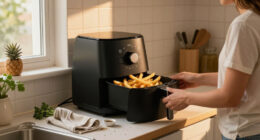
But here’s the mistake almost everyone makes: shopping by capacity and ignoring footprint. Many drawer-style air fryers are taller than they are wide — a 4-quart basket model can tower 13–15 inches high, which matters if you have cabinets hanging over your counter. Meanwhile, a squat cylindrical model might hold less but slide into a corner you weren’t using anyway.
Measure before you buy: check the height under your cabinets, the depth of your counter, and remember you need 3–5 inches of open space behind the unit for steam and heat to vent.
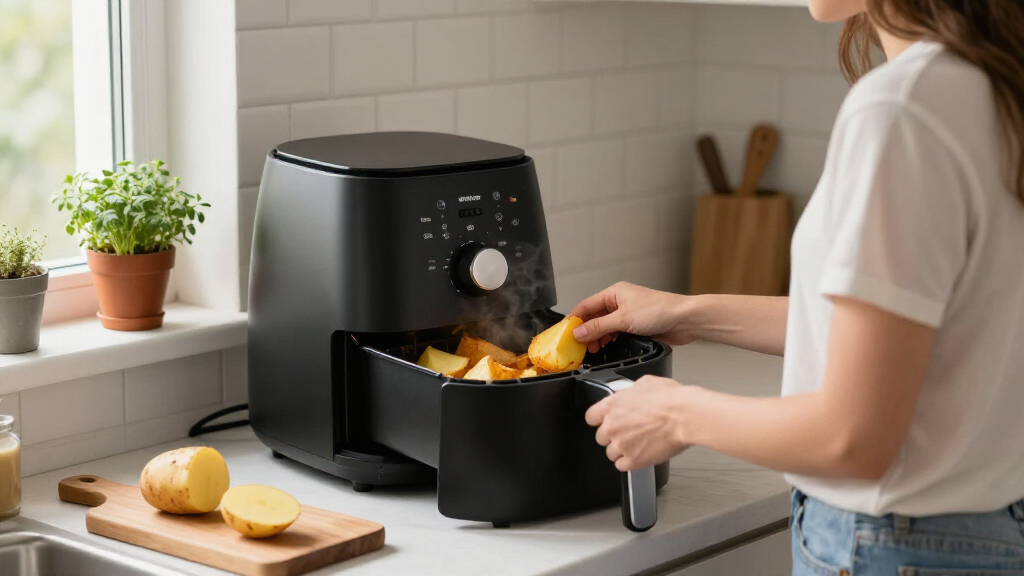
Drawer vs. Oven vs. Cylindrical: Which Design Saves the Most Space
Drawer (basket) air fryers are the best all-around choice for small kitchens — they’re the most popular design, the easiest to clean, and they use vertical space instead of hogging counter width. Oven-style models win on versatility but lose on footprint, and compact cylindrical models win on raw counter space.
Think of it like luggage. A drawer-style air fryer is a carry-on suitcase: tall, grab-and-go, fits in an overhead bin. An oven-style model is a full rolling trunk — more room, more options, but it’s taking up the trunk of your car. Pick based on what you actually cook.
| Design | Typical Footprint | Best For | Tradeoff |
|---|---|---|---|
| Drawer/basket | ~10–13″ wide, 13–15″ tall | Everyday crisping, easiest cleanup | Needs drawer-pull clearance |
| Oven-style | 15–18″ wide, 11–13″ tall | Toast, bake, rotisserie, dehydrating | Biggest counter hog |
| Compact cylindrical | ~8–10″ wide | Dorms, desks, minimal counters | Small capacity, less even cooking |
One trend worth knowing: multi-function consolidation. Air fryer toaster ovens and Instant Pots with air fryer lids replace two or three appliances with one. If your counter is a battleground, one 16-inch box that toasts, air fries, and bakes may beat three separate machines — even though the single box is bigger.
Will It Trip Your Breaker? Wattage and Ventilation Basics
Small air fryers draw 800–1,500 watts, and in older apartments that number matters — run a 1,500-watt air fryer on the same circuit as a microwave or kettle and you may meet your breaker mid-dinner. Before buying, check the wattage label and figure out which outlets share a circuit (usually everything on one wall of a small kitchen).
Safety-wise, treat an air fryer like a small oven that happens to sit on your counter. It needs 3–5 inches of clearance on all sides, especially the back, where hot air vents out. Never tuck it under upper cabinets while running — that venting steam and heat can damage cabinet finishes over time, and trapped heat is a genuine fire risk.
Real-world example: a friend in a studio apartment kept her air fryer in a corner next to the fridge, wedged against the wall with two inches behind it. The food cooked unevenly, the wall got a heat-discolored patch, and the unit’s fan worked overtime. She moved it four inches forward on a cutting board — problem solved. Airflow is not optional; it’s how the machine actually cooks.
- Placement: flat, heat-safe surface, away from sink splatter
- Clearance: several inches of open space behind and above
- Never run it unattended, and never use extension cords as a permanent fix
- Food safety: cook poultry to an internal temp of 165°F (74°C) — air fryers cook fast, and fast isn’t the same as done
Where to Put It When You’re Not Using It: Storage That Works
The best storage solution for a small air fryer is a lower cabinet or shelf, and that’s why weight matters more than people expect — models in the 8–12 pound range are manageable to lift daily; anything heavier tends to stay out on the counter forever. Measure your cabinet opening before you buy, because a 15-inch-tall drawer model won’t fit a standard 12-inch cabinet shelf gap.
My favorite trick from small-apartment dwellers: store the air fryer in the spot where your slow cooker or rice maker currently lives, and donate whichever one you use less. The air fryer likely replaces it. It reheats leftovers better than a microwave (crispy, not soggy), roasts vegetables faster than an oven, and handles frozen food without preheating.
Cleaning in a tiny sink is easier than you’d think, because most modern baskets are removable and dishwasher-safe with nonstick coatings. Hand-washing a 2-quart basket fits in even a bar-sized apartment sink. Wipe the heating element area with a damp cloth once it’s cool, and never submerge the base — that’s where the electronics live.
Quick clean routine: soak the basket in warm water with a drop of dish soap for 15 minutes, wipe with a soft sponge, and skip the abrasive scrubbers — they shred nonstick coating.
Why a Small Air Fryer Beats Your Big Oven (Most Nights)
A compact air fryer uses less energy than a full-size oven for small portions, cooks 20–50% faster for most foods, and needs little to no preheating — 2–3 minutes at most, versus the 10–15 minutes a conventional oven demands. For a household of one or two, that’s the difference between a weeknight side dish and a decision to skip vegetables entirely.
Then there’s the heat factor. In a small kitchen, a full oven turns the whole room into a sauna — miserable in summer, worse in a studio apartment where the kitchen is the living room. An air fryer contains nearly all its heat inside the basket. Your kitchen stays cool, and your AC bill thanks you.
And yes, it’s genuinely healthier than deep frying — some foods see 70–80% less fat since you’re using a tablespoon or less of oil instead of a quart. You won’t mistake an air-fried wing for a deep-fried one, but the crunch — that shhhhk when you bite in — is surprisingly close.
The honest limits: small air fryers can’t handle wet batters (they drip before they set), large batches, or anything taller than the basket. If you host dinner parties for eight, this isn’t your machine. For Tuesday-night dinners for two, it’s exactly right.
What You Should Actually Pay (and When Cheap Is Too Cheap)
Expect to pay $30–80 for a good compact air fryer and $80–150 for mid-range models from brands like Ninja, Cosori, and Instant. Below $30, you’re gambling on heating consistency and build quality. Above $150, you’re mostly paying for features — windows in the basket, internal lights, app controls, dual baskets — not better fries.
The real difference between cheap and expensive isn’t the food; it’s the experience. Budget models often have hot spots (one side of your fries browns first), louder fans, and flimsier baskets whose coating flakes within a year. Mid-range models distribute heat more evenly and feel like they’ll survive a move. One recent feature genuinely worth the upgrade money: a windowed basket with an internal light, so you can check food without pulling the drawer and dumping heat.
My recommendation for most small kitchens: a 3–4 quart drawer model from a known brand around $80–100. It’s the sweet spot of capacity, footprint, and durability — big enough for real meals, small enough to stash in a cabinet.
Frequently Asked Questions
Can I use an air fryer in a dorm room or small studio apartment?
Usually yes, but check two things first: your housing rules (some dorms ban air fryers as heat-producing appliances) and your circuit capacity. Compact models draw 800–1,500 watts — a cylindrical 2-quart model on the lower end is safest for older wiring. Always place it on a flat, heat-safe surface with several inches of clearance.
Will a small air fryer fit under my kitchen cabinets?
Maybe not while running. Drawer models are often 13–15 inches tall, and hot air vents out the back — you need 3–5 inches of open space behind and above the unit for airflow. Measure the height under your cabinets before buying, and plan to pull the air fryer forward on the counter during use.
Can a small air fryer replace my oven or toaster?
For day-to-day cooking, mostly yes — it reheats, roasts, and crisps faster than an oven with no preheating. But it can’t handle whole chickens, large batches, or wet batters. If you want a true replacement, look at a compact air fryer toaster oven, which toasts, bakes, and air fries in one footprint.
Are air fryers energy-efficient compared to a regular oven?
Yes, for small portions. A compact air fryer draws 800–1,500 watts and cooks 20–50% faster than a full oven with almost no preheating, so it uses meaningfully less total energy for one or two servings. For large family meals, a full oven is still the better tool.
What’s the difference between a $40 and a $120 air fryer?
Mainly heating consistency, noise, and build quality. Cheap models often have hot spots that cook unevenly, louder fans, and nonstick coatings that wear out faster. Mid-range brands like Ninja, Cosori, and Instant distribute heat more evenly and last longer — the food quality difference itself is modest.
Conclusion
If you take one thing from this: measure your space, match the wattage to your circuits, and buy the 2–4 quart drawer model that fits both. Capacity is marketing; footprint is physics. The best small air fryer isn’t the most powerful one — it’s the one you’ll actually pull out of the cabinet on a Tuesday.
So grab a tape measure tonight. Check the height under your cabinets, the depth of your counter, and the wattage on your microwave’s label. Five minutes of measuring beats a $100 appliance collecting dust because it doesn’t fit anywhere. And honestly? The first batch of crispy, golden fries — no preheat, no oven-sauna, no grease smell clinging to your studio — sells itself.
NFL season / tailgating Picks
team gear
As an affiliate, we earn on qualifying purchases.