

Get kitchen staples and gadgets delivered free — and shop member deals
- Fast, free delivery on millions of items
- Access to Prime Big Deal Days deals on October 6–7
- Prime Video, Amazon Music and more included
Small Kitchen, Big Decision: Mini Air Fryer or Slim Basket Model?
If your kitchen counter is measured in inches rather than feet, an air fryer purchase becomes a space negotiation before it becomes a cooking decision. The two options most small-kitchen shoppers weigh are the compact 2-quart mini air fryer (the coffee-maker-sized units from brands like Dash, Chefman, and Ninja’s smaller models) and the slim 4-5 quart basket air fryer (models like the Ninja AF101 or Cosori Lite, designed with a narrower footprint than their bulky 6-8 quart siblings). The tension is straightforward: the mini wins on counter and cabinet space, but its capacity caps out at one or two servings. The slim basket model gives you enough room to cook a full dinner for two, but it demands more of your limited surface area. This comparison walks through footprint, capacity, cooking performance, versatility, cleaning, noise, and value so you can decide which tradeoff actually fits your household — because for single cooks the mini is often the smarter buy, while for couples it usually is not.
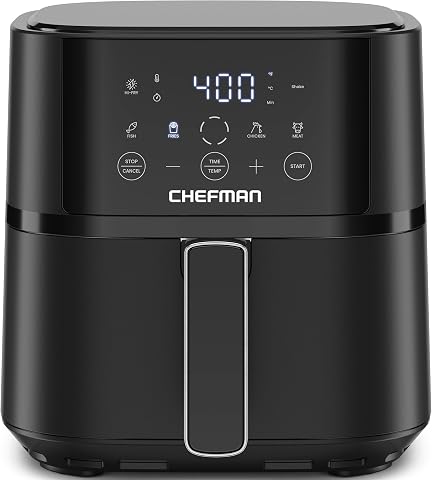
Chefman 4 QT Compact Air Fryer with Hi-Fry Technology, Touchscreen Controls and 4 Presets – Black
- ✔ Capacity: 4 quarts
- ✔ Max Temperature: 450°F (Hi-Fry)
- ✔ Power: 1500W

CHEFMAN 2 Qt Mini Air Fryer – Digital Space-Saving Compact Air Fryer with Nonstick and Dishwasher Safe Basket, Quick & Easy Meals…
- ✔ Capacity: 2 quarts
- ✔ Max Temperature: 400°F
- ✔ Power: 900W

Ninja AF101 Air Fryer, 4 Qt, 4-in-1, Grey
- ✔ Capacity: 4 quarts
- ✔ Functions: Air fry, roast, reheat, dehydrate
- ✔ Temperature Range: 105°F–400°F
Chefman 4 QT Compact Air Fryer with Hi-Fry Technology, Touchscreen Controls and 4 Presets – Black
This model takes our top spot because it resolves the core small-kitchen dilemma better than anything else here: it occupies a modest countertop footprint while still offering a full 4-quart basket that serves two to four people. That means you can cook a complete dinner in one batch instead of running two rounds — a real quality-of-life difference the 2-quart Chefman simply cannot match.The standout differentiator is Hi-Fry technology reaching 450°F, a full 50 degrees hotter than both the Chefman 2 Qt and the Ninja AF101. In practice, that extra heat matters most for foods that depend on a hard sear — frozen chicken, breaded cutlets, wings — where 400°F models sometimes leave you with edges that are dry rather than crisped. The touchscreen interface with four one-touch presets keeps operation simple, though it is worth noting the Ninja AF101 offers broader functionality (roast, reheat, dehydrate) if cooking versatility matters more to you than peak temperature.Thoughtful details round it out: an audible shake reminder halfway through cooking, automatic shutoff when the basket is removed or the timer ends, and a dishwasher-safe nonstick basket and rack. The tradeoffs are real but manageable. Four presets is fewer than many competitors, so expect to set time and temperature manually for anything beyond the basics. And like most air fryers at this size, it needs manual shaking for the crispiest results — the reminder helps, but you still have to do it. For a single person or couple with occasional guests, though, this pick makes the most sense: it is the smallest machine here that still cooks like a full-size air fryer.
Pros:
- Compact footprint paired with a genuinely useful 4-quart capacity for 2-4 people
- 450°F Hi-Fry technology delivers noticeably crispier results than 400°F rivals
- Shake reminders and automatic shutoff make everyday cooking more hands-off and safe
- Dishwasher-safe nonstick basket and rack simplify cleanup in a cramped sink
Cons:
- Only 4 presets, fewer than many similarly sized competitors
- Still requires manual shaking for the crispiest outcomes
- Capacity is limiting for larger households or meal prep
Best for: Couples and small households who want full-size air fryer performance without a full-size footprint
Not ideal for: Families of four or more who need to cook large batches in a single session, or buyers who want multi-function versatility like dehydration
Bottom line: The best balance of size, capacity, and crisping power in this lineup — a small-footprint air fryer that doesn’t force you to cook in batches.
“The best balance of size, capacity, and crisping power in this lineup — a small-footprint air fryer that doesn’t force you to cook in batches.”
CHEFMAN 2 Qt Mini Air Fryer – Digital Space-Saving Compact Air Fryer with Nonstick and Dishwasher Safe Basket, Quick & Easy Meals…
Where the 4-quart Chefman is about balancing size and capacity, this model is about winning the space war outright. Measuring roughly 10 by 10 by 8.3 inches and weighing under six pounds, it is the only pick here that genuinely fits inside a cabinet or on a shelf between uses — a decisive advantage if your counter real estate is already spoken for by a coffee maker and a toaster. Its square basket design squeezes more usable cooking area out of the 2-quart capacity than a round basket would, which softens the size penalty somewhat.Compared with the Best Overall pick, the differences come down to what you give up. The 900W heating element is less powerful than the 4-quart model’s 1500W, so cook times run longer and the ceiling is 400°F rather than 450°F — expect good crispness on fries and nuggets, but less browning punch on breaded or dense foods. Capacity is the bigger constraint: this is a one-to-two person machine, full stop. Attempting to feed more means cooking in shifts, which erodes the convenience that drew you to an air fryer in the first place.What impressed us in the comparison is how little else was sacrificed. You still get a capacitive digital touchscreen, an audible shake reminder, automatic shutoff, and a dishwasher-safe nonstick basket and rack — the same core conveniences as its bigger sibling, just scaled down. At 5.9 pounds, it is also the easiest to move on and off the counter daily. This model is better suited to dorm rooms, studios, offices, and solo cooks than to anyone sharing meals; anyone feeding more than two should step up to either 4-quart option and accept the larger footprint.
Pros:
- Smallest footprint in the lineup; light enough to store in a cabinet and retrieve daily
- Square basket maximizes usable cooking space within the 2-quart capacity
- Digital touchscreen, shake reminder, and automatic shutoff despite the mini size
- Dishwasher-safe nonstick basket and rack keep cleanup quick
Cons:
- 2-quart capacity limits you to one or two portions per batch
- 900W power and 400°F cap mean slower cooking and less browning than the 4-quart Chefman
- Cooking for guests requires multiple rounds
Best for: Solo cooks, students, and anyone whose air fryer needs to fit in a cabinet or share a very crowded counter
Not ideal for: Households of two or more who cook full meals — the 2-quart basket forces batch cooking
Bottom line: The right choice when counter and storage space are the deciding factor — just accept that it is strictly a one-to-two person appliance.
“The right choice when counter and storage space are the deciding factor — just accept that it is strictly a one-to-two person appliance.”
Ninja AF101 Air Fryer, 4 Qt, 4-in-1, Grey
The Ninja AF101 earns its place by arguing that a small kitchen benefits most from appliances that do more than one job. Its four cooking programs — air fry, roast, reheat, and dehydrate — mean it can replace not just a deep fryer but also handle reheating leftovers without sogginess and drying fruit or herbs. That reheat function alone is a quiet advantage over both Chefman models, which treat reheating as just another manual time-and-temperature job.The 105°F to 400°F temperature range is the widest in this lineup on the low end, and that range is exactly what makes dehydration practical — the Chefman models cannot gently dry food at low heat. Rapid air circulation delivers crispy results with up to 75% less fat than traditional frying, and the ceramic-coated nonstick basket holds about 2 lbs of French fries, putting capacity on par with the 4-quart Chefman rather than the mini.So why is this ranked third rather than first? Because its advantages are conditional. It gives up the Chefman 4 QT’s 450°F Hi-Fry mode (a 50-degree handicap for maximum browning) and offers no shake reminder, so you are on your own for timing mid-cook stirs — both Chefmans nudge you automatically. The exterior also requires manual wiping, and while the footprint is comparable to the Chefman 4 QT, it is not meaningfully smaller, so it does not win on the small-kitchen criterion that anchors this guide. This pick makes the most sense for buyers who see an air fryer as a multi-tool; if you purely want the crispiest fries in the least space, the Chefman 4 QT is the stronger choice.
Pros:
- 4-in-1 versatility with air fry, roast, reheat, and dehydrate programs
- Wide 105°F–400°F range enables gentle dehydration as well as high-heat crisping
- Ceramic-coated nonstick, dishwasher-safe basket and crisper plate
- Holds up to 2 lbs of fries — full small-household capacity
Cons:
- No shake reminder, unlike both Chefman models
- 400°F maximum trails the Chefman 4 QT’s 450°F Hi-Fry mode
- Exterior requires manual wiping; footprint is not smaller than the Chefman 4 QT
Best for: Small-kitchen cooks who want one appliance to air fry, roast, reheat, and dehydrate instead of four separate gadgets
Not ideal for: Buyers who want maximum browning power at high heat or automatic shake reminders to keep cooking hands-off
Bottom line: The most capable multi-function machine of the three — choose it when versatility matters more than peak heat and reminders.
“The most capable multi-function machine of the three — choose it when versatility matters more than peak heat and reminders.”
As an Amazon Associate we earn from qualifying purchases.
At a Glance
| Criteria | Compact 2-quart mini air fryer | Slim 4-5 quart basket air fryer | Winner |
|---|---|---|---|
| Countertop footprint | Very small; roughly 8×8 inches, fits any counter | Small but taller and wider; roughly 11×12 inches | A |
| Cooking capacity | 1-2 portions; a single chicken breast or small fries batch | 2-4 portions; fits a whole small chicken or family-side dish | B |
| Cooking performance | Faster preheat, less even airflow for larger items | More even airflow, better crisping at volume | B |
| Versatility | Limited; too small for whole proteins or batch cooking | Broader; roasts, bakes, reheats larger quantities | B |
| Cleaning and maintenance | Quick to wash by hand; small nonstick basket | Larger basket takes more sink space but dishwasher-safe on most models | Tie |
| Noise | Quieter on average due to smaller fan | Comparable; slightly louder fans on some models | A |
| Storage friendliness | Fits most cabinets and shelves easily | Too tall for many cabinets; mostly lives on the counter | A |
| Value per dollar | Cheap entry point, but poor value if you outgrow it | Better long-term value for two-person households | Depends |
Key Differences
The single biggest practical difference is capacity, and it shapes everything else. A 2-quart mini handles about one chicken breast and a handful of fries, or two small servings of one dish. That is fine for one person cooking single-component meals, but the moment you try to feed two people, or cook a protein and a side simultaneously, you are running multiple batches while the first portion goes cold. A 4-5 quart model cooks both portions at once, fits a whole small chicken or a bag of frozen fries, and reheats leftovers in a single pass. For couples and roommates, this is the difference between the appliance being a daily tool versus a frustrating bottleneck.
The counterargument is space, and it is real. A mini occupies roughly the footprint of a large coffee mug cluster — about 8 by 8 inches — and stands short enough to slide into a cabinet or onto a shelf between uses. Slim 4-5 quart models still claim 11 by 12 inches and stand 12-14 inches tall, which frequently does not fit under upper cabinets and rarely fits inside them. If your counter already hosts a toaster and a kettle, the mini may be the only option that physically works without storing it in a closet. Note that both options need clearance for venting — several inches behind and above — so neither can be tucked flush against a wall.
Performance differences are smaller than capacity differences but still favor the larger unit. Bigger baskets allow better airflow around food, producing more even crisping, and most 4-5 quart models offer a wider temperature range and preset programs. Minis preheat faster (two to three minutes versus five) and are genuinely fine for fries, nuggets, and single salmon fillets — but the ceiling is lower for anything bulky.
Detailed Comparison
Countertop footprint (Compact 2-quart mini air fryer wins — major)
The mini wins this clearly. At roughly 8 by 8 inches and under 11 inches tall, a 2-quart unit fits on the sliver of counter beside a sink or under most wall cabinets. A slim 4-5 quart model needs roughly 11 by 12 inches, stands 12-14 inches tall, and often cannot live under upper cabinets at all. Neither can be pushed against a wall, since both need 4-5 inches of rear and top clearance for venting. In practice: if your usable counter is under 2 feet of open run, the mini may be the only permanent-counter option; if you have 3 feet, the slim model fits comfortably alongside a kettle.
Cooking capacity (Slim 4-5 quart basket air fryer wins — major)
The slim basket model wins decisively. Four to five quarts cooks two full portions of most dishes, handles a 3-4 pound chicken, a full bag of frozen fries, or two salmon fillets with room for air to circulate. The 2-quart mini tops out at one chicken breast, a small batch of fries, or two small servings of one component. The practical consequence: singles are satisfied; couples end up cooking in shifts. If you meal-prep or ever cook for guests, the mini becomes a constraint almost immediately. This is the criterion most likely to cause buyer’s remorse in the wrong direction — people who buy too small often replace the unit within a year.
Cooking performance (Slim 4-5 quart basket air fryer wins — moderate)
The slim model wins, though the gap is moderate rather than dramatic. Larger baskets give the fan more room to circulate air around food, which produces more even browning, especially at full loads. Minis excel at small jobs — they preheat in 2-3 minutes and crisp single portions quickly — but crowding is a persistent problem, and crowded food steams instead of crisps. Both categories reach typical 400-degree-plus maximums, but 4-5 quart models more often include wider temperature ranges, shake reminders, and programmed presets. For fries and nuggets, the difference is minor; for roast vegetables or breaded cutlets at volume, it is noticeable.
Versatility (Slim 4-5 quart basket air fryer wins — moderate)
The slim model wins. Beyond raw capacity, mid-size basket fryers handle whole proteins, small baking projects (muffins, small loaves), and reheating pizza or takeout for two. Minis are limited to small single-dish jobs: they cannot roast a chicken, and batch cooking means three consecutive cycles. That said, neither option replaces an oven for a family Thanksgiving — versatility here is relative. If your small kitchen already lacks a full oven (studio apartments, dorms, ADUs), the slim model effectively becomes your secondary oven and the versatility gap matters much more.
Cleaning and maintenance (minor difference)
Roughly a tie, with different strengths. The mini’s basket washes in under a minute by hand because it is small, but few minis are dishwasher-safe, and their nonstick coatings tend to be thinner and wear faster on budget units. Slim 4-5 quart models from reputable brands almost always have dishwasher-safe baskets and sturdier nonstick, but the larger basket takes more sink space — relevant if your sink is a single small basin. In a tiny kitchen, hand-washing anything is annoying; the slim model’s dishwasher compatibility offsets its larger size.
Noise (Compact 2-quart mini air fryer wins — minor)
The mini wins slightly. Smaller fans move less air and tend to run a few decibels quieter, which matters in open-plan studio apartments where the kitchen is your bedroom. Slim basket models are comparable to standard air fryers — audible but not disruptive, roughly a loud conversation. This is a minor difference unless you are exceptionally noise-sensitive or cook while others sleep.
Storage friendliness (Compact 2-quart mini air fryer wins — moderate)
The mini wins clearly. Most 2-quart units fit inside a standard cabinet, on a pantry shelf, or even in a large drawer, meaning you can reclaim the counter entirely between uses. Slim 4-5 quart models are too tall for most cabinets and effectively become permanent counter residents. If your strategy is ‘store it away after each use,’ the mini is the only practical choice — lugging a 12-inch-tall unit in and out of a cabinet daily gets old fast.
Value per dollar (moderate difference)
This depends entirely on household size. Minis cost less upfront — typically $30-60 versus $80-130 for a good slim basket model — but if you outgrow the capacity within a year, the cheap purchase becomes a down payment on the larger unit you should have bought. For a single cook, the mini is excellent value. For two people, the slim model’s extra $40-70 buys daily usability that the mini cannot deliver. Do not pay premium-brand prices for a mini; the technology is simple and budget units perform capably at that size. At 4-5 quarts, brand quality matters more, and spending $90-120 on a Ninja or Cosori is usually worth it over a $50 no-name unit.
Compact 2-quart mini air fryer: Pros and Cons
Pros:
- Smallest possible countertop footprint — fits nearly any kitchen
- Cheapest entry point, typically $30-60
- Fits inside cabinets and shelves for off-counter storage
- Faster preheat times of 2-3 minutes
- Quieter operation, better for studio apartments
- Ideal portioning for one person with minimal waste
Cons:
- Only cooks 1-2 portions; multiple batches needed for couples
- Cannot fit whole chickens or larger proteins
- Crowding causes uneven, steamy results
- Often no dishwasher-safe parts or presets
- Frequently outgrown, leading to a second purchase
Slim 4-5 quart basket air fryer: Pros and Cons
Pros:
- Cooks full meals for two in one cycle
- Handles whole small chickens and batch cooking
- More even airflow and crisping at full loads
- Dishwasher-safe baskets on most reputable models
- Wider temperature range and useful presets
- Doubles as a secondary oven for oven-less kitchens
Cons:
- Larger footprint; often cannot sit under upper cabinets
- Too tall for most cabinet storage — lives on the counter
- Higher cost, typically $80-130
- Slower preheat, around 5 minutes
- Bulky to hand-wash in a small single-basin sink
Who Should Choose What
Choose Compact 2-quart mini air fryer if:
- You live alone and cook single portions — the capacity limit will rarely affect you
- Your usable counter space is under 2 feet or shared with a toaster and kettle
- You want to store the appliance away between uses rather than give it a permanent counter spot
- You mainly cook frozen snacks, fries, nuggets, or single fillets
- You want to try air frying cheaply before committing counter space and money
Choose Slim 4-5 quart basket air fryer if:
- You cook for two people most nights and want one-cycle dinners
- You have roughly 3 feet of open counter or a spot not blocked by upper cabinets
- Your kitchen lacks a real oven, and the air fryer will serve as your secondary oven
- You batch cook, meal prep, or reheat large leftover portions
- You want to roast whole proteins or cook protein-plus-side simultaneously
Skip both if: You regularly cook for three or more people — a larger 6+ quart dual-zone model makes more sense despite the footprint, since batch-cooking in a small unit wastes the time you were trying to save.
Value for Money
Value here hinges on avoiding the replacement cycle, not on the sticker price. A $40 mini that gets abandoned within a year because it cannot feed two people is worse value than a $100 slim model used daily for five years. Equally, a $100 slim model crammed onto an overcrowded counter where it becomes an obstacle is not a bargain either. For single-person households, the mini at $30-60 is genuinely the better buy — premium features at 2 quarts add little. For two-person households, the extra $40-70 for a 4-5 quart slim model from a reputable brand (Ninja, Cosori, Instant) buys daily one-cycle dinners and better build quality, which is where the money is well spent. Resist paying extra for smart-app connectivity or oversized preset counts on either size; capacity and footprint are the features that actually determine satisfaction.
Final Verdict
If you are cooking for one, choose the 2-quart mini. It fits any counter, stores in a cabinet, costs half as much, and its capacity limit almost never bites a single cook. If you are cooking for two, choose the slim 4-5 quart basket model and find the counter space for it — the capacity difference is the single deciding factor, and a mini that forces you to cook dinner in two shifts will frustrate you far more than a slightly larger appliance will. The one exception: if your counter simply cannot physically accommodate 11 by 12 inches even after decluttering, take the mini rather than a mid-size unit wedged under cabinets with no venting clearance — overheating an air fryer in a tight spot is a safety issue, not just a performance one. For most small-kitchen shoppers who live with another eater, the slim basket model is the better long-term purchase despite the footprint.
Frequently Asked Questions
Can a 2-quart air fryer really feed two people?
Occasionally, but not comfortably. It fits roughly two small servings of a single dish — say, fries for two — but a complete dinner for two (protein plus sides) requires separate batches. If you cook real meals for two more than once or twice a week, a 4-5 quart model saves time and produces better results.
Can I store an air fryer in a cabinet instead of leaving it on the counter?
Minis, yes — most fit a standard cabinet or shelf. Slim 4-5 quart models are usually 12-14 inches tall and too large for typical cabinet interiors, so they function as permanent counter appliances. Also check that any storage spot leaves the unit fully cooled and dry before stowing it.
Do air fryers need clearance space around them in a small kitchen?Yes — plan on 4-5 inches of open space behind and above the unit for venting, regardless of size. Pushing any air fryer flush against a wall or under a low cabinet traps heat, degrades performance, and creates a fire risk. Measure your intended spot including clearance, not just the appliance’s listed dimensions.
Are mini air fryers powerful enough, or just weak versions of big ones?They are genuinely capable at their intended scale. A 2-quart unit preheats faster than a large one and crisps single portions well. The limitation is volume, not heat — wattage is proportionate to basket size on reputable models. Where they fall short is crowded loads and bulky items, which is a capacity problem, not a power problem.
Is it worth paying extra for a brand-name slim model versus a budget one?At 4-5 quarts, usually yes. Brand-name units (Ninja, Cosori, Instant) tend to have more durable nonstick coatings, dishwasher-safe parts, more accurate thermostats, and better warranty support — differences that matter for an appliance used near-daily. At 2 quarts, the technology is simple enough that a $40 budget unit performs capably, so save your money there.
Fall Picks
fall essentials
As an affiliate, we earn on qualifying purchases.