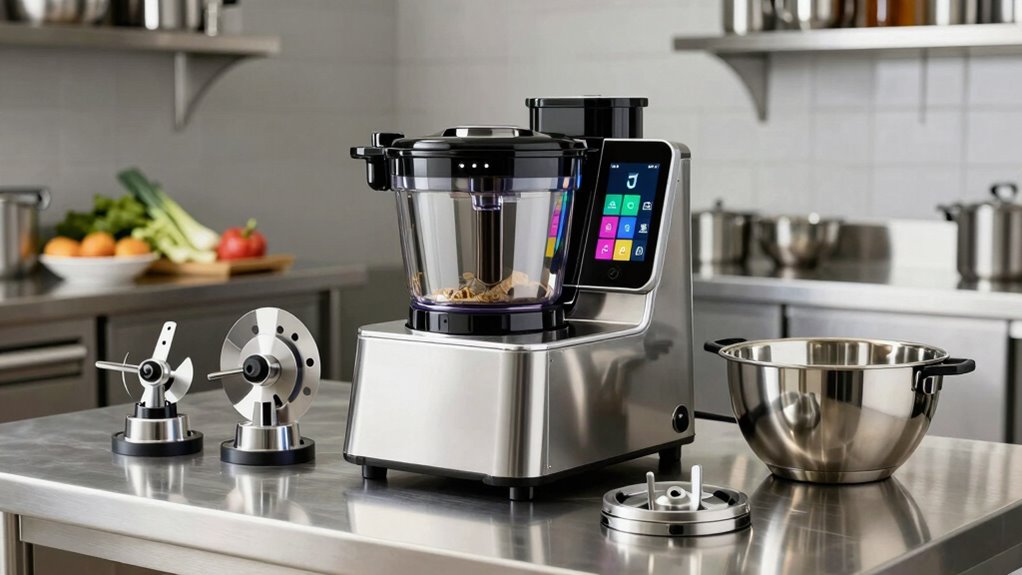

Commercial food processors range from compact batch machines to high-capacity units built for continuous prep. My best overall pick is the Robot Coupe R101BCLR, a compact bowl model suited to kitchens that value a clear view of each batch. The Waring 4-quart continuous-feed model stands out for ongoing prep, while the HAKKA 1800W 9L targets larger-volume work. The tradeoff is between batch size, workflow, and the counter space and cleanup each machine demands. Read on for how these seven options compare and which one fits your kitchen.

Get kitchen staples and gadgets delivered free with Prime
- Fast, free delivery on millions of items
- Prime Video, Amazon Music and more included
- Member-only deals all year
Complete the kit


Key Takeaways
- The Robot Coupe R101BCLR pairs a 2.5-quart clear bowl with a compact batch workflow, making it the most balanced pick for kitchens that do not need continuous feeding.
- Waring’s 4-quart continuous-feed model is the lineup’s clearest fit for steady prep, while bowl models suit cooks who prefer processing and checking batches in one container.
- The HAKKA’s 9L capacity and 1800W motor favor larger workloads, but that scale may be excessive for kitchens with limited counter space or modest daily prep.
- The TK vegetable chopper’s five discs make it a task-focused option for varied vegetable cuts; it is less suited to buyers seeking a general-purpose bowl processor.
- Waring’s 2.5-, 3.5-, and 4-quart bowl models offer capacity choices within one product family, so batch volume and available space are more useful decision points than brand alone.
| Robot Coupe R101BCLR Food Processor with 2.5 Qt Clear Bowl, 120V |  | Best for Small Batches | Motor: 1/4 HP fan-cooled induction motor | Motor speed: 1,725 RPM | Bowl capacity: 2.5 qt | VIEW ON AMAZON | See Our Full Breakdown |
| Waring Commercial Food Processor with 4-Quart Capacity and Continuous Feed |  | Best Overall for Flexible Prep | Batch bowl capacity: 4 quarts (16 cups) | Motor: 2 horsepower | Voltage: 120 VAC | VIEW ON AMAZON | See Our Full Breakdown |
| TK Commercial Vegetable Chopper, 750W, 5 Discs |  | Best for High-Volume Vegetable Prep | Motor: 750W (1 HP) copper motor | Processing capacity: Up to approximately 360 lb/hr | Included discs: 5: 2 mm and 4 mm slicers; 3 mm, 5 mm, and 7 mm shredders | VIEW ON AMAZON | See Our Full Breakdown |
| Waring Commercial Food Processor, 3.5-Quart |  | Best for Sealed-Bowl Batch Prep | Capacity: 3.5 quarts | Motor: Continuous-duty commercial motor; source lists 3/4 HP peak and 1 HP | Voltage: 120 V AC | VIEW ON AMAZON | See Our Full Breakdown |
| HAKKA Commercial Food Processor, 1800W, 9L |  | Best for Large Chopping Batches | Brand: HAKKA FOOD PROCESSING | Model: HR-9 | Power: 1800W | VIEW ON AMAZON | See Our Full Breakdown |
| Waring 2.5-Quart Commercial Food Processor |  | Best for Liquid Prep in a Compact Batch | Capacity: 2.5 quarts | Motor: 3/4 horsepower | Voltage: 120 V | VIEW ON AMAZON | See Our Full Breakdown |
| Waring 4-Quart Commercial Food Processor |  | Best for Continuous-Duty Liquid Processing | Capacity: 4 quarts | Motor: 2 peak HP | Bowl material: Polycarbonate | VIEW ON AMAZON | See Our Full Breakdown |
| food processors commercial | Motor | Voltage | Certifications | Capacity |
|---|---|---|---|---|
| Robot Coupe R101BCLR Food Proc | 1/4 HP fan-cooled induction motor | 120V | — | — |
| Waring Commercial Food Process | 2 horsepower | 120 VAC | — | — |
| TK Commercial Vegetable Choppe | 750W (1 HP) copper motor | — | NSF and ETL | — |
| Waring Commercial Food Process | Continuous-duty commercial motor; source lists 3/4 HP peak and 1 HP | 120 V AC | UL and ETL Sanitation | 3.5 quarts |
| HAKKA Commercial Food Processo | — | — | — | 9L |
| Waring 2.5-Quart Commercial Fo | 3/4 horsepower | 120 V | ULus and ETL sanitation certified | 2.5 quarts |
| Waring 4-Quart Commercial Food | 2 peak HP | 120 VAC | ETL sanitation | 4 quarts |
More Details on Our Top Picks
Robot Coupe R101BCLR Food Processor with 2.5 Qt Clear Bowl, 120V
The Robot Coupe R101BCLR suits a commercial kitchen that needs a compact processor for sauces, chopped aromatics, or other small batches. Its clear 2.5-quart bowl lets staff check texture without stopping to open the lid, while the pulse control gives more say over how finely ingredients are processed. The fan-cooled 1/4 HP induction motor is a smaller-scale setup than the 2 HP Waring 4-Quart Continuous Feed, which is better suited to larger volumes and more varied prep. That size difference is also the Robot Coupe’s main limit: a 2.5-quart bowl means more rounds when demand rises. It includes a smooth S blade, scraper, and honing stone, but only one blade type is specified, so it is less adaptable for slicing and shredding than the Waring.
Pros:- Clear bowl makes it easy to monitor ingredients as they process
- Pulse control helps manage texture
- Fan-cooled induction motor is suited to repeated processing
- Includes a scraper and honing stone alongside the S blade
Cons:- 2.5-quart capacity can require repeated batches during busy service
- Only a smooth S blade is described, limiting the specified cutting options
Best for: Cafés and small commercial kitchens that regularly prepare sauces, dips, or chopped ingredients in modest batches
Not ideal for: High-volume kitchens needing continuous slicing, shredding, or large-batch processing
- Motor:1/4 HP fan-cooled induction motor
- Motor speed:1,725 RPM
- Bowl capacity:2.5 qt
- Bowl material:Clear plastic
- Voltage:120V
- Included accessories:Smooth S blade, honing stone, scraper
- Controls:On/off switches and pulse
Our verdict“Choose the Robot Coupe for controlled small-batch prep; pick the Waring 4-Quart Continuous Feed when volume and cutting variety matter more.”
Waring Commercial Food Processor with 4-Quart Capacity and Continuous Feed
For kitchens that alternate between batch work and a steady stream of sliced or shredded produce, the Waring Commercial 4-Quart is the most versatile fit in this group. Its 2 HP motor, 4-quart bowl, and continuous-feed chute let staff handle both contained recipes and larger prep runs without relying on one workflow. The included adjustable slicer, double-sided shredder, whipping disc, and LiquiLock S-blade give it more ready-to-use range than the Robot Coupe R101BCLR, which is specified with a single blade type and a smaller bowl. That flexibility takes space and setup: staff need to assemble it correctly for the safety interlock, and some additional accessories are sold separately. Kitchens that mainly need bulk vegetable slicing may prefer the dedicated TK chopper’s stated hourly capacity.
Pros:- Combines a 4-quart batch bowl with a continuous-feed chute
- 2 HP motor supports a broad range of prep tasks
- Includes slicing, shredding, whipping, and chopping attachments
- LiquiLock system is designed to help prevent leaks and spills
Cons:- Correct assembly is required for the safety interlock to operate
- Some additional parts and accessories are sold separately
Best for: Restaurants and caterers that need one machine for batch processing, slicing, shredding, and whipping
Not ideal for: Kitchens focused mainly on repetitive vegetable slicing that want a dedicated chopper with a stated high hourly throughput
- Batch bowl capacity:4 quarts (16 cups)
- Motor:2 horsepower
- Voltage:120 VAC
- Frequency:60 Hz
- Current:6 amps
- Cord length:5 feet
- Warranty:5 years on motor; 2 years on parts and labor
- Included accessories:LiquiLock S-blade, small and large pushers, disc stem, adjustable slicing disc, whipping disc, double-sided shredding disc
Our verdict“Choose this Waring when a commercial kitchen needs one processor for both batch recipes and varied produce prep.”
TK Commercial Vegetable Chopper, 750W, 5 Discs
The TK is the specialist pick for kitchens that process produce by the tray rather than make a range of bowl-based recipes. Its stated capacity of up to approximately 360 lb per hour and five included slicing and shredding discs make it more focused on throughput than the Waring Commercial 4-Quart, which pairs continuous feed with a broader set of food-processing functions. A large hopper and small feed tube accommodate different ingredient sizes, while the interlock and overload protection add practical safeguards for busy prep areas. The tradeoff is specialization: the TK is described as a vegetable chopper, with no batch bowl or S-blade function specified. Its disc system can expand to 13, but the other eight discs are sold separately, so the included configuration may not cover every cut a kitchen wants.
Pros:- Stated processing capacity reaches approximately 360 lb per hour
- Includes five slicing and shredding discs in multiple sizes
- Large hopper and small feed tube handle different ingredient sizes
- NSF and ETL certifications, interlock, and overload protection are specified
Cons:- Eight additional discs in the 13-disc system are sold separately
- Its vegetable-chopping focus offers less recipe flexibility than the Waring 4-Quart
Best for: Restaurant prep teams, commissaries, and caterers that need repeated slicing and shredding across large amounts of produce
Not ideal for: Kitchens looking for one machine to chop, puree, whip, and process non-vegetable recipes
- Motor:750W (1 HP) copper motor
- Processing capacity:Up to approximately 360 lb/hr
- Included discs:5: 2 mm and 4 mm slicers; 3 mm, 5 mm, and 7 mm shredders
- Expandable disc system:13 discs total; 8 additional discs available separately
- Feed openings:Large hopper and small feed tube
- Certifications:NSF and ETL
- Safety features:Safety interlock, overload protection, non-slip feet
- Warranty:12 months
Our verdict“Pick the TK for sustained vegetable slicing and shredding; choose the Waring 4-Quart for broader food-processing tasks.”
Waring Commercial Food Processor, 3.5-Quart
This Waring is a practical choice for food-service teams that want a sealed 3.5-quart bowl for soups, sauces, and vegetable prep, without the continuous-feed setup of the 4-quart Waring. Its polycarbonate bowl is clear and described as scratch-resistant, so staff can monitor batches while the easy-pour lid supports transferring prepared ingredients. The continuous-duty motor is intended for repeated commercial processing, but the source gives conflicting horsepower figures—3/4 peak and 1 HP—so I would not use a precise motor comparison to distinguish it from the 2 HP Waring 4-Quart. The smaller stated capacity may suit kitchens with moderate batch needs, though the Robot Coupe R101BCLR offers an even smaller footprint in capacity terms. This model also lacks the range of included discs specified for the 4-quart alternative.
Pros:- Sealed bowl is designed to reduce leaks during processing
- Clear, scratch-resistant polycarbonate makes contents visible
- Continuous-duty motor is intended for batch processing
- Easy-pour lid supports transferring prepared ingredients
Cons:- Source lists conflicting motor horsepower figures
- No continuous-feed chute or varied disc set is specified
- Commercial format may take more space than a small kitchen needs
Best for: Food-service kitchens making repeated moderate batches of soups, sauces, and prepared vegetables in a sealed bowl
Not ideal for: High-throughput prep stations that need continuous feeding, multiple included cutting discs, or a clearly specified motor rating
- Capacity:3.5 quarts
- Motor:Continuous-duty commercial motor; source lists 3/4 HP peak and 1 HP
- Voltage:120 V AC
- Frequency:60 Hz
- Current:6 amps
- Bowl material:Polycarbonate
- Dimensions:10.13 × 16 × 11.5 in
- Certifications:UL and ETL Sanitation
Our verdict“Choose this model for sealed, moderate-size batch prep; select the 4-quart Waring for continuous feed and more included attachments.”
HAKKA Commercial Food Processor, 1800W, 9L
When a kitchen’s priority is chopping substantial quantities in one load, the HAKKA HR-9 stands apart with its 9L capacity and 1800W power rating. Its adjustable 1,000–2,500 RPM speed range gives operators room to match processing pace to the ingredient, while the stainless steel body and blade suit a work area built around commercial prep. Unlike the Waring Commercial 4-Quart, which includes slicing, shredding, and whipping attachments, the HAKKA is described around chopping and includes only a chopping blade. That makes it a more focused option for kitchens that value capacity over cutting variety. The supplied information does not state a continuous-feed system, certifications, or a warranty, so buyers needing those details for a specific operation may find the TK chopper or Waring easier to evaluate.
Pros:- 9L capacity supports larger chopping batches than the 3.5-quart Waring
- Adjustable speed from 1,000 to 2,500 RPM
- Food-grade stainless steel body and chopping blade
- Dual safety protection is specified
Cons:- Only a chopping blade is listed, limiting specified cutting options
- No continuous-feed system, certifications, or warranty details are provided
Best for: Commercial kitchens that chop large batches of vegetables, fruit, bread, or meat and need adjustable processing speed
Not ideal for: Prep teams that need continuous-feed slicing, multiple cutting discs, or stated certifications and warranty coverage
- Brand:HAKKA FOOD PROCESSING
- Model:HR-9
- Power:1800W
- Capacity:9L
- Speed:1,000–2,500 RPM
- Material:Food-grade stainless steel
- Included components:Chopping blade
- Recommended use:Chopping
Our verdict“Choose the HAKKA for high-capacity chopping with variable speed; choose the Waring 4-Quart for more varied cutting and feed options.”
Waring 2.5-Quart Commercial Food Processor
The 2.5-quart capacity and LiquiLock bowl make this Waring a practical fit for kitchens preparing sauces, dressings, and purees in modest batches. Its 3/4-horsepower motor and included slicing, shredding, grating, and whipping discs give it more range than a single-purpose chopper such as the TK Commercial Vegetable Chopper, while the extra-large feed tube can reduce prep time for whole vegetables. Compared with the Waring 4-Quart Commercial Food Processor, this model takes less batch volume and has a lower stated motor rating, so it suits smaller runs rather than continuous, high-volume service. The tradeoff is that its 2.5-quart bowl may require repeated batches during a rush, and the product data does not specify a warranty. I’d choose it for versatile liquid and vegetable prep where a larger processor would be more machine than the station needs.
Pros:- LiquiLock bowl helps contain liquids during processing
- Extra-large feed tube accepts whole vegetables
- Includes discs for slicing, shredding, grating, and whipping, plus an S blade
- ULus and ETL sanitation certifications
Cons:- 2.5-quart capacity can mean repeated batches for busy service
- 3/4-horsepower motor is less powerful than the 2 peak HP Waring 4-Quart model
- Warranty details are not provided in the product data
Best for: Cafés and small restaurant kitchens that make sauces, purees, and sliced vegetables in moderate batches
Not ideal for: High-volume food-service teams that need larger batches or continuous-duty capacity
- Capacity:2.5 quarts
- Motor:3/4 horsepower
- Voltage:120 V
- Bowl system:LiquiLock seal bowl
- Feed tube:Extra large
- Included accessories:Grating, shredding, slicing, and whipping discs; S blade
- Certifications:ULus and ETL sanitation certified
- Plug connection:5-15 phase
Our verdict“Choose this Waring for small commercial kitchens that want liquid handling and several prep functions in a 2.5-quart bowl.”
Waring 4-Quart Commercial Food Processor
For kitchens that process soups, sauces, or marinades in larger runs, the sealed 4-quart bowl and 2 peak HP motor make this Waring the more production-minded choice in this pair. Its clear-view polycarbonate bowl lets staff check contents without opening the unit, while the heavy-duty housing and stainless steel drive shaft are aimed at food-service work. Compared with the Waring 2.5-Quart Commercial Food Processor, it offers more capacity and a higher stated motor rating, but the smaller model lists a wider set of included discs and an extra-large feed tube. This 4-quart model’s product data does not list those accessories, so buyers focused on slicing and shredding should verify what is included. Its commercial build can also take up too much room in a home kitchen, and it requires 120 VAC power.
Pros:- Sealed bowl is designed to contain soups, sauces, and marinades
- 2 peak HP motor is specified for continuous food-service use
- Clear, scratch-resistant polycarbonate bowl makes contents visible
- Heavy-duty housing and stainless steel drive shaft
Cons:- Commercial-grade construction may be bulky for home kitchens
- Limited to 120 VAC power
- Included cutting accessories are not specified in the product data
Best for: Restaurant and catering teams that regularly prepare larger batches of soups, sauces, and marinades
Not ideal for: Home cooks or compact prep stations with limited counter space, or kitchens that need a specified range of slicing and shredding discs
- Capacity:4 quarts
- Motor:2 peak HP
- Bowl material:Polycarbonate
- Voltage:120 VAC
- Frequency:60 Hz
- Certifications:ETL sanitation
- Warranty:5-year motor; 2-year parts and labor
- Drive shaft:Stainless steel
Our verdict“Pick this model for larger, frequent liquid-processing batches when its commercial footprint and 120 VAC requirement suit your kitchen.”

How We Picked
I ranked these machines around the needs that shape commercial prep: batch capacity, the way ingredients enter and leave the machine, cutting versatility, and likely fit on a busy kitchen line. Continuous-feed designs can keep ingredients moving during repetitive prep, while bowl models let staff work in contained batches and inspect what they have processed. I also weighed whether a specialized vegetable chopper’s disc selection matched a distinct job, and whether the HAKKA’s larger stated capacity made sense for higher-volume kitchens.
The order reflects the balance of workflow flexibility and practical fit across different kitchen sizes, rather than motor power or capacity alone. The Robot Coupe takes the overall spot for its compact 2.5-quart bowl format; the Waring continuous-feed model ranks highly for sustained prep, and the HAKKA serves the largest-volume use case. The remaining Waring bowl models give buyers a range of batch sizes, while the TK is ranked for kitchens whose priority is vegetable cutting. Published specifications do not establish duty cycle, cleaning time, or service support, so buyers should confirm those details with the manufacturer or seller before purchase.
| food processors commercial | Certifications |
|---|---|
| Robot Coupe R101BCLR Food Proc | — |
| Waring Commercial Food Process | — |
| TK Commercial Vegetable Choppe | NSF and ETL |
| Waring Commercial Food Process | UL and ETL Sanitation |
| HAKKA Commercial Food Processo | — |
| Waring 2.5-Quart Commercial Fo | ULus and ETL sanitation certified |
| Waring 4-Quart Commercial Food | ETL sanitation |
Factors to Consider When Choosing Food Processors Commercial
Choosing a commercial processor starts with the work your kitchen repeats most often. Capacity and wattage matter, but workflow, staff habits, storage, and cleanup can have a larger effect on daily usefulness. I would map the machine to your actual prep routine before choosing by headline specifications.
Match Capacity to Your Typical Batch
Choose a bowl size around the batch you make most often, rather than the largest quantity you might prepare on an unusually busy day. An oversized bowl can take up counter and storage space while encouraging staff to process more than the machine handles evenly. A smaller unit may require more batches, yet it can be easier to place near the prep station and put into service. Think about whether your recipes call for frequent small quantities or a few large runs. Check whether the stated capacity describes the bowl volume or a practical working load, since those figures are not always interchangeable. If your volume varies sharply by shift, consider whether a second smaller machine would keep prep moving more reliably than one oversized unit.
Choose a Workflow: Bowl or Continuous Feed
A bowl processor keeps ingredients in a container while they are processed, which helps with controlled batches and tasks that need visual checks. Continuous-feed machines are designed to handle a stream of ingredients, which can help when staff are repeatedly slicing or shredding produce. Neither format makes sense for every task: continuous feed may be unnecessary for occasional sauces or small batches, while a bowl machine can slow down repetitive bulk prep. Map the path from whole ingredients to the next station before buying. Account for where the output lands and whether staff can replenish ingredients without interrupting other work. A clear workflow plan can prevent a machine from becoming a bottleneck despite having ample capacity.
Treat Attachments as a Menu Decision
Discs and blades only add value when they match work the kitchen performs regularly. Before choosing an attachment set, list the cuts and preparations your menu actually requires, then check which parts are included and which are optional. A specialized chopper with several discs may be more useful than a general processor when vegetable cuts dominate prep. For a broader menu, confirm that the machine supports the needed tasks, such as chopping, slicing, or shredding, rather than assuming one attachment covers them all. Extra parts also need labeled storage and a cleaning routine. A smaller, frequently used set can be easier for a team to manage than a larger assortment that rarely leaves its storage bin.
Check Electrical Fit and Operating Demands
Motor wattage alone does not tell you how a machine will perform in your kitchen. Confirm voltage and plug requirements against the intended outlet, and review the manufacturer’s guidance for suitable ingredients and operating cycles. A higher wattage or larger capacity can be attractive for demanding prep, but it does not replace information about duty cycle or commercial service support. Ask how the unit handles the ingredients your team processes most, especially dense or fibrous foods. Consider who will operate it and whether the controls are straightforward during a busy shift. These checks help avoid selecting a machine whose published headline specifications do not match the actual work.
Plan for Cleaning, Storage, and Staff Turnover
Food contact parts need a cleaning routine that staff can follow between tasks and at closing. Find out which pieces detach, how they should be washed, and whether the manufacturer lists any parts as hand-wash only. A machine with many attachments may widen the range of cuts but adds pieces to clean, dry, and store. Check the unit’s footprint alongside the space needed to load ingredients and remove the bowl or feed accessories. If multiple people will use it, simple assembly and clear storage for blades can reduce setup mistakes. Ask about replacement parts and service access before purchase, since a machine that is hard to maintain can disrupt prep when a component wears out.
Frequently Asked Questions
Should I choose a continuous-feed processor or a bowl model for a restaurant?
Base that choice on how ingredients move through your prep station. Continuous feed suits repetitive slicing or shredding when staff need to keep adding ingredients and collect output separately. A bowl model is often a better fit for contained batches that need chopping or visual checks before transfer. If the kitchen performs both kinds of work, compare the importance and frequency of each task rather than assuming one format can replace the other. Confirm the included accessories and intended uses before deciding.
Is a 9L processor too large for a small commercial kitchen?
It may be, if most recipes call for small batches or counter space is already tight. A large stated capacity is useful when the kitchen regularly processes substantial quantities, but it can be awkward when the machine is rarely filled. Consider storage, access around the unit, and whether staff can move and clean its parts comfortably. Compare the machine’s full footprint with the available prep area, not just the bowl volume. For variable workloads, a smaller processor may keep routine tasks simpler.
Does higher wattage mean a commercial processor will be faster?
Not by itself. Wattage describes electrical power, but real work rate also depends on blade design, ingredient type, batch size, and the machine’s recommended operating cycle. A unit with a high wattage figure may still be a poor match if its attachments do not suit your prep tasks. Look for manufacturer guidance on the foods and workloads the model is intended to handle. When available, compare task-specific performance information instead of treating motor power as a stand-in for speed.
How much capacity should I leave unused in a processor bowl?
Follow the model’s fill limits and operating instructions rather than filling to the rim. Ingredients need space to circulate or move through the blade path, and overfilling can lead to uneven results or spills. The practical working amount varies with the task and ingredient, so chopping dense vegetables may call for a different load than processing softer foods. If the manufacturer does not specify working capacity, ask before relying on the bowl’s nominal volume. Smaller, consistent batches can be easier to control than one overloaded run.
What should I confirm about warranty and service before buying?
Check what the warranty covers, how long coverage lasts, and whether it applies to commercial use. Ask where service is available and how the kitchen can obtain replacement blades, discs, bowls, or other wear parts. Confirm whether routine maintenance or specific cleaning practices affect coverage. A processor that fits the workload still creates downtime if parts are difficult to source. Keep the model’s service information where the people responsible for equipment purchasing can find it.
Conclusion
For a balanced compact bowl processor, I recommend the Robot Coupe R101BCLR as the best overall fit in this lineup. Kitchens focused on repeated slicing and shredding should look first at the Waring 4-quart continuous-feed model, while the HAKKA 1800W 9L is the premium-scale choice for larger prep volumes, provided its footprint suits the kitchen. For value, the Waring 2.5-quart model is the sensible smaller-batch option to compare, and the Robot Coupe’s straightforward bowl format also makes it a strong pick for beginners. Choose the TK chopper for vegetable-focused cutting with multiple discs; among the Waring bowl models, select 3.5 or 4 quarts when your typical batches justify the extra capacity. Confirm included parts, electrical fit, cleaning directions, and service terms before placing an order.
Halloween Picks
halloween
As an affiliate, we earn on qualifying purchases.