Choosing among spotting scopes for birding comes down to a simple tension: optical reach versus weight, budget, and tripod stability. The Vortex Diamondback HD 20-60×85 earns my best overall pick for its edge-to-edge sharpness and reliable weatherproofing at a mid-premium price, while the Celestron Ultima 20-60×80 stands out as the strongest value and the compact Vortex Crossfire HD 12-36×50 is the clear choice for hikers who prioritize portability. Most budget scopes in this roundup pair large 80mm objectives with shaky tripods, which works at 30x but turns frustrating at 60x. Whether you’re a backyard lister or chasing shorebirds across mudflats, the right scope depends on how far you’ll carry it and how much chromatic aberration you’ll tolerate. Keep reading for the full breakdown of all 15 models.

Get kitchen staples and gadgets delivered free with Prime
- Fast, free delivery on millions of items
- Prime Video, Amazon Music and more included
- Member-only deals all year
Key Takeaways
- Glass quality mattered more than raw magnification: the Vortex Diamondback HD and Celestron Ultima resolved more feather detail at 45x than several budget 75x scopes could at any setting.
- Nearly every budget scope in this lineup (under the Vortex tier) bundles a tripod, and almost all of those tripods are the weak link — expect to add a sturdier head if you bird in wind.
- The 60mm-class scopes (NWDEY and the 20-60×60 angled model) are the only genuinely walk-all-day options here; every 85-100mm model demands a car or short hiking distance.
- Phone adapters, included on the Sogries and several budget models, sound great for digiscoping but produced soft, dim images — dedicated photographers should still budget for a proper adapter.
- Angled eyepieces dominated this roundup for good reason: they’re more comfortable for long shorebird sessions and let you share the scope with birders of different heights without re-leveling the tripod.
| Vortex Crossfire HD Angged Spotting Scope, 20–60×80 |  | Best Overall | Objective lens diameter: 80 mm | Magnification: 20–60x | Viewing angle: Angled | VIEW ON AMAZON | See Our Full Breakdown |
| NWDEY 25-75×60 Spotting Scope with 60-Inch Tripod |  | Best Budget Starter Kit | Magnification: 25-75x | Objective lens diameter: 60mm | Prism: BAK4 | VIEW ON AMAZON | See Our Full Breakdown |
| 20-60×85 Spotting Scope with Full Size Tripod |  | Best for Low-Light Birding | Magnification: 20-60x | Objective lens diameter: 85mm | Prism type: BAK4 | VIEW ON AMAZON | See Our Full Breakdown |
| Sogries 20-60×80 HD Spotting Scope with Phone Adapter & Tripod |  | Best Digiscoping Bundle | Magnification: 20-60x | Objective lens: 80mm | Prism: BAK4 | VIEW ON AMAZON | See Our Full Breakdown |
| Celestron Ultima 20-60×80 Angled Spotting Scope |  | Best for Upgradability and Support | Objective lens diameter: 80mm | Zoom magnification: 20-60x | Viewing angle: 45° angled | VIEW ON AMAZON | See Our Full Breakdown |
| FalconPro Elite 25-75×85 Spotting Scope with Heavy-Duty Tripod |  | Best Full Kit Under Pressure | Magnification: 25-75x | Objective Lens Diameter: 85mm | Prism Type: BAK4 | VIEW ON AMAZON | See Our Full Breakdown |
| 20-60×60… 20-60×80 Spotting Scope with Tripod |  | Best Budget Digiscoping Starter | Magnification: 20x-60x | Objective Lens Diameter: 80mm | Field of View: 82.9-48 ft per 1,000 yards | VIEW ON AMAZON | See Our Full Breakdown |
| SVBONY SV28 100mm Spotting Scope, 25-75x Magnification |  | Best for Low-Light Birding | Aperture: 100mm | Magnification: 25-75x | Lens Coating: Fully multi-coated | VIEW ON AMAZON | See Our Full Breakdown |
| 20-60×60 Angled Spotting Scope with Tripod | 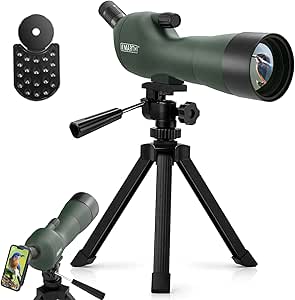 | Best Lightweight Travel Pick | Magnification: 20x-60x | Objective Lens Diameter: 60mm | Eye Relief: 17mm | VIEW ON AMAZON | See Our Full Breakdown |
| Vortex Diamondback HD Spotting Scope 20-60×85 Angled |  | Best Premium Optics | Magnification: 20-60x | Objective Lens Diameter: 85mm | Body Style: Angled | VIEW ON AMAZON | See Our Full Breakdown |
| Vortex Crossfire HD 12-36×50 Angled Spotting Scope |  | Best for Traveling Birders | Magnification: 12-36x | Objective Lens: 50mm | Body Style: Angled | VIEW ON AMAZON | See Our Full Breakdown |
| DiamondEdge 25-75×80 Spotting Scope with Desktop Tripod |  | Best Big-Zoom Accessory Kit | Magnification: 25-75x | Objective Lens: 80mm | Eyepiece: 23mm | VIEW ON AMAZON | See Our Full Breakdown |
| 20–60×80 HD Waterproof Spotting Scope |  | Best Digiscoping Starter Kit | Magnification: 20x–60x | Objective Lens: 80mm | Optics: Fully multi-coated | VIEW ON AMAZON | See Our Full Breakdown |
| WOSPORTS 25-75×85 Spotting Scope with Tripod for Target Shooting |  | Best Maximum Light Gathering | Magnification: 25-75x | Objective Lens: 85mm fully multi-coated | Prism: BAK4 Porro | VIEW ON AMAZON | See Our Full Breakdown |
| SVBONY SV28 Spotting Scope, Angled 25-75×70 with Tripod |  | Best Budget Beginner Pick | Magnification: 25-75x | Objective Lens: 70mm | Eyepiece: Zoom, 45-degree angled | VIEW ON AMAZON | See Our Full Breakdown |
| spotting scopes for birding | Magnification | Included accessories | Objective lens diameter |
|---|---|---|---|
| Vortex Crossfire HD Angged Spo | 20–60x | — | 80 mm |
| NWDEY 25-75×60 Spotting Scope | 25-75x | Smartphone adapter, carry bag, lens covers, cleaning cloth | 60mm |
| 20-60×85 Spotting Scope with F | 20-60x | Carrying bag, phone adapter, cleaning kit | 85mm |
| Sogries 20-60×80 HD Spotting S | 20-60x | — | — |
| Celestron Ultima 20-60×80 Angl | — | Soft carrying case, extended tripod mounting plate, eyepiece pouch, lens cloth | 80mm |
| FalconPro Elite 25-75×85 Spott | 25-75x | Heavy-duty full-size tripod, phone adapter | 85mm |
| 20-60×60… 20-60×80 Spotting | 20x-60x | Tabletop tripod, mount, carrying case, storage bag, covers, cleaning cloth | 80mm |
| SVBONY SV28 100mm Spotting Sco | 25-75x | Desktop tripod, smartphone adapter, lens cover, eyepiece cover, carrying bag | — |
| 20-60×60 Angled Spotting Scope | 20x-60x | 14-inch tabletop tripod, shoulder-strap carrying case | 60mm |
| Vortex Diamondback HD Spotting | 20-60x | — | 85mm |
| Vortex Crossfire HD 12-36×50 A | 12-36x | — | — |
| DiamondEdge 25-75×80 Spotting | 25-75x | Tabletop tripod, lens covers, pouch, carrying case, cleaning cloth | — |
| 20–60×80 HD Waterproof Spottin | 20x–60x | Aluminum tripod, smartphone adapter, carrying case, lens cloth | — |
| WOSPORTS 25-75×85 Spotting Sco | 25-75x | — | — |
| SVBONY SV28 Spotting Scope | 25-75x | Phone adapter, desktop tripod | — |
More Details on Our Top Picks
Vortex Crossfire HD Angged Spotting Scope, 20–60×80
This is the pick I would point most birders toward first. What separates the Crossfire HD from budget rivals like the NWDEY 25-75×60 is optical discipline: the HD optical system and fully multi-coated lenses hold color fidelity and brightness at high magnification, where cheaper scopes turn images dim and soft. The helical focus is faster and finer than the dual-knob setup on the Sogries 20-60×80, which matters when you are twitching between a close warbler and a distant raptor. The Arca-Swiss compatible foot snaps straight onto quality tripod heads without adapters, and the unconditional lifetime warranty outclasses the two-year coverage elsewhere in this lineup. The tradeoff: no tripod or phone adapter is included, so you will spend more to build out a complete kit.
Pros:- HD optics stay sharp and bright at 60x magnification
- Fast helical focus for tracking moving birds
- Arca-Swiss foot works with quality tripod heads out of the box
- Unconditional lifetime warranty
Cons:- No tripod or accessories included, adding to total cost
- At 3.3 lbs it needs a sturdy tripod for stable high-power viewing
Best for: Birders who already own a decent tripod and want dependable optics with a lifetime warranty
Not ideal for: First-time buyers on a tight budget — nothing is included, so you must buy a tripod separately
- Objective lens diameter:80 mm
- Magnification:20–60x
- Viewing angle:Angled
- Focus:Helical
- Tripod compatibility:Arca-Swiss compatible
- Waterproof and fogproof:Yes
- Weight:3.3 lbs
- Warranty:Lifetime, unlimited and unconditional
Our verdict“The strongest all-around optics in this batch for serious birders who can supply their own tripod.”
NWDEY 25-75×60 Spotting Scope with 60-Inch Tripod
For a first foray into birding, this bundle removes every barrier: scope, 60-inch tripod, smartphone adapter, bag, and cleaning cloth all arrive in one box. The 60mm objective is smaller than the 80–85mm lenses on the Celestron Ultima or the 20-60×85 full-size scope, so expect dimmer views at dawn and dusk — but for daytime pond and field birding, the BAK4 prism and fully multi-coated lens deliver genuinely usable images. Its 25-75x zoom range actually out-reaches the Vortex Crossfire on paper, though image quality at 75x will not match it. That is the core tradeoff: reach over refinement. Eye alignment at high power takes patience, which is normal at this price tier.
Pros:- Everything included: tripod, phone adapter, bag, and lens care
- Wide 25-75x zoom range for the price
- BAK4 prism and fully multi-coated 60mm lens
- Smartphone adapter makes digiscoping accessible for beginners
Cons:- 60mm objective limits brightness in early morning and evening
- Image softens considerably near 75x without precise eye alignment
Best for: Beginners and casual backyard birders who want a complete, affordable kit on day one
Not ideal for: Low-light specialists — the 60mm objective gathers noticeably less light than 80mm+ rivals at dusk
- Magnification:25-75x
- Objective lens diameter:60mm
- Prism:BAK4
- Lens coating:Fully multi-coated
- Tripod height:60 inches
- Included accessories:Smartphone adapter, carry bag, lens covers, cleaning cloth
Our verdict“The easiest, cheapest way to start spotting birds — as long as you mostly bird in daylight.”
20-60×85 Spotting Scope with Full Size Tripod
That 85mm objective is the reason this scope earns its slot: it pulls in roughly 25% more light than the 80mm Celestron Ultima, and the difference shows during those first minutes after sunrise when skulking species are most active. The wide 101ft field of view at low power beats the Sogries (86.4 feet) noticeably, making it easier to find and follow birds before zooming in — a genuine advantage for anyone still building spotting skills. The bundled full-size tripod with bubble level is sturdier than the desktop-class stands often bundled at this price. The compromises are physical: this is one of the heaviest, bulkiest setups here, and brightness predictably drops near 60x. It is a car-to-hide scope, not a hiking companion.
Pros:- 85mm objective delivers class-leading brightness at dawn and dusk
- Wide field of view makes locating birds easier before zooming
- Full-size adjustable tripod with built-in bubble level included
- Waterproof and dirt-resistant for messy field conditions
Cons:- Heavy and bulky compared with 60–80mm rivals
- Image brightness fades noticeably at maximum 60x
Best for: Dawn and dusk birders who prioritize light-gathering and mostly view from fixed locations
Not ideal for: Hikers and traveling birders — the 85mm body plus full-size tripod is a heavy load to carry
- Magnification:20-60x
- Objective lens diameter:85mm
- Prism type:BAK4
- Lens coating:FMC (Fully Multi-Coated)
- Field of view:101–48 ft @ 1000 yards
- Tripod height range:13.3–63 in
- Weatherproofing:Waterproof, dirt-resistant
- Included accessories:Carrying bag, phone adapter, cleaning kit
Our verdict“The low-light champion of this group, best for birders who set up in one spot and stay there.”
Sogries 20-60×80 HD Spotting Scope with Phone Adapter & Tripod
This option stands out for birders who want to photograph what they see. The bundled 360° rotating tripod and smartphone adapter are more digiscoping-ready than the Celestron Ultima’s T-adapter route, which assumes you already own camera gear. Optically, the full broadband multi-coating over BAK4 prisms holds its own against the similarly sized Vortex Crossfire in decent light, though it lacks the Vortex’s edge-to-edge refinement at high power. Comfort details are done well: the 45° angled eyepiece and twist-up eyecups suit glasses wearers, and the detachable 22mm eyepiece opens upgrade paths later. The 2-year warranty is the weak point — a fraction of the protection Vortex and Celestron offer — and as a newer brand there is less long-term track record to lean on.
Pros:- 360° rotating tripod and phone adapter included for immediate digiscoping
- Bright low-light optics with BAK4 prisms and full broadband coating
- Twist-up eyecups and 45° angle comfortable for glasses wearers
- Waterproof, nitrogen-purged body with rubber armor
Cons:- Only a 2-year warranty from a newer brand
- Slightly narrower field of view than the 85mm full-size competitor
Best for: Birders focused on smartphone photography who want a complete rotating-tripod digiscoping setup
Not ideal for: Buyers who value long-term warranty protection — two years pales next to lifetime coverage from Vortex or Celestron
- Magnification:20-60x
- Objective lens:80mm
- Prism:BAK4
- Coating:Full Broadband Multi-Coating (FBMC)
- Eyepiece:22mm detachable 1.25″ interface, 45° angle
- Waterproof/fogproof:Yes (nitrogen purged)
- Weight:1.18 kg
- Warranty:2 years
Our verdict“The most complete phone-photography package here, best for birders who document, not just observe.”
Celestron Ultima 20-60×80 Angled Spotting Scope
The Ultima 80 has earned its long-standing reputation by doing the fundamentals well: a large 80mm objective, multi-coated optics with honest color and contrast, and a zoom eyepiece with an integrated T-adapter for attaching a DSLR — a more serious photography path than the Sogries’ smartphone-only approach. Where the Vortex Crossfire HD is the sharper optical instrument, the Celestron counters with US-based expert tech support and a limited lifetime warranty that gives hesitant buyers peace of mind. It also includes a thoughtfully practical accessory set, including an extended tripod mounting plate that balances better on heads than the stubby feet on some rivals. One honest caveat: the 45° angled view takes practice for newcomers aiming at birds in flight or quickly relocating targets.
Pros:- Integrated T-adapter enables DSLR digiscoping without extra purchases
- Multi-coated optics deliver strong color and contrast in dim light
- Limited lifetime warranty with US-based expert support
- Extended tripod mounting plate improves balance on tripod heads
Cons:- Angled viewing takes practice for quickly acquiring distant birds
- No tripod included, unlike the NWDEY or Sogries bundles
Best for: Birders planning to grow into DSLR digiscoping who want established brand support
Not ideal for: Complete novices — the angled design and T-adapter workflow demand a learning curve before it feels natural
- Objective lens diameter:80mm
- Zoom magnification:20-60x
- Viewing angle:45° angled
- Optics coating:Multi-coated anti-reflective
- Eyepiece:Zoom eyepiece with integrated T-adapter
- Included accessories:Soft carrying case, extended tripod mounting plate, eyepiece pouch, lens cloth
- Warranty:Celestron Limited Lifetime US Warranty
Our verdict“A proven all-rounder for birders who want an upgrade path to camera digiscoping and solid manufacturer backing.”
FalconPro Elite 25-75×85 Spotting Scope with Heavy-Duty Tripod
The FalconPro Elite stands out for being the rare budget-class scope that ships with a tripod actually rated to hold it steady at 75x. That matters for birding more than most specs suggest: at maximum zoom, a wobbly mount ruins the view faster than mediocre glass does. The 85mm objective paired with a BAK4 prism gathers enough light for dawn chorus sessions when warblers are most active, and the dual-speed coarse/fine focus lets you snap from a perched bird to one in flight without hunting for focus. Compared with the generic 20-60×80 kit scope in this roundup, the FalconPro trades a wider field of view for a more stable platform and finer focus control. The tradeoff is weight — this is a scope you drive to a blind with, not one you sling over a shoulder on a long hike.
Pros:- Heavy-duty tripod stays stable even at 75x, unlike the tabletop tripods bundled with cheaper kits
- Dual-speed focusing handles both quick target acquisition and fine detail work
- 85mm BAK4 optics deliver usable images in early morning and dusk light
- Phone adapter makes digiscoping records of rare birds straightforward
Cons:- Combined scope-and-tripod weight is impractical for walking-intensive birding
- Angled body can be awkward when viewing from a car window mount
Best for: Birders who watch from a fixed spot — blinds, decks, or wetland overlooks — and want one box with everything included
Not ideal for: Backcountry birders covering miles on foot; the full-size tripod and 85mm optics make this a heavy load
- Magnification:25-75x
- Objective Lens Diameter:85mm
- Prism Type:BAK4
- Body Style:Angled
- Focus System:Dual speed (coarse and fine)
- Weatherproofing:Waterproof, fog-proof (nitrogen-purged, O-ring sealed)
- Included Accessories:Heavy-duty full-size tripod, phone adapter
Our verdict“If your birding happens mostly from one spot and you want a complete, stable kit out of the box, this is the strongest bundled value here.”
20-60×60… 20-60×80 Spotting Scope with Tripod
This 20-60×80 kit is built around one idea: getting a phone camera onto a big objective lens for as little cash as possible. The included smartphone adapter, paired with a multi-coated 80mm lens and BAK4 Porro prisms, means a beginner can start cataloguing yard birds and shorebirds the day the box arrives. Its 82.9-foot field of view at low power is genuinely useful for tracking moving birds — wider than what the SVBONY SV28 offers at comparable zoom. The catch is the tabletop tripod: at 60x on a short mount, every hand movement on the phone translates into image shake, so plan on a taller tripod eventually. Compared with the similarly sized 20-60×85 full-size kit in this guide, you give up platform stability and low-light reach but spend far less to start.
Pros:- 80mm multi-coated objective with BAK4 Porro prisms punches above its price class
- Wide 82.9-foot field of view at 20x helps track birds in flight
- Complete accessory bundle including phone adapter, case, and covers
- Waterproof and fog-proof housing holds up in damp field conditions
Cons:- Tabletop tripod is inadequate for stable viewing at high magnification
- Phone adapter only fits devices between 54-90mm wide and 14mm thick, excluding many modern phones with cases
Best for: Beginner birders and backyard naturalists who want to try digiscoping before committing serious money
Not ideal for: Anyone planning to use 60x regularly; the tabletop tripod cannot deliver a steady image at high zoom
- Magnification:20x-60x
- Objective Lens Diameter:80mm
- Field of View:82.9-48 ft per 1,000 yards
- Prism Type:BAK4 Porro
- Waterproof / Fog-proof:Yes / Yes
- Smartphone Adapter Fit:54-90mm wide, up to 14mm thick
- Included Accessories:Tabletop tripod, mount, carrying case, storage bag, covers, cleaning cloth
Our verdict“A sensible low-risk entry point for digiscoping-curious birders, provided you budget for a real tripod down the road.”
SVBONY SV28 100mm Spotting Scope, 25-75x Magnification
The SV28’s 100mm aperture is the largest in this entire roundup, and for birders that translates directly into one thing: usable images when the light is bad. Owls at dusk, bitterns in reed beds at dawn, skulking rails on overcast days — a big objective keeps colors honest and detail visible when an 80mm scope goes dim. The fully multi-coated optics and 25-75x zoom round out a genuinely capable optical package. The tradeoff is that the bundled desktop tripod simply cannot support 75x magnification, so the real cost includes a sturdy full-size tripod purchased separately. Compared with the FalconPro Elite, which arrives with a tripod rated for its top magnification, the SV28 demands more assembly and extra spend — but wins outright when the question is light-gathering per dollar.
Pros:- 100mm aperture out-gathers every other scope in this lineup in dim conditions
- Fully multi-coated optics preserve contrast and color at high zoom
- Twist-up eyecups accommodate eyeglass wearers comfortably
- Universal 1/4-inch mount works with virtually any tripod you upgrade to
Cons:- Included desktop tripod is not stable enough for serious use at 75x
- Large aperture makes it heavy and awkward for extended carrying
Best for: Birders who specifically chase crepuscular species — owls, rails, night-herons — where maximum light gathering matters most
Not ideal for: Travel birders and anyone on a strict total budget; the 100mm body is bulky and needs a separate sturdy tripod
- Aperture:100mm
- Magnification:25-75x
- Lens Coating:Fully multi-coated
- Tripod Mount:Universal 1/4-inch threaded
- Eyecups:Twist-up
- Included Accessories:Desktop tripod, smartphone adapter, lens cover, eyepiece cover, carrying bag
Our verdict“The pick for low-light specialists who will pair this glass with a proper tripod of their own choosing.”
20-60×60 Angled Spotting Scope with Tripod
At roughly a foot and a half long with a 60mm objective, this is the lightest serious option in this batch — and for birders who walk, that counts for more than raw magnification. A 60mm scope you actually carry beats an 85mm scope left in the car. The angled body, 17mm of eye relief, and standard 1/4″-20 thread make it comfortable for eyeglass wearers and easy to mount on any tripod or car-window mount you already own. Against the heavier 20-60×80 kits elsewhere in this guide, this model gives up meaningful low-light performance and image brightness at 60x — the view gets dim and soft near maximum zoom. The included 14-inch tabletop tripod is a placeholder rather than a real field tool. Note that listed weight figures conflict between listings, so verify before packing.
Pros:- Light, compact body is realistic to carry on long birding walks
- 17mm eye relief works well for eyeglass wearers
- Standard 1/4″-20 thread accepts any tripod or window mount
- Waterproof, nitrogen-filled construction handles humid and coastal conditions
Cons:- Image brightness and sharpness drop off noticeably at the 60x end
- Tabletop tripod included in the kit is too short and shaky for field use
- Conflicting published weight figures make actual portability hard to confirm
Best for: Walking birders, travelers, and anyone pairing a scope with a car-window mount for mobility-first birding
Not ideal for: Birders who bird mostly from a fixed spot in low light; the 60mm objective dims noticeably at high zoom
- Magnification:20x-60x
- Objective Lens Diameter:60mm
- Eye Relief:17mm
- Field of View:3280.84 feet
- Tripod Thread:1/4″-20
- Dimensions:13.39 x 3.15 x 5.51 inches
- Weight:3.5 lbs (listed item weight)
- Included Accessories:14-inch tabletop tripod, shoulder-strap carrying case
Our verdict“The right choice when portability is non-negotiable, as long as you accept the optical limits of a 60mm objective.”
Vortex Diamondback HD Spotting Scope 20-60×85 Angled
This is the glass-quality benchmark of the batch. The Diamondback HD’s HD optical system delivers resolution and color fidelity that budget 80-85mm scopes — the FalconPro Elite included — cannot match at 60x, which is exactly where cheap spotting scopes fall apart. Subtle field marks become readable: the chestnut scapular line on a distant plover, the fine streaking that separates two Empidonax flycatchers at a respectful distance. The argon-purged, O-ring-sealed body with Armortek lens coatings is built for years of coastal and tropical birding, and the unconditional lifetime VIP warranty means a fall off a tripod platform is a repair, not a replacement. Two honest tradeoffs: no tripod or phone adapter is included, so the true cost of a working setup is higher, and the 85mm body is heavy for long carries compared with the 60mm travel pick above.
Pros:- HD optical system resolves fine plumage detail at high magnification better than any budget scope in this guide
- Argon-purged, O-ring-sealed body with Armortek lens protection suits harsh coastal and humid environments
- Arca-Swiss plus 1/4-20 mounting fits premium and standard tripods alike
- Unlimited, transferable lifetime VIP warranty adds long-term value
Cons:- No tripod, phone adapter, or case included — accessories add real cost
- 85mm objective makes it heavy for birders who hike between sites
Best for: Serious birders who prioritize image quality and want optics backed for life, and who already own a decent tripod
Not ideal for: First-time buyers wanting an all-in-one kit — tripod, phone adapter, and case all cost extra here
- Magnification:20-60x
- Objective Lens Diameter:85mm
- Body Style:Angled
- Focus:Built-in helical focus wheel
- Weatherproofing:Waterproof (O-ring sealed), fogproof (argon purged)
- Tripod Mounting:Arca-Swiss compatible, 1/4-20 thread
- Lens Protection:Armortek coating
- Warranty:Unlimited, unconditional lifetime VIP Warranty
Our verdict“The pick for birders ready to invest in optical quality and warranty protection rather than bundled accessories.”
Vortex Crossfire HD 12-36×50 Angled Spotting Scope
Where most scopes in this lineup chase maximum zoom, the Crossfire HD 12-36×50 makes a different bet: that birders carry their optics more than they tripod them. At 12-36x with a 50mm objective, it trades raw reach for a package that fits in a daypack, and the HD glass with reduced chromatic aberration means colors on a warbler at 30x look cleaner than they do through budget 75x scopes like the WOSPORTS 25-75×85, whose image softens at the top of its range. The Arca-Swiss compatible foot is a quiet advantage over the Gosky DiamondEdge, which forces you to fuss with a basic 1/4″-20 mount.
The tradeoff is honest: 36x tops out before shorebird and hawk-watch work begins. And unlike the 65mm and 80mm Crossfire models, this one lacks a built-in sunshade.
Pros:- HD optical system with excellent resolution and true-to-life color
- Arca-Swiss compatible foot mounts directly to quality tripods
- Waterproof, fogproof, rubber-armored build
- Unlimited lifetime VIP Warranty from Vortex
Cons:- Caps at 36x, limiting long-range identification
- No built-in sunshade on the 50mm model
Best for: Hiking birders and travelers who want premium glass and a lifetime warranty in a packable size
Not ideal for: Hawk watchers and shorebird counters who need 60x-plus reach — 36x won’t resolve distant raptors
- Magnification:12-36x
- Objective Lens:50mm
- Body Style:Angled
- Foot Mount:Arca-Swiss compatible
- Waterproof / Fogproof:Yes / Yes (nitrogen purged)
- Armor:Rubber
- Warranty:Unlimited lifetime VIP Warranty
Our verdict“This pick makes the most sense for birders who walk miles with a scope on their shoulder and value glass quality and warranty over maximum zoom.”
DiamondEdge 25-75×80 Spotting Scope with Desktop Tripod
The Gosky DiamondEdge wins on completeness: unlike the SVBONY SV28, which ships with just a phone adapter and small tripod, this kit arrives with covers, a pouch, a case, a cleaning cloth, and a tripod — essentially everything a first-time birder needs on day one. The 25-75x zoom paired with an 80mm objective gathers enough light to keep dawn warbler viewing usable where smaller objectives go dim, and the 23mm eyepiece is noticeably more comfortable than typical zoom eyepieces for long glassing sessions.
Reality check: that 80mm tube is heavy and awkward for field hiking, and the bundled tabletop tripod is undermatched for the scope’s weight — plan on a real tripod eventually. Compared with the 20-60×80 HD kit, the DiamondEdge offers more zoom but slightly shakier performance at full 75x.
Pros:- 25-75x zoom with 80mm objective for bright, detailed long-range views
- Large 23mm eyepiece for comfortable wide-field viewing
- Waterproof, fogproof, rotatable rubber-armored body
- Full accessory kit including case, covers, and tripod
Cons:- Heavy and bulky compared with 50-70mm alternatives
- Image clarity degrades near maximum 75x
- Included tabletop tripod is too basic for the scope’s weight
Best for: New birders who want a complete out-of-the-box kit for car-based birding at refuges and wetlands
Not ideal for: Backcountry birders — the 80mm body and underpowered tabletop tripod make it a poor hiking companion
- Magnification:25-75x
- Objective Lens:80mm
- Eyepiece:23mm
- Prism:BAK4
- Coating:Fully multi-coated
- Weatherproofing:Waterproof, nitrogen-filled, O-ring sealed, fogproof
- Mount Thread:1/4″-20 standard
- Included Accessories:Tabletop tripod, lens covers, pouch, carrying case, cleaning cloth
Our verdict“A strong value package for stationary, drive-up birding where reach matters more than portability — just budget for a sturdier tripod down the road.”
20–60×80 HD Waterproof Spotting Scope
What separates this scope from the crowded 80mm field is its included smartphone adapter — for birders who want to photograph and log sightings without buying a separate digiscoping rig, this is the most direct path. The 20-60x zoom range is actually better matched to an 80mm objective than the DiamondEdge’s 25-75x; staying at 60x keeps brightness and sharpness usable, where pushing budget glass to 75x usually disappoints. The 45-degree angled body makes long stakeouts at a marsh hide comfortable, and the aluminum tripod in the box is a genuine head start rather than an afterthought.
The drawbacks are transparency gaps: no published weight or dimensions means you’re guessing about packability, and image quality at 60x will trail premium options like the Vortex Diamondback HD.
Pros:- Smartphone adapter included for immediate digiscoping
- Sensible 20-60x zoom matched to the 80mm objective
- Waterproof, fogproof, nitrogen-purged rubber-armored body
- Aluminum tripod and carrying case included
Cons:- No published weight or dimensions
- Image quality trails premium 80mm scopes at high zoom
Best for: Birders who want to pair their scope with a phone for photos and record-keeping on a budget
Not ideal for: Weight-conscious hikers and anyone who needs published specs before buying — sizing details are absent
- Magnification:20x–60x
- Objective Lens:80mm
- Optics:Fully multi-coated
- Body Design:45° angled
- Weather Protection:Waterproof, fogproof, nitrogen-purged
- Body Armor:Rubber armored
- Included Accessories:Aluminum tripod, smartphone adapter, carrying case, lens cloth
Our verdict“The most practical entry point for birders whose phone is their camera and whose budget can’t stretch to name-brand glass.”
WOSPORTS 25-75×85 Spotting Scope with Tripod for Target Shooting
With an 85mm fully multi-coated objective and BAK4 Porro prism, the WOSPORTS pulls in more light than anything else in this batch — a real advantage for birders watching herons and rails at dusk, when the SVBONY SV28’s 70mm lens starts struggling. The 25-75x zoom with a smooth fast-focus wheel lets you snap from scanning wide to locking onto a perched bird quickly, and the 360° swivel tripod plus phone adapter make it surprisingly capable for casual digiscoping, echoing what the 20-60×80 HD kit offers but with a larger aperture.
Its roots in target shooting show, though: the included table tripod is too short and wobbly for steady 75x birding from a vehicle or blind, and brightness inevitably fades at the top of the zoom. Birders doing serious ID work at distance will still want a full-size tripod.
Pros:- 85mm FMC objective with BAK4 Porro prism for bright, sharp images
- 25-75x zoom with smooth fast-focus wheel
- Waterproof, fog-proof, nitrogen-sealed rubber-armored body
- Complete kit with smartphone adapter for digiscoping
Cons:- Table tripod is unstable for high-magnification field use
- Image brightness drops at maximum 75x
Best for: Low-light birders and backyard watchers who want maximum brightness and don’t mind adding a real tripod
Not ideal for: Field birders relying on the bundled table tripod — it’s too unstable for usable 75x viewing
- Magnification:25-75x
- Objective Lens:85mm fully multi-coated
- Prism:BAK4 Porro
- Field of View:102–52.5 ft / 1000 yards
- Weather Resistance:Waterproof, fog-proof, nitrogen-sealed
- Eyecup:Twist-up
- Warranty:1 year
Our verdict“If dusk and dawn viewing define your birding, this 85mm optic delivers the brightest budget image here — provided you upgrade the tripod.”
SVBONY SV28 Spotting Scope, Angled 25-75×70 with Tripod
At 910 grams, the SV28 is the lightest full-zoom scope in this roundup — for a beginner who isn’t sure birding will stick, that matters more than edge-sharp glass. The built-in extendable sunshade is a feature even the pricier Vortex Crossfire HD 50mm omits, cutting glare when you’re scanning a backlit lake at midday. The 70mm objective keeps views reasonably bright to around 200 yards, which covers feeder watching, marsh edges, and most local-park birding, and the bundled phone adapter makes first digiscoping attempts nearly free.
Compromises arrive at the tripod and the top of the zoom: the desktop tripod shakes visibly at 75x, and manual-only focusing is slower for fast-moving birds. Compared with the 20-60×80 HD kit, you give up light gathering and a sturdier tripod — but also a lot of bulk.
Pros:- Lightweight 910g body that’s easy to carry all day
- Built-in extendable sunshade reduces midday glare
- Waterproof and fogproof with non-slip exterior
- Phone adapter included for beginner digiscoping
Cons:- Desktop tripod is unstable at high magnifications
- Manual focus is slow for fast-moving birds
- Optics tuned for beginners rather than serious identification work
Best for: First-time birders and casual backyard watchers wanting an affordable, lightweight all-in-one kit
Not ideal for: Advanced birders doing distant shorebird or raptor ID — optical precision and stability fall short
- Magnification:25-75x
- Objective Lens:70mm
- Eyepiece:Zoom, 45-degree angled
- Focal Length:380mm
- Field of View:64 feet
- Coating:Fully multi-coated
- Weight:910 g
- Waterproof:Yes
- Included Accessories:Phone adapter, desktop tripod
Our verdict“The cheapest credible way to find out whether spotting-scope birding is for you, without the weight or cost of an 80mm rig.”

How We Picked
Because birding demands long observation sessions, fine color discrimination, and often long carries, I judged each scope on four weighted criteria: image quality at realistic magnifications (30-45x is where birders actually live, not the advertised 75x), build and weatherproofing (fog-proofing and rubber armor matter in coastal and marsh habitats), handling and tripod stability (a shaky mount ruins good glass), and value relative to intended buyer. A $150 scope was not penalized for chromatic fringing the way a $900 scope was, because expectations differ by tier.
The ranking logic follows use case rather than pure optical ranking. Premium HD glass rises to the top for serious birders, proven mid-range models fill the value slots, and budget bundles are ordered by how well their included accessories actually serve a birder versus a target shooter. Where two scopes share similar optics, the one with the better tripod, warranty, or ergonomics placed higher — which is why Vortex’s lifetime warranty and the Celestron’s balanced kit outperform several similarly priced generic imports.
Factors to Consider When Choosing Spotting Scopes For Birding
Before matching a scope to your birding style, it helps to understand why these instruments vary so much in price and performance — and where beginners most often overspend or underspend.Objective Size: The Weight-Brightness Tradeoff
An 80-100mm objective gathers more light, which matters at dawn when warblers are most active and at high magnification when images dim. But that brightness comes at a cost most buyers underestimate: a fully loaded 85mm rig can weigh over six pounds before you add a field tripod, and it will not ride comfortably on a shoulder strap all day. A 60-65mm scope gives up roughly one hour of usable light at each end of the day but can genuinely be carried on long walks. The mistake I see most often is a backyard or car birder buying compact for portability they never use, or a hiking birder buying an 85mm monster that stays home. Match the objective to how far you actually walk from the parking spot, not to the aperture number that looks impressive.
Magnification Reality Check: Ignore the Top Number
Almost every scope in this category advertises 60x or 75x, and almost no birder uses those settings productively. Atmospheric heat shimmer makes 60x+ unusable by mid-morning in most habitats, and budget glass goes soft well before the top of the zoom range. What separates good scopes from mediocre ones is how clean the image stays at 30-45x, the range where you identify distant shorebirds, raptors, and waterfowl. When comparing models, mentally relabel a 20-60x scope as a 20-45x scope and judge it accordingly. A scope that is genuinely sharp to 45x will outperform a fuzzier 75x scope every single time in the field.
Angled Versus Straight Eyepieces
The angled design dominates this roundup and birding in general for practical reasons: it lets you use a shorter, lighter tripod; it’s far more comfortable for prolonged viewing of perched birds; and groups of birders of different heights can share one scope without constantly cranking the column up and down. Straight scopes still have their advocates — they’re faster to get on a moving bird and easier to use from a car window mount — but very few models in this price class offer straight versions. If you bird mostly alone from a vehicle, seek out a straight option; if you walk trails or share a scope with a partner or class, angled is the safer choice.
The Tripod Problem Nobody Warns You About
Included tripods are the hidden failure point of nearly every budget spotting scope bundle. A 60-inch aluminum tripod with a small head might hold an 80mm scope still in a living room, but add a coastal breeze and your 45x view becomes a vibrating blur that causes eye fatigue within minutes. Serious birders almost always end up buying a separate tripod and fluid or geared head, which can cost as much as a budget scope itself. My advice: treat any bundled tripod as a starter convenience, factor the cost of a sturdier mount into your total budget, and don’t reject an otherwise good optical package because its tripod is mediocre — that’s the easiest component to replace.
Glass Coatings and Chromatic Aberration
This is where the price tiers in this roundup actually come from. Fully multi-coated HD glass with extra-low-dispersion elements — like the Vortex HD models — keeps high-contrast subjects like a black-and-white pelican against bright water from smearing purple and green fringes along feather edges. Standard multi-coated budget glass produces noticeable fringing at high zoom, which matters for birding specifically because fine plumage detail is often the identification criterion. You don’t need ED glass to enjoy herons and gulls at 25x, but if you’re separating distant peeps or gull species, the upgrade pays for itself in identification confidence.
Weatherproofing and Field Durability
Birding happens in the worst light and weather, because that’s when birds are active. Nitrogen or argon purging prevents internal fogging when you move a cold scope into a warm car or hide, and rubber armor protects against the inevitable tripod tip on rocky ground. Many generic imports claim water resistance without true sealing — check for O-ring sealed, fog-proof construction rather than ‘waterproof coating’ language. A lifetime warranty, like Vortex’s unconditional coverage, is effectively an insurance policy on a tool that will live in a car trunk and get knocked around for a decade. Budget scopes can bird happily for years, but plan on gentler treatment.
Frequently Asked Questions
Is 60x magnification enough for identifying distant shorebirds?
For most shorebird and waterfowl identification, 45-60x is plenty — and often more than atmospheric conditions allow. The limiting factor is rarely magnification and usually image quality: a sharp 45x view through HD glass shows more feather detail than a hazy 75x view through budget glass. If you regularly scan mudflats at 200+ yards, prioritize objective size and glass quality over the top zoom number. Heat shimmer will cap your usable magnification by mid-morning regardless of what the dial says.
Should I buy an 80mm budget scope or a 60mm scope from a better brand?
This is the classic tradeoff in this roundup, and the answer depends on your birding style. The budget 80mm gives you a brighter image at dawn and dusk, which matters for owls, rails, and dawn warbler pushes — but with more chromatic fringing and softer edges. A quality 60mm like the Vortex Crossfire HD 12-36×50 delivers cleaner color and better build in a package you’ll actually carry on trails. If you bird within a short walk of the car, take the 80mm; if you hike, the smaller premium scope will get used far more often. The best scope is the one that isn’t sitting at home because it’s too heavy.
Do the included phone adapters work for bird photography?
As casual digiscoping tools, yes — the Sogries and similar bundles let you capture record shots and identifiable documentation images of birds you’ve spotted. But don’t expect telephoto-lens quality: phone adapters magnify every optical flaw, and budget scope images tend to look soft and dim compared to what your eye sees. For identification records and social media, they’re genuinely useful and cost nothing extra. If photography is a primary goal, a dedicated universal digiscoping adapter on a higher-grade scope produces dramatically better results. Treat bundled adapters as a free bonus, not a deciding factor.
Are the tripods included with budget scopes good enough for birding?
Barely, and only in calm conditions. The bundled 60-inch aluminum tripods typically hold a scope steady enough at 20-30x, but at higher magnification or in any breeze, vibration makes fine detail impossible to read and fatigues your eyes quickly. They’re fine for getting started and for feeder-watching from a deck. Once birding becomes a regular habit, upgrading to a sturdier tripod with a smooth pan head is the single biggest usability improvement you can make — often more noticeable than upgrading the scope itself. Budget roughly the cost of a second budget scope for a tripod that genuinely tames an 85mm instrument.
What magnification range is most useful for general birding?
In practice, most birders live between 20x and 45x. Twenty to thirty power covers woodland edges, hawk watches, and feeder observation with a wide, bright, easy-to-aim field of view. Pushing to 40-45x is where you’ll resolve shorebird plumage, raptor silhouettes, and distant waterfowl detail. Above that, usable image quality depends more on glass and air conditions than the zoom dial. A 20-60x zoom is the versatile sweet spot; the 25-75x ranges on budget scopes rarely deliver usable images at their maximum, so treat those top settings as marketing rather than capability.
Conclusion
For the best overall birding scope, the Vortex Diamondback HD 20-60×85 combines genuinely sharp HD glass, true weatherproofing, and an unconditional lifetime warranty — it’s the scope a committed birder buys once. The best value goes to the Celestron Ultima 20-60×80, which delivers most of the viewing experience of premium models at a mid-range price. Budget-conscious beginners should start with the Sogries 20-60×80 or the NWDEY 25-75×60: both include everything needed to start birding immediately, with tripods you can upgrade later. Hikers and travelers get the Vortex Crossfire HD 12-36×50, the only truly packable option here with optics worth carrying. For digiscopers and record-shot photographers, the SVBONY SV28 100mm offers the largest objective in the lineup at a remarkable price, while low-light specialists and marsh birders will appreciate its dawn brightness. Whatever you choose, remember that the bundled tripod on any budget pick is your first upgrade — a steady mount makes even modest glass perform like a tier above.
Evergreen bestsellers Picks

KitchenAid Artisan 5-Quart Tilt-Head Stand Mixer, Blue Velvet

Dyson V8 Cyclone Cordless Vacuum

Shark ZU102 Rotator Pet Upright Vacuum with PowerFins HairPro & Odor Neutralizer Technology, Charcoal
As an affiliate, we earn on qualifying purchases.