Induction cooktops heat pans directly with magnetic energy, which means faster boiling, tighter temperature control, and a cooler kitchen than any conventional electric burner. After comparing 15 popular models, the Duxtop 9100MC stands out as the best overall pick for its balance of power, intuitive controls, and reliability at a mid-range price. The AMZCHEF Double Cooktop is the clear choice if you need two burners and a griddle in one package, while the Nuwave Pro Chef brings commercial-grade durability for serious cooks. The main tradeoff you’ll face in this category is precision versus simplicity: temperature-probe models and 20-level controls excel at delicate cooking, while single-knob units win on ease of use. Read on for the full breakdown of all 15 models and who each one suits best.

Get kitchen staples and gadgets delivered free with Prime
- Fast, free delivery on millions of items
- Prime Video, Amazon Music and more included
- Member-only deals all year
Key Takeaways
- The Duxtop 9100MC earned the top spot because it balances 1800W of power with a simple control scheme — most competitors force you to choose between precision features and usability.
- Every model in this lineup runs at 1800W, which is the practical ceiling for a standard 120V outlet — real differentiation came down to coil size, temperature range, and control granularity, not raw power.
- Nuwave dominates the precision niche: three of its models (Flex, Probe, and Double Pro) offer probe cooking or unusually wide temperature ranges, making the brand the go-to for sous-vide-style and low-heat work.
- Double-burner units like the AMZCHEF 2-Burner and Nuwave Double Pro split total power between zones, so they suit multi-dish cooking better than high-heat searing — a tradeoff single-burner picks avoid.
- Commercial-grade models (Nuwave Pro Chef, ChangBERT NSF) cost more and skip convenience features like timers, but their heavier coils and builds sustain high heat far longer — worthwhile only if you cook intensively.





More Details on Our Top Picks
Duxtop Portable Induction Cooktop, 1800W, Silver
This model stands out as the most balanced portable induction burner in the lineup. With 20 preset power levels and 20 temperature levels, it offers finer control granularity than the Duxtop 8100MC’s 15 levels, which matters when you’re trying to hold a simmer without scorching. The 10-hour timer is unusually generous — long enough for slow braises, something the AAOBOSI’s 4-hour cap can’t match. Safety is well covered too, with a child safety lock and auto-pan detection that cuts power when no pot is present. The tradeoff is familiarity: like most Duxtop units, it can emit a faint high-pitched whine with certain layered cookware, and the glass surface needs a cooling period before wiping down.
Pros:- 40 combined power and temperature presets for precise control
- 10-hour timer supports slow cooking and braising
- Child safety lock and auto-pan detection
- Compact, lightweight body stores easily in a cabinet
Cons:- Certain cookware layers can produce high-pitched noise
- Surface needs a cooling period before cleaning
Best for: Everyday home cooks who want the most versatile single-burner portable with long-timer flexibility
Not ideal for: Households sensitive to high-frequency noise, or anyone who wants to cook with non-magnetic cookware like copper or plain aluminum
- Power:1800W
- Voltage:110/120V
- Energy Efficiency:83%
- Preset Power Levels:20
- Preset Temperature Levels:20
- Timer:Up to 10 hours
- Cookware Compatibility:Magnetic cookware, minimum 5 inches diameter
- Safety Features:Child safety lock, auto-pan detection
Our verdict“If you want one portable induction burner that handles everything from delicate sauces to all-day stews, this is the safest all-around bet.”
Nuwave Flex Precision Induction Cooktop, 6.5-inch Heating Coil, Black
Where the Duxtop Silver focuses on breadth of presets, the Nuwave Flex goes deep on accuracy: 81 preset temperatures from 100°F to 500°F, adjustable on the fly without interrupting the cook. That range is wider at the low end than the Duxtop 8100MC’s 140°F floor, which makes this model better suited to tempering chocolate, holding sous vide-style water baths, or keeping sauces warm without overshooting. The shatter-resistant ceramic glass surface also feels more rugged than typical portable units. The catch is specialization — there’s no timer or child lock mentioned, and the 6.5-inch coil means oversized stockpots won’t heat evenly, so it’s a specialist tool rather than a do-everything burner.
Pros:- 81 temperature presets with on-the-fly adjustment
- Wide 100°F to 500°F range covers delicate low-heat tasks
- Shatter-resistant ceramic glass surface
- Fast, even heating from the induction coil
Cons:- No built-in timer or child lock
- 6.5-inch coil limits usable pot size
Best for: Cooks who obsess over exact temperatures — melting, tempering, and low-and-slow holding
Not ideal for: Anyone wanting an all-in-one workhorse, since it lacks a timer and smart safety features
- Heating Coil Size:6.5 inches
- Surface Material:Ceramic glass
- Temperature Range:100°F to 500°F
- Preset Temperatures:81
- Cookware Compatibility:Induction-compatible cookware only
Our verdict“For temperature-obsessed cooking where a few degrees matter, nothing else in this lineup matches its control resolution.”
AMZCHEF Double Induction Cooktop, 1800W 2 Burner with Griddle Pan, Grey
This is the only product in this batch that solves the single-burner bottleneck: two independently controlled cooking zones, plus a removable non-stick griddle pan that turns the whole surface into a flat-top for pancakes, steaks, and smash burgers. Compared with the Duxtop Silver or the AAOBOSI, you gain genuine meal-coordination ability — searing on one zone while simmering on the other. The tradeoff is physics: with 1800W split across two burners, running both zones at full blast isn’t realistic, so it’s better for medium-heat multitasking than double high-heat searing. Cookware is also constrained to a 4.72 to 9.44 inch diameter range, and the griddle, while handy, is a non-stick surface that won’t last as long as the ceramic glass beneath it.
Pros:- Two independently controlled burners in one portable unit
- Removable non-stick griddle adds flat-top cooking
- Combined knob and touch controls are intuitive
- Easy-to-clean ceramic glass surface
Cons:- Shared 1800W limits simultaneous high-intensity cooking
- Strict cookware size range of 4.72 to 9.44 inches
Best for: Small kitchens, dorms, and RV owners who need two dishes going at once plus griddle capability
Not ideal for: Cooks who regularly run two high-heat burners simultaneously — the shared 1800W budget won’t support it
- Power:1800W total (1100W max per burner)
- Voltage:120V
- Number of Burners:2
- Griddle Pan:Removable, non-stick
- Control Type:Knob + touch
- Surface Material:Ceramic glass
- Cookware Compatibility:Magnetic cookware, 4.72 to 9.44 inches diameter
Our verdict“The smartest pick here for anyone whose real complaint about portables is having only one burner.”
AAOBOSI Portable Induction Cooktop, 1800W, 20 Temp & Power Levels, Timer
At 1.7 inches thick and roughly 14 inches wide, this is the most travel-friendly design in the batch, and it earns its role through dedicated preset modes — Boil, Hot Pot, Stew, and Keep Warm — that remove guesswork entirely. That’s a friendlier approach than the Duxtop Silver’s raw 40 presets for anyone cooking in a cramped RV galley or a studio apartment. The residual heat indicator is a genuinely useful safety touch that the Duxtop 8100MC doesn’t advertise. Tradeoffs mirror its size: the cooking surface accommodates small-to-medium pots only, so a large stockpot for pasta night will overhang awkwardly, and the 4-hour timer trails the Duxtop Silver’s 10-hour ceiling for extended slow cooking.
Pros:- Slim 1.7-inch profile slips into any cabinet or RV drawer
- One-touch presets for boil, hot pot, stew, and keep warm
- Child lock plus residual heat indicator
- Fast, responsive 1800W heating
Cons:- Small cooking surface limits pot size
- 4-hour timer is shorter than competing models
Best for: RV travelers, campers with shore power, and studio-apartment dwellers who value portability and one-touch presets
Not ideal for: Cooks who regularly use large stockpots or Dutch ovens — the compact surface won’t support them
- Wattage:1800W
- Heating Elements:1
- Controls:Touch
- Preset Modes:Boil, Hot Pot, Stew, Keep Warm
- Power Levels:20 temperature and 20 power levels
- Timer:4 hours
- Surface Material:Ceramic glass
- Dimensions:11″D x 13.8″W x 1.7″H
Our verdict“The right choice when space is the deciding factor and one-touch simplicity beats granular control.”
Duxtop 1800W Portable Induction Cooktop Countertop Burner, Gold 8100MC
Compared with the Duxtop Silver reviewed above, the 8100MC trims features to hit a lower price point: 15 power levels instead of 20, a 170-minute timer instead of 10 hours, and no child lock. What survives the cuts is everything that actually matters for everyday cooking — 1800W of responsive power, a digital panel, auto-pan detection, and error diagnostics that tell you when cookware isn’t compatible rather than leaving you guessing. Its 140°F to 460°F temperature range covers most tasks, though low-heat purists should note the Nuwave Flex goes down to 100°F. Like its siblings, it demands induction-ready cookware — cast iron, steel, or enameled aluminum — and shares the family trait of occasional high-pitched noise from layered pots. For a first induction burner or a spare, those compromises are easy to accept.
Pros:- Core 1800W performance matches pricier models at a lower cost
- Auto-pan detection and error diagnostics prevent confusion
- Built-in countdown timer up to 170 minutes
- Compact and lightweight for storage
Cons:- 170-minute timer caps long slow-cooking sessions
- No child safety lock
- High-pitched noise possible with certain cookware layers
Best for: First-time induction buyers and anyone wanting a reliable spare burner without paying for extra presets
Not ideal for: Slow-cooking enthusiasts who need timers beyond ~3 hours, and parents who want a child lock
- Power:1800W
- Voltage:120V, 15A
- Power Levels:15
- Temperature Range:140°F to 460°F
- Timer:Up to 170 minutes
- Safety Features:Auto-pan detection, error diagnostics
- Cookware Compatibility:Cast iron, steel, enameled aluminum
Our verdict“A sensible entry point into induction cooking that gives up convenience features, not performance.”
Nuwave Portable Induction Cooktop with Probe, 100°F to 500°F
What separates this Nuwave unit from most single-burner rivals is its bundled smart thermometer. Where the Duxtop 8100MC asks you to guess at doneness, this model monitors internal food temperature up to 212°F, which changes the game for poaching chicken, holding sauces, or candy work. The 100°F to 500°F range with labeled presets is friendlier than raw wattage dials, and 85–90% efficiency means less wasted energy than a conventional coil burner. The tradeoff is flexibility: unlike the Nuwave Double Pro reviewed later, there’s only one zone, and the low end bottoms out at 100°F, so true sous-vide-style low cooking is off the table. Cookware must be induction-compatible, as with every pick here.
Pros:- Smart thermometer tracks internal food temperature up to 212°F
- Five labeled presets plus a wide 100°F–500°F range
- Efficient 85–90% energy conversion heats fast
- Automated recipes reduce guesswork for beginners
Cons:- Temperature floor of 100°F excludes true low-temperature cooking
- Single burner with no multitasking capability
Best for: Home cooks who want hands-off precision for proteins and sauces without babysitting a thermometer
Not ideal for: Slow-cooking enthusiasts — the 100°F floor and preset structure limit genuine low-and-temperature work
- Temperature Range:100°F to 500°F
- Preset Temperatures:Low=100°F, Medium=200°F, Medium High=300°F, High=400°F, Sear=500°F
- Probe Temperature Monitoring:Up to 212°F
- External Temperature Control:Up to 480°F
- Efficiency:85%–90%
- Burners:1
Our verdict“This pick makes the most sense for anyone who values probe-guided accuracy over raw power or dual zones.”
Amazon Basics 1800W Portable Electric Induction Cooktop with Child Lock and Overheat Protection
For a first dip into induction, the Amazon Basics burner keeps things simple and affordable without cutting corners on safety. The child lock and overheat protection are features often reserved for pricier models, and the wafer-thin 1-inch profile slips into an RV drawer or cabin shelf easily. Compared with the AMZCHEF single-burner, it offers fewer adjustment increments — 8 power levels versus 20 — so fine-tuning a simmer is clunkier here. The 440°F ceiling is also lower than the Nuwave Gold’s range, ruling out hard searing. Still, as a no-frills entry point that answers the question ‘is induction for me?’, this option stands out for delivering dependable basics at a lower commitment level.
Pros:- Child lock and overheat protection at a budget-friendly tier
- Ultra-thin 1-inch profile stores anywhere
- 8 power levels handle everyday boiling, frying, and sautéing
- Tempered glass surface wipes clean easily
Cons:- Not designed for slow or low-temperature cooking
- Requires cookware within a specific induction-compatible size range
Best for: Budget-conscious first-timers, RV owners, and anyone wanting a spare burner for occasional use
Not ideal for: Precision cooks — 8 coarse power levels and no low-temperature support frustrate delicate work
- Wattage:1800 watts
- Controls:Touch
- Heating Elements:1
- Material:Tempered glass
- Max Temperature:440°F
- Power Levels:8
- Dimensions:2.56″ D x 12.99″ W x 1″ H
Our verdict“A sensible, safety-equipped starter burner for casual cooks who want induction convenience without a big spend.”
Nuwave Double Pro Cooktop Induction Countertop Burner, Portable, 50°F-575°F
This is the most capable burner in this batch. The 50°F to 575°F span is the widest here — low enough for gentle holds, hot enough for proper searing — and the two independent zones let you simmer a sauce while searing a steak. Compared with the Nuwave PIC Double, the Double Pro’s Dynamic Watt Technology manages power distribution between zones more intelligently, so both burners perform without tripping a standard circuit. The touch panel is sleek but introduces a learning curve that the Amazon Basics unit avoids; expect a session with the manual before everything feels intuitive. It’s also strictly a countertop appliance — anyone outfitting a permanent kitchen build should look at the AMZCHEF Double instead.
Pros:- Widest temperature range in this batch at 50°F–575°F
- Two independent zones for genuine multitasking
- Dynamic Watt Technology balances power across burners
- Glass surface and touch panel clean up in seconds
Cons:- Touch controls involve a learning curve for newcomers
- Countertop-only design with a larger footprint than single burners
Best for: Small-apartment cooks and holiday hosts who need two dishes going at once with precise control
Not ideal for: Tight-counter kitchens — two zones demand serious surface space and nearby outlets
- Temperature Range:50°F to 575°F
- Burners:2 independent zones
- Control Type:Touch panel
- Technology:Dynamic Watt Technology
- Surface:Glass
- Form Factor:Portable countertop
Our verdict“If multitasking and range matter more than portability, this dual-zone model justifies its premium over single burners.”
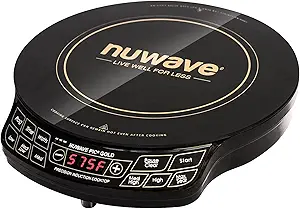
Nuwave Gold Precision Induction Cooktop
The Nuwave Gold occupies a different niche than the power-focused entries here. Its 96 pre-programmed settings make it the closest thing to a set-and-forget instrument for finicky tasks — melting chocolate without scorching, holding a hollandaise, warming milk. The shatter-proof ceramic glass top is tougher than the tempered glass on the Amazon Basics model, a real advantage in busy households. On-the-fly temperature and timer adjustments beat the pause-and-restart workflow of simpler units. The catch: at 1500 watts it’s the weakest burner in this batch, so big-pot pasta water will test your patience compared with the 1800W AMZCHEF. It’s also priced above basic models, which stings if you only boil and fry.
Pros:- 96 pre-programmed settings excel at delicate, low-heat tasks
- Shatter-proof ceramic glass surface is durable and safe
- Temperature and timer adjustable on the fly
- Energy-efficient electromagnetic heating
Cons:- 1500W output is the lowest in this lineup
- Premium pricing relative to basic single burners
Best for: Bakers and sauce-makers who need exact low-heat control more than raw boiling power
Not ideal for: High-volume cooks — 1500 watts struggles with large stockpots and rapid searing
- Wattage:1500 watts
- Heating Elements:1
- Controls:Touch
- Preset Settings:96 pre-programmed
- Surface Material:Shatter-proof ceramic glass
- Voltage:120 volts
- Dimensions:12″ D x 14.25″ W x 4.5″ H
Our verdict“Worth it for precision-focused cooks who treat temperature control as the whole point; skip it if you mostly boil water.”
AMZCHEF Portable Induction Cooktop, 20 Temperature & Power Levels, 1800W
The AMZCHEF single burner splits the difference between the stripped-down Amazon Basics unit and the program-heavy Nuwave Gold. Its 20 power and temperature levels give you the fine-grained adjustment the basics model lacks, without the Nuwave’s price premium or preset overload — you get precision without a manual-reading session. At 5.5 pounds and under 2 inches tall, it travels better than most, and the waste heat reminder is a thoughtful safety touch for households with curious hands. Compared with the Nuwave Double Pro, you obviously give up the second zone, and 1800W caps out for high-demand jobs like wok-style cooking. Cookware needs a magnetic base, and the ceramic top demands flat-bottomed pans for best contact.
Pros:- 20 power and temperature levels enable genuinely precise tuning
- Full 1800W output for fast boiling and frying
- Lightweight 5.5-pound build stores and travels easily
- Safety lock plus waste heat reminder protect kids and careless hands
Cons:- 1800W ceiling limits high-demand tasks like aggressive searing
- Performance depends heavily on flat, magnetic cookware
Best for: Detail-oriented cooks who want 20-level adjustability and solid 1800W power at a midrange price
Not ideal for: Anyone needing serious searing headroom or dual burners — a single 1800W zone has a ceiling
- Wattage:1800W
- Voltage:120V
- Controls:Touch
- Adjustment Levels:20 power and temperature levels
- Surface:Ceramic glass
- Heating Elements:1
- Dimensions:13.8″ x 11.0″ x 1.8″
- Weight:5.5 pounds
Our verdict“A strong middle path for cooks who find budget burners too coarse and premium models too complicated.”
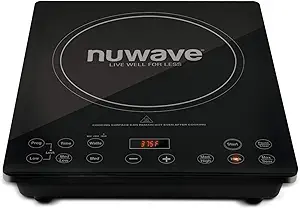
Nuwave Pro Chef Induction Cooktop, Commercial-Grade Portable Burner
Where most portable burners in this roundup—including the Duxtop 9100MC—offer 20 preset levels, the Nuwave Pro Chef goes far deeper with 94 adjustable temperature settings spanning 100°F to 575°F. That granularity matters for anyone doing low-and-slow simmering, chocolate work, or searing at the top of the range, where a 20-step increment can overshoot by 25 degrees or more. The shatter-proof ceramic glass also feels more durable than the ABS-and-glass construction on the Duxtop models. Compared with the ChangBERT below, it trades NSF certification and a stainless housing for finer control and a wider temperature ceiling. The cost of that precision is price—commercial-grade features push it above basic single-burner units—and it still demands induction-compatible cookware.
Pros:- 94 adjustable temperature settings for near-lab-grade control
- Huge 100°F to 575°F range covers simmering through searing
- Shatter-proof ceramic glass survives rough RV and campsite use
- Three wattage settings (900/1500/1800W) adapt to limited circuits
Cons:- Premium price for features most casual cooks won’t use
- Only works with magnetic cookware
- Single burner requires a nearby outlet at all times
Best for: Serious home cooks and small-scale professionals who need exact temperature control for delicate or high-heat techniques
Not ideal for: Budget buyers or occasional cooks who won’t notice the difference between 94 settings and 20
- Temperature Range:100°F to 575°F
- Temperature Settings:94 adjustable
- Wattage Settings:900 / 1500 / 1800 watts
- Material:Shatter-proof ceramic glass
- Technology:Induction with patented insulation
- Portability:Lightweight; suits RVs, dorms, campsites
Our verdict“Buy it if temperature precision is the whole point of your cooking; skip it if a 20-level burner already covers your needs.”
ChangBERT Induction Cooktop, Commercial Grade Portable Cooker, 8” Heating Coil, NSF Certified, 1800W
This is the only NSF-certified model in the batch, which is exactly why it exists: health-department approval means it can legally serve in food trucks, catering setups, and restaurant kitchens where the Duxtop 9100MC or Nuwave Pro Chef can’t. The stainless steel housing wipes down fast and shrugs off commercial abuse, and a 100-pound load capacity comfortably holds stockpots that would worry lighter plastic-bodied units. The 8-inch coil also gives it a larger effective heating area than the standard 6.5-inch coils on the Nuwave Flex. What you give up is refinement—its 18 temperature settings are far coarser than the Nuwave Pro Chef’s 94, and there’s no stated cookware compatibility guidance, so buyers must verify their own pots.
Pros:- NSF, UL, and ETL certifications for professional/commercial use
- Stainless steel housing built for heavy daily abuse and easy cleaning
- 100-pound load capacity handles large commercial stockpots
- 10-hour timer supports long unattended simmering and holding
Cons:- 120V only—cannot run on 240V commercial circuits
- 18 temperature settings feel coarse next to precision models
- Commercial-grade build carries a commercial-grade price
Best for: Food truck operators, caterers, and restaurant kitchens that need certified, sanitize-on-the-fly equipment
Not ideal for: Home cooks paying a commercial premium for certifications they’ll never need
- Wattage:1800W
- Voltage:120V
- Power Levels:9 preset
- Temperature Settings:18
- Heating Coil:8-inch induction
- Material:Stainless steel
- Certifications:NSF, UL, ETL
- Maximum Load:100 pounds
- Timer:Up to 10 hours
Our verdict“If a health inspector will ever look at your cooktop, this is the one; otherwise cheaper home models do the job.”
Nuwave PIC Double Portable Induction Cooktop
Two burners change what a portable cooktop can do, and the Nuwave PIC Double delivers two independent 8-inch zones on a single cord—something the single-burner Duxtop 9100MC and Nuwave Pro Chef simply can’t match. That means you can simmer a sauce on one side while pasta boils on the other, which matters enormously for dorm rooms, vacation rentals, and holiday overflow cooking. The dynamic watt management splits its 1800W between zones intelligently rather than tripping breakers, and 106 temperature settings rival the Pro Chef’s precision. The honest tradeoff: at 15.7 pounds and nearly two feet wide, this stops being genuinely portable. If you only occasionally need a second burner, the AMZCHEF double with griddle pan bundles more value for occasional entertaining.
Pros:- Two independent heating zones from one outlet
- 106 temperature settings across 50°F to 575°F
- Dynamic watt technology prevents circuit overload when both zones run
- Seamless ceramic glass surface wipes clean in one pass
Cons:- Nearly 16 pounds and 24 inches wide—barely portable
- Both zones share 1800W total, so simultaneous high-heat cooking is limited
- 115V requirement restricts use in older or non-North-American wiring
Best for: Dorm residents, vacation-home owners, and holiday cooks who need two burners without a full stove
Not ideal for: Campers and RVers—the weight and footprint defeat the point of portable cooking on the road
- Heating Elements:2 independent 8-inch zones
- Wattage:1800 watts (shared)
- Temperature Settings:106, from 50°F to 575°F
- Controls:Push button
- Material:Ceramic glass
- Dimensions:14.1″D x 23.6″W x 2.6″H
- Weight:15.7 pounds
- Max Load per Zone:25 pounds
Our verdict“The right pick when two burners are the requirement and counter space is the compromise; wrong if you actually carry your cooktop anywhere.”
Duxtop 1800W Portable Induction Cooktop Countertop Burner, Black 9100MC
The Duxtop 9100MC is the straightforward pick: 1800W of power, 20 preset power and temperature levels, and a 6.2-pound body that goes from drawer to counter in seconds. It doesn’t chase the Nuwave Pro Chef’s 94-setting precision or the ChangBERT’s commercial certifications, and most cooks won’t miss either. What it does deliver is the same fast, efficient induction heating at a friendlier price, with auto-pan detection that cuts power the moment a pot lifts. Its 83% energy efficiency beats any radiant electric plate. The compromises are familiar: magnetic cookware of at least 5 inches diameter is mandatory, the glass surface stays hot after cooking, and there’s no timer—something the Duxtop LCD model below includes.
Pros:- 20 preset power and temperature levels cover everyday cooking
- Featherweight 6.2-pound body stores anywhere
- Auto-pan detection saves energy and adds safety
- 83% energy efficiency outperforms electric coil and radiant plates
Cons:- No built-in timer, unlike similarly priced rivals
- Surface remains hot after use—a real hazard with kids around
- Requires magnetic cookware at least 5 inches in diameter
Best for: First-time induction buyers and budget-conscious cooks who want reliable performance without paying for extras
Not ideal for: Anyone who needs a timer, child lock, or fine temperature control for delicate cooking
- Wattage:1800 watts
- Voltage:120 volts
- Presets:20 power/temperature levels
- Controls:Push button
- Energy Efficiency:83%
- Dimensions:12.7″D x 16.3″W x 3.8″H
- Weight:6.2 pounds
Our verdict“The sensible default single burner—buy it unless a timer or safety lock is non-negotiable.”
Duxtop Portable Induction Cooktop, 1800W, Black
Think of this Duxtop as the 9100MC upgraded for households with kids: it adds a child safety lock, a built-in digital timer up to 10 hours, and a modern LCD touch panel that’s easier to read than the 9100MC’s push buttons. Those additions cost a little more, but they solve the two biggest complaints about basic induction burners—accidental activation and forgotten pans. Its 20 power levels and 100°F–460°F range match the 9100MC, though the ceiling falls short of the Nuwave Pro Chef’s 575°F, so hard searing is weaker here. The honest quirk with this and most induction units: layered or tri-ply cookware can emit a high-pitched whine during operation, which is worth knowing before you buy.
Pros:- Child safety lock prevents curious hands from turning it on
- Digital LCD timer runs up to 10 hours for unattended cooking
- Touch controls are clearer and faster than button alternatives
- Auto-pan detection shuts off heat when cookware is removed
Cons:- Temperature tops out at 460°F, below searing-grade rivals
- High-pitched noise can occur with layered cookware
- Same 5-inch magnetic cookware minimum as cheaper models
Best for: Parents and caregivers who need lockable controls and timed cooking in a compact burner
Not ideal for: Serious searers and stir-fry cooks—the 460°F ceiling limits high-heat techniques
- Power:1800W
- Voltage:120V
- Temperature Range:100°F to 460°F
- Power Levels:20
- Timer:Up to 10 hours
- Controls:Digital LCD touch panel
- Cord Length:5 ft
- Safety Features:Child safety lock, auto-pan detection
Our verdict“Worth the small premium over the 9100MC if a child lock and timer matter in your kitchen; otherwise stick with the cheaper unit.”

How We Picked
I ranked these 15 induction cooktops on four buyer-relevant criteria rather than spec-sheet one-upmanship. Heating performance came first: coil diameter (larger coils heat pans more evenly and tolerate bigger cookware), sustained power delivery, and how honestly each model handles its wattage ceiling. Control precision was second — the number of power and temperature levels, whether settings are direct-entry or scroll-through, and whether a probe or timer adds genuine cooking value. Usability and safety covered panel readability, child locks, auto shutoff, and error codes for incompatible cookware. Finally, build quality and value judged whether each model’s construction and feature set justified its position against near-identical rivals.
The ranking logic is straightforward: models that combined broad capability with few compromises sit at the top, while niche specialists earn slots based on how well they serve their specific buyer. Because several units here share the same 1800W rating and near-identical feature lists, small differentiators — coil size, temperature range width, panel design, included accessories — decided the ordering. Double-burner and commercial models were judged against their own class, since splitting power across zones changes what they can realistically do.
Factors to Consider When Choosing Induction Cooktops
Choosing between induction cooktops is less about wattage and more about matching a model’s design choices to how you actually cook. These are the factors that separated winners from near-misses in this comparison.Wattage Means Less Than You Think
Nearly every portable induction cooktop sold in North America tops out at 1800W because that’s the safe maximum on a standard 120V household circuit — so don’t let wattage drive your decision when comparing models in this class. What actually varies is how efficiently each unit converts that power into heat, which depends on coil diameter, pan contact, and the electronics behind the panel. A larger coil (8 inches versus 6.5) distributes energy across more of the pan base, reducing hot spots and letting large skillets heat evenly. Double-burner models split their 1800W between zones, which means each burner may run well below full power when both are active — fine for simmering two sauces, frustrating for searing two steaks. A common mistake is buying a dual unit expecting full power on both burners simultaneously; check whether the model shares power across zones before assuming otherwise.
Temperature Range and Control Granularity
Induction’s biggest advantage over gas and radiant electric is precise, repeatable temperature control — but only if the model exposes it well. Basic units offer 8–10 power levels, which is enough for boiling and frying but coarse for melting chocolate or holding a simmer. Models with 20 temperature levels or wide ranges (like Nuwave’s 50°F–575°F span) give you repeatable results for low-heat tasks such as yogurt, sous-vide-style cooking, or keeping food warm without overcooking. Probe-equipped models go further by holding food itself at a set temperature rather than the pan surface. The tradeoff: more granular controls usually mean more buttons and a steeper learning curve. If you mostly boil water and cook dinner quickly, paying extra for 20 levels is money spent on capability you’ll never touch.
Cookware Compatibility
Induction only works with magnetic cookware — cast iron, most stainless steel, and enamel-coated iron — and this is the single most common disappointment for first-time buyers. Glass, copper, aluminum, and non-magnetic stainless pans will trigger error codes or simply not heat. Test your existing pans with a refrigerator magnet: if it sticks firmly to the base, the pan will work. Also check pan base diameter against the cooktop’s coil size, because most units shut off or underperform with undersized cookware. If your cookware collection is mostly aluminum nonstick, factor the cost of replacing two or three key pans into your budget. Some models in this lineup include a griddle or note compatible diameters clearly, which saves trial and error.
Single Burner Versus Double
The choice between one and two burners shapes everything else about the purchase. A single-burner unit gives you full power in one zone, a smaller footprint, and simpler storage — the right call if you’re adding a burner to a small kitchen, RV, or dorm, or need an extra zone during holiday cooking. A double cooktop replaces more of a full stove and suits apartments, vacation homes, and catering setups, but the shared power budget means slower high-heat work, and the wider footprint needs real counter space. Buyers frequently underestimate ventilation and outlet placement too: doubles need clear access to a dedicated outlet and shouldn’t share a circuit with other appliances. If you regularly cook multi-dish meals, a double is worth the compromise; if you mostly need one fast burner, a single will outperform it for less money.
Durability, Noise, and Fan Behavior
Every induction cooktop has an internal cooling fan, and fan noise and cycling behavior vary more than spec sheets suggest. Cheap fans run constantly and loudly; better models modulate fan speed with heat load and go quiet at low settings. Build quality shows up in the glass-ceramic top (resistant to scratches and thermal shock), the housing rigidity, and how well buttons survive daily use. Commercial-grade models justify their premium with heavier coils, reinforced housings, and electronics rated for hours of continuous high-power use — a genuine benefit for heavy cooks, overkill for occasional use. Also look for safety features that matter in real kitchens: auto shutoff when cookware is removed, overheat protection, lockable panels around kids, and spill-tolerant touch controls.
Where This Unit Fits in Your Kitchen
Before buying, be honest about the use case. Portable induction excels as an extra burner, a primary stove replacement for small spaces, or a precision tool for low-heat cooking — but it’s a poor fit if you expect gas-style responsiveness with arbitrary cookware. Think about storage too: single units slide into a cabinet easily, while doubles need dedicated counter or shelf space. If you’re replacing a stove entirely, plan for at least one high-power single plus a double, rather than one dual unit doing everything. And if you cook for crowds or run long simmering projects, prioritize models with long timers and stable low-end temperature control over maximum-boil speed, since sustained low heat is where cheap units wobble most.
Frequently Asked Questions
Do all induction cooktops need special cookware?
Yes — every model in this roundup requires magnetic cookware, because induction heats the pan itself through a magnetic field rather than heating a surface. Cast iron, most tri-ply stainless steel, and enameled iron work; aluminum, copper, glass, and non-magnetic stainless steel will not. A quick test with a refrigerator magnet on the pan base tells you everything: firm stick means compatibility. Pan base diameter also matters, since most units detect undersized cookware and either refuse to heat or cycle erratically. If you’re starting from a fully aluminum nonstick collection, budget for at least one or two induction-ready replacements before your cooktop arrives.
Is a double induction cooktop as powerful as two separate burners?
Usually not, and this is the most common misconception in the category. Most portable double units — including the dual models in this comparison — draw from the same 1800W circuit and split that power between zones, so running both burners means each gets a fraction of full power. That’s perfectly fine for simmering a sauce while keeping a pot warm, but it makes simultaneous high-heat searing or two rapid boils impractical. Two separate single-burner units on two different circuits will outperform one double for heavy parallel cooking, at the cost of counter space and two power cords. Choose a double for convenience and space savings, not for doubled power.
Are more temperature and power levels actually worth paying for?
It depends entirely on what you cook. If your routine is boiling pasta, frying eggs, and searing at high heat, eight to ten power levels are plenty, and a simpler panel will feel faster to use. The value of twenty levels and wide temperature ranges shows up in low-heat work: melting chocolate, holding a sauce below a simmer, slow-scrambling eggs, or maintaining a precise water bath. Probe-equipped models add another layer by regulating food temperature rather than pan temperature, which matters for holding cooked food or gentle reheating. Paying for granularity you won’t use just adds buttons to press; skipping it when you do delicate work means frustration and scorched dishes.
Can I use a portable induction cooktop as my main stove?
You can, and many people in small apartments, studios, and vacation homes do — but plan for the tradeoffs. A single unit means one cooking zone, so multi-dish meals require sequencing or a second burner. Power sharing and circuit limits mean you shouldn’t run an induction cooktop and a microwave or kettle on the same outlet without expecting a tripped breaker. Induction also demands compatible cookware and a flat, stable surface with clearance for the cooling fan. For one or two people, a quality single plus a double unit covers nearly everything a full stove does, with faster boiling and easier cleanup as bonuses.
Why do commercial-grade models cost more when they have the same 1800W rating?
The premium buys durability and sustained performance, not raw power. Commercial-grade units like the NSF-certified models in this lineup use heavier copper coils, reinforced housings, and electronics rated to run at high power for hours without thermal throttling — consumer models often dial back output as they warm up during long sessions. Commercial units also typically skip convenience features like presets, timers, and touch panels, replacing them with rugged physical controls that survive heavy use. For someone who cooks intensively every day or runs a small food operation, that reliability pays for itself. For a household cooking dinner a few nights a week, the extra money buys durability you’ll never stress.
Conclusion
The right induction cooktop depends less on specs and more on how you cook. For most buyers, the Duxtop 9100MC is the best overall choice: full 1800W power, straightforward controls, and a track record of reliability make it the safest all-around pick in this lineup. If budget leads the decision, the Amazon Basics 1800W model delivers the core induction experience — solid power, child lock, overheat protection — without paying for features you may not use, with the Duxtop 8100MC Gold as a stylish step up at a still-modest price.
For precision-minded cooks, the Nuwave line splits by need: the Flex suits beginners with its small coil and simple operation, the Probe model handles low-and-slow temperature work, and the Double Pro covers two-zone precision cooking. The Nuwave Pro Chef and NSF-certified ChangBERT are the premium picks for heavy daily use, trading convenience features for sustained commercial-grade performance. Families and small-space cooks who want real two-burner capability should look at the AMZCHEF Double with griddle or the Nuwave PIC Double, keeping in mind the shared power budget. Whichever direction you take, check your cookware with a magnet first — that single step prevents the most common disappointment in induction cooking.