For most interchangeable-lens camera users, the DJI RS 4 Mini is my best overall pick: it brings three-axis stabilization in a smaller package than full-size rigs. Phone creators can get a more purpose-built option from the DJI Osmo Mobile 8, while the ChromLives handle grip suits simple, low-cost support without motors. The main tradeoff is between a light, uncomplicated grip and a powered gimbal that needs balancing, charging, and a compatible payload. Camera weight and whether you shoot on a phone, action camera, or mirrorless body matter more than the word “stabilizer” on the box. Read on for all 14 picks, their distinct roles, and the factors that can help you choose.

Get kitchen staples and gadgets delivered free with Prime
- Fast, free delivery on millions of items
- Prime Video, Amazon Music and more included
- Member-only deals all year
Key Takeaways
- The roundup spans two different approaches: simple grips such as ChromLives and Zeadio add a steadier handhold, while DJI, Hohem, and FeiyuTech gimbals actively stabilize movement.
- The DJI RS 4 Mini is the strongest middle ground for many camera users because it offers powered stabilization in a more compact class than the DJI RS 4.
- Phone users have dedicated options across the DJI Osmo Mobile 7 and 8 and Hohem iSteady X3 SE; camera gimbals are not automatic upgrades for smartphone shooting.
- The Zeadio All-in-One kit bundles a light, microphone, and phone holder, while the triple cold-shoe grip gives accessory-heavy setups room to grow without motors.
- Payload fit separates the camera gimbals: check the camera, lens, and accessories as a complete rig before choosing among the RS 3 Mini, RS 4 Mini, SCORP models, and RS 4.
| ChromLives Universal Camera Handle Grip Stabilizer with 1/4″ Male Screw |  | Best Simple Grip | Brand: ChromLives | Model: Handle Grip | Mounting screw: 1/4-inch male | VIEW ON AMAZON | See Our Full Breakdown |
| AFUNTA Pro Handheld Video Camera Stabilizer for DSLR, Camcorder, GoPro, Canon, Nikon, Sony, and Smartphones (up to 2.1 lbs) |  | Best Counterweighted Handheld Pick | Maximum load: 2.1 lbs | Mount: 1/4-inch screw | Handle: Comfort grip | VIEW ON AMAZON | See Our Full Breakdown |
| Zeadio All-in-One Video Handheld Stabilizer Kit with LED Light, Microphone & Phone Holder |  | Best Complete Vlogging Rig | Model: DV-HDE-UG28 | Included items: Handheld stabilizer, LED light, microphone, phone mount, action-camera adapter | Mounts: 3 cold shoes and 2 x 1/4-inch screw mounts | VIEW ON AMAZON | See Our Full Breakdown |
| Zeadio Video Action Stabilizing Handle Grip with Cold-Shoe Mount for DSLR Cameras and Camcorders |  | Best for Low-Angle Filming | Camera mount: Standard 1/4-20 thread | Accessory mount: Cold shoe | Handle material: Cushioned NBR padding | VIEW ON AMAZON | See Our Full Breakdown |
| DJI RS 3 Mini Camera Gimbal Stabilizer |  | Best Compact Motorized Gimbal | Weight in portrait mode: 795 g | Weight with horizontal arm: 850 g | Payload capacity: 0.4–2 kg | VIEW ON AMAZON | See Our Full Breakdown |
| DJI Osmo Mobile 7 Smartphone Gimbal Stabilizer |  | Best for Beginner Smartphone Filmmakers | Weight: 300 g | Stabilization: 3-axis gimbal | Battery life: Up to 10 hours | VIEW ON AMAZON | See Our Full Breakdown |
| DJI RS 4 Mini Camera Gimbal Stabilizer |  | Best Compact Gimbal for Mirrorless Cameras | Payload capacity: 2 kg / 4.4 lb | Setup: 1 second with automatic axis locks | Vertical switch: About 10 seconds | VIEW ON AMAZON | See Our Full Breakdown |
| Zeadio Handheld Stabilizer with Triple Cold-Shoe Mount for Cameras and Smartphones |  | Best for Accessory-Heavy Action Rigs | Model: DV-HDE-TG17 | Mounting thread: Standard 1/4-20 | Cold-shoe mounts: 3 | VIEW ON AMAZON | See Our Full Breakdown |
| DJI Osmo Mobile 8 Gimbal Stabilizer for Phone, 3-Axis Stabilization |  | Best All-in-One Smartphone Vlogging Gimbal | Stabilization: 3-axis | Battery life: Up to 10 hours | Pan rotation: 360° | VIEW ON AMAZON | See Our Full Breakdown |
| Hohem iSteady X3 SE 3-Axis Gimbal Stabilizer for iPhone & Android, Black |  | Best Compact Value Pick | Stabilization: 3-axis, iSteady 8.0 | Weight: 0.79 lb | Payload capacity: 0.66 lb | VIEW ON AMAZON | See Our Full Breakdown |
| FeiyuTech SCORP Mini 3 Pro 3-Axis Gimbal Stabilizer | 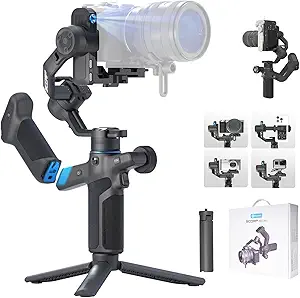 | Best for Multi-Device Shooters | Stabilization: 3-axis | Payload capacity: 4.4 lb (2 kg) | Compatibility: Mirrorless cameras, compact cameras, smartphones, and action cameras | VIEW ON AMAZON | See Our Full Breakdown |
| FeiyuTech SCORP 2 Gimbal Stabilizer for DSLR and Mirrorless Cameras |  | Best for Camera Control | Stabilization: 3-axis | Maximum payload: 2500 g | Display: 1.3-inch touchscreen | VIEW ON AMAZON | See Our Full Breakdown |
| DJI RS 4 Camera Gimbal Stabilizer for Canon, Sony, Nikon & Fujifilm |  | Best for Heavier Camera Rigs | Stabilization: 3-axis | Payload capacity: 3 kg (6.6 lb) | Battery runtime: Up to 12 hours with BG21; up to 29.5 hours with separately sold BG70 | VIEW ON AMAZON | See Our Full Breakdown |
| DJI RS 4 Mini Combo Camera Gimbal Stabilizer |  | Best for Fast Solo Setups | Payload capacity: 2 kg (4.4 lb) | Setup: Auto axis locks; 1 second | Vertical shooting switch: 10 seconds | VIEW ON AMAZON | See Our Full Breakdown |
| camera stabilizer | Stabilization |
|---|---|
| ChromLives Universal Camera Ha | — |
| AFUNTA Pro Handheld Video Came | — |
| Zeadio All-in-One Video Handhe | — |
| Zeadio Video Action Stabilizin | — |
| DJI RS 3 Mini Camera Gimbal St | 3rd-generation RS stabilization algorithm |
| DJI Osmo Mobile 7 Smartphone G | 3-axis gimbal |
| DJI RS 4 Mini Camera Gimbal St | — |
| Zeadio Handheld Stabilizer wit | — |
| DJI Osmo Mobile 8 Gimbal Stabi | 3-axis |
| Hohem iSteady X3 SE 3-Axis Gim | 3-axis, iSteady 8.0 |
| FeiyuTech SCORP Mini 3 Pro 3-A | 3-axis |
| FeiyuTech SCORP 2 Gimbal Stabi | 3-axis |
| DJI RS 4 Camera Gimbal Stabili | 3-axis |
| DJI RS 4 Mini Combo Camera Gim | — |
More Details on Our Top Picks
ChromLives Universal Camera Handle Grip Stabilizer with 1/4″ Male Screw
The ChromLives Handle Grip is a basic handhold for adding control to handheld shooting, not a gimbal that levels out camera movement. Its metal body and rubber surface give you a secure-feeling grip, while the standard 1/4-inch screw works with many cameras and accessories. Compared with the Zeadio Video Action Stabilizing Handle Grip, it lacks a cold shoe for mounting a light or microphone, so it suits a stripped-down setup better. It also takes less setup than the AFUNTA Pro Handheld Video Camera Stabilizer, but offers no gimbal or counterweight to smooth motion. The tradeoff is straightforward: this is an inexpensive-in-complexity way to hold a camera more comfortably, provided you already have any adapters you need.
Pros:- Metal construction with an anti-slip rubber surface
- Standard 1/4-inch male screw supports a range of compatible gear
- Ergonomic grip can make handheld shooting more comfortable
Cons:- Does not provide gimbal or active stabilization
- Phone and action-camera mounts are not included
- A ball head is needed for 360-degree rotation
Best for: Camera owners who want a comfortable, minimal handle for a 1/4-inch-compatible camera or accessory
Not ideal for: Creators who need active motion smoothing, accessory mounting, or a ready-to-use phone or action-camera adapter
- Brand:ChromLives
- Model:Handle Grip
- Mounting screw:1/4-inch male
- Material:Metal with rubber surface
- Manufacturer part number:1125
- Warranty:1 year
Our verdict“Choose the ChromLives for a simple, comfortable camera handle if you already have the adapters your setup needs.”
AFUNTA Pro Handheld Video Camera Stabilizer for DSLR, Camcorder, GoPro, Canon, Nikon, Sony, and Smartphones (up to 2.1 lbs)
The AFUNTA Pro adds a gimbal and adjustable counterweight to a handheld rig, giving light cameras a mechanical way to steady motion. Its 2.1-pound maximum load makes it a better fit for a phone, action camera, or DSLR with a light lens than a heavier camera kit. Compared with the simple ChromLives Handle Grip, AFUNTA takes more effort to balance but is built to manage movement rather than only improve your hold. The DJI RS 3 Mini offers motorized stabilization and a much higher payload, though it is a more involved electronic system. AFUNTA’s manual setup keeps things simple once balanced, but fine-tuning can introduce some shake, and heavier camera combinations are outside its stated limit.
Pros:- Gimbal and adjustable counterweight support manual balancing
- Accepts compatible cameras through a standard 1/4-inch screw
- Comfort grip handle suits handheld operation
- Designed for several light camera types, including phones and action cameras
Cons:- Maximum supported setup weight is 2.1 pounds
- Fine-tuning can cause slight shake
- Requires balancing and adjustment for the camera setup
Best for: Beginners with a lightweight camera, phone, or action camera who want a manually balanced handheld stabilizer
Not ideal for: Hybrid shooters using heavier mirrorless bodies or long lenses, or anyone seeking motorized stabilization
- Maximum load:2.1 lbs
- Mount:1/4-inch screw
- Handle:Comfort grip
- Counterweight:Adjustable polished chrome
- Color options:Red, silver, or black
Our verdict“Pick AFUNTA if your camera setup is light and you prefer a manual gimbal and counterweight over a basic handle.”
Zeadio All-in-One Video Handheld Stabilizer Kit with LED Light, Microphone & Phone Holder
The Zeadio All-in-One Kit is the most ready-to-build handheld setup here: it includes a light, microphone, phone holder, and action-camera adapter alongside its grip. Three cold shoe mounts and two 1/4-inch mounts let you arrange accessories without sourcing as many parts separately. Its LED has adjustable brightness and color temperature, giving vloggers more control over mixed lighting than the simpler Zeadio Video Action Stabilizing Handle Grip, which provides only a cold shoe. This is still a handheld rig, not a motorized gimbal like the DJI RS 3 Mini; the grip may help with handling, but it cannot independently level camera movement. The recommended maximum weight is 500 g, so bulky camera-and-accessory combinations are a poor match. The microphone also needs its TRRS cable connected correctly.
Pros:- Includes an LED light, microphone, phone holder, and action-camera adapter
- Three cold shoes and two 1/4-inch mounts offer flexible accessory placement
- LED brightness and color temperature are adjustable
- Grip and included accessories support a compact creator setup
Cons:- Recommended maximum setup weight is 500 g
- Handheld grip does not provide motorized stabilization
- Microphone needs a correctly connected straight TRRS cable
Best for: Phone and lightweight-camera vloggers who want a grip, light, microphone, and mounting points in one kit
Not ideal for: Creators with heavier camera rigs or anyone who needs motorized stabilization for walking shots
- Model:DV-HDE-UG28
- Included items:Handheld stabilizer, LED light, microphone, phone mount, action-camera adapter
- Mounts:3 cold shoes and 2 x 1/4-inch screw mounts
- Recommended maximum weight:500 g
- LED brightness:800 lux at 0.5 m
- Color temperature:3000K–7000K
- Brightness range:10%–100%
- CRI:95+
- Warranty:1 year
Our verdict“Choose this Zeadio kit for a lightweight vlogging setup with built-in lighting and audio accessories, provided you do not need a motorized gimbal.”
Zeadio Video Action Stabilizing Handle Grip with Cold-Shoe Mount for DSLR Cameras and Camcorders
The Zeadio Video Action Stabilizing Handle Grip is aimed at low-angle filming, where holding a camera from below can be more practical than gripping the body. Its padded handle is designed to reduce hand fatigue, and the cold shoe mount gives you a place for a small accessory such as a light or microphone. Unlike the ChromLives Handle Grip, it has that built-in accessory mount; unlike the Zeadio All-in-One Kit, it does not bundle a light, microphone, or phone holder. That keeps this option focused, but the word “stabilizing” should not be mistaken for active stabilization: there is no gimbal or motor to counter walking movement. It makes more sense for controlled low-angle takes and action-style handheld framing than for footage that needs a level, floating look.
Pros:- Standard 1/4-20 thread fits compatible cameras and camcorders
- Cold shoe supports a compatible light or microphone
- Cushioned NBR handle is suited to longer handheld sessions
- Designed for low-angle and action-style filming
Cons:- No gimbal or active stabilization mechanism
- Does not include lighting, audio gear, or a phone holder
- Handheld movement can still appear in footage
Best for: DSLR and camcorder owners filming low-angle scenes who want a padded handle and one accessory shoe
Not ideal for: Walk-and-talk shooters who need active stabilization or creators who want a complete accessory kit
- Camera mount:Standard 1/4-20 thread
- Accessory mount:Cold shoe
- Handle material:Cushioned NBR padding
- Compatibility:Cameras and camcorders with a 1/4-20 thread
Our verdict“Pick this Zeadio handle for low-angle camera work and accessory mounting, not for smoothing walking footage.”
DJI RS 3 Mini Camera Gimbal Stabilizer
The DJI RS 3 Mini is the motorized choice in this group, built for mirrorless camera combinations weighing up to 2 kg. Its three-axis stabilization can counter camera movement in a way the handheld AFUNTA Pro and the two Zeadio grips cannot. At 795 g in portrait mode, it is designed to be carried more easily than a larger camera gimbal, while native vertical shooting makes social video framing more direct. Bluetooth shutter control and a touchscreen add camera-side convenience, though compatibility depends on the camera and lens combination. The tradeoffs are setup and activation: it requires the DJI Ronin app, and its payload is lower than the full-size DJI RS 3. Buyers who only need a simple grip will find this more equipment than they need.
Pros:- Three-axis motorized stabilization for compatible mirrorless setups
- Lightweight design at 795 g in portrait mode
- Native vertical shooting supports social-video framing
- Touchscreen and Bluetooth shutter control add onboard convenience
Cons:- Maximum payload is 2 kg, below the full-size DJI RS 3
- Requires the DJI Ronin app for activation
- Camera and lens compatibility depends on the specific combination
Best for: Traveling mirrorless shooters who want motorized stabilization, vertical shooting, and a lighter gimbal for compatible camera setups
Not ideal for: Owners of camera and lens combinations above 2 kg, or buyers who only need a basic handheld grip
- Weight in portrait mode:795 g
- Weight with horizontal arm:850 g
- Payload capacity:0.4–2 kg
- Screen:1.4-inch full-color touchscreen
- Connectivity:Bluetooth shutter control
- Compatible camera brands:Canon, Sony, Nikon, Fujifilm
- Stabilization:3rd-generation RS stabilization algorithm
- Activation app:DJI Ronin app
Our verdict“Choose the RS 3 Mini if you need motorized stabilization in a travel-friendly package and your camera setup fits its 2 kg payload.”
DJI Osmo Mobile 7 Smartphone Gimbal Stabilizer
The Osmo Mobile 7 is the easiest fit here for someone who wants steadier phone footage without building a camera rig. Its 3-axis stabilization and ActiveTrack 7.0 help keep moving subjects framed, while ShotGuides and One-Tap Edit in DJI Mimo give beginners a guided route from filming to a finished clip. The built-in tripod is handy for solo recording, and the foldable body keeps it more travel-friendly than the handle-based Zeadio stabilizers. Compared with the newer Osmo Mobile 8, though, this model lacks the listed built-in extension rod, audio reception, and lighting, so it is a simpler setup rather than an all-in-one vlogging kit. Android users should also account for DJI Mimo being distributed outside Google Play, and some tracking accessories are separate.
Pros:- Three-axis stabilization smooths handheld phone footage
- ActiveTrack 7.0 with dual-lens tracking helps keep subjects framed
- Built-in tripod supports hands-free recording
- Up to 10 hours of operation with USB-C phone charging
Cons:- DJI Mimo must be downloaded from DJI’s website rather than Google Play
- Tracking Kit and Multifunctional Module are sold separately
- Lacks the Osmo Mobile 8’s listed extension rod, audio reception, and lighting
Best for: New smartphone video creators who want guided shooting features, subject tracking, and a built-in tripod for solo clips
Not ideal for: Android users who prefer installing apps only through Google Play, or vloggers who want integrated lighting and audio features
- Weight:300 g
- Stabilization:3-axis gimbal
- Battery life:Up to 10 hours
- Tracking:ActiveTrack 7.0, dual-lens tracking
- Design:Foldable with built-in tripod
- Charging:USB-C; can charge a phone
- Compatibility:iPhone and Android
- Included:Gimbal and Magnetic Phone Clamp 4
Our verdict“Choose the Osmo Mobile 7 for beginner-friendly phone filming and tracking if you can work with DJI’s app download process.”
DJI RS 4 Mini Camera Gimbal Stabilizer
The RS 4 Mini is the camera-focused choice in this group: its 2 kg payload accommodates supported mirrorless and vlog camera setups, while automatic axis locks shorten setup between takes. Teflon-enhanced balancing is intended to make balancing adjustments smoother, and the 10-second vertical switch helps creators change framing for portrait content without rebuilding the rig. That makes it more versatile for camera work than the phone-only Osmo Mobile 7, but it is still a compact system with a firm payload ceiling. Heavier camera bodies or lens combinations may exceed its capacity, where the larger DJI RS 4 is a better fit. Intelligent tracking and smartphone support add flexibility, though the DJI Ronin app download requirement may add friction for Android users.
Pros:- Supports compatible camera setups up to 2 kg
- Automatic axis locks enable a quick setup
- Switches to vertical shooting in about 10 seconds
- Includes a tripod and essential accessories
Cons:- The 2 kg payload limit excludes many heavier camera and lens combinations
- DJI Ronin app must be downloaded from DJI’s website rather than Google Play
- More involved than a phone gimbal for buyers who only film on smartphones
Best for: Solo creators using a compatible lightweight mirrorless or vlog camera who regularly switch between landscape and vertical video
Not ideal for: Filmmakers with heavier camera-and-lens combinations that approach or exceed the 2 kg payload limit
- Payload capacity:2 kg / 4.4 lb
- Setup:1 second with automatic axis locks
- Vertical switch:About 10 seconds
- Compatible brands:Canon, Sony, Nikon, Fujifilm
- Supported devices:Mirrorless cameras, vlog cameras, smartphones
- Balancing:Teflon-enhanced balancing
- Tracking:Intelligent subject tracking
- Included:Gimbal, tripod, essential accessories
Our verdict“Pick the RS 4 Mini if your mirrorless kit fits its payload limit and fast vertical shooting matters to your workflow.”
Zeadio Handheld Stabilizer with Triple Cold-Shoe Mount for Cameras and Smartphones
The Zeadio is a handheld support rig for shooters who need to carry a camera and accessories together. Its three cold-shoe mounts make room for items such as a microphone and light, while dual side handles and a removable handle offer different ways to hold the setup for low-angle or action footage. A standard 1/4-20 thread, phone cage, and action-camera adapter give it broader device compatibility than the phone-only Hohem iSteady X3 SE. The tradeoff is that this is a grip-based stabilizer, not a motorized gimbal: it does not offer the listed three-axis correction or subject tracking of the DJI Osmo Mobile models. The added mounting space is useful on set, but it also makes the rig bulkier to carry, and phone shutter compatibility may vary.
Pros:- Three cold-shoe mounts accommodate multiple accessories
- Supports cameras, camcorders, action cameras, and smartphones
- Dual grips and removable handle offer varied holding positions
- Includes a phone cage and action camera adapter
Cons:- Does not provide the motorized three-axis stabilization of the DJI Osmo Mobile gimbals
- Bulky once accessories and a camera are mounted
- Included smartphone shutter compatibility may vary by phone
Best for: Action and event shooters who need to mount a camera or phone alongside a light and microphone
Not ideal for: Travel vloggers seeking pocketable gear or buyers who need motorized stabilization to smooth walking footage
- Model:DV-HDE-TG17
- Mounting thread:Standard 1/4-20
- Cold-shoe mounts:3
- Handles:Dual side handles and removable handle
- Included items:Handheld stabilizer, phone cage, action camera adapter, removable handle
- Smartphone feature:Phone cage with wireless shutter
- Warranty:1 year
Our verdict“Choose the Zeadio when accessory mounting and flexible handheld grips matter more than motorized shake correction.”
DJI Osmo Mobile 8 Gimbal Stabilizer for Phone, 3-Axis Stabilization
The Osmo Mobile 8 combines stabilization with several pieces of vlogging gear in one foldable unit. Its built-in extension rod and tripod support wider framing and hands-free shots, while the included Multifunctional Module adds the listed audio reception and lighting functions. That makes it a fuller solo-creator setup than the Osmo Mobile 7, which has a tripod but not those listed integrated features. The 360° pan rotation and intelligent tracking also suit action clips and live streams where the subject moves around the frame. The added functions matter most to creators who will use them; phone filmmakers wanting only steady footage may find the simpler Osmo Mobile 7 sufficient. DJI Mimo’s website download requirement is another step for Android users.
Pros:- Three-axis stabilization with intelligent tracking
- Built-in extension rod and tripod support flexible solo framing
- Included Multifunctional Module adds audio reception and lighting
- Up to 10 hours of battery life with phone charging
Cons:- DJI Mimo must be downloaded from DJI’s website rather than Google Play
- More built-in functions may be unnecessary for buyers who only need basic stabilization
- The 10-hour battery figure is a maximum operating time
Best for: Solo smartphone vloggers who want tracking, hands-free framing, and integrated lighting and audio functions in one kit
Not ideal for: Phone users seeking only basic stabilization, or Android users who avoid downloading apps outside Google Play
- Stabilization:3-axis
- Battery life:Up to 10 hours
- Pan rotation:360°
- Features:Native tracking, audio reception, lighting
- Built-in equipment:Extension rod and tripod
- Phone charging:Supported
- Included items:Gimbal, Multifunctional Module, Magnetic Phone Clamp, USB-C cables, storage pouch
- Model:Osmo Mobile 8
Our verdict“Choose the Osmo Mobile 8 if you want a phone gimbal that also supplies useful framing, lighting, and audio tools for solo vlogging.”
Hohem iSteady X3 SE 3-Axis Gimbal Stabilizer for iPhone & Android, Black
The iSteady X3 SE is a straightforward travel option for phone owners who want three-axis stabilization in a foldable body. Its detachable magnetic remote lets a solo creator start or control a shot from a distance, and the 11-hour battery rating edges past the 10-hour figures listed for both Osmo Mobile models. The 0.66 lb payload limit, however, calls for a fairly light phone setup; adding heavier accessories may push it beyond its stated capacity. Compared with the Osmo Mobile 8, it has no listed built-in extension rod, tripod, lighting, or audio reception, so it is a simpler carry rather than an integrated filming kit. AI tracking and templates run through Hohem Joy, making app use part of the experience.
Pros:- Foldable, pocket-sized design suits travel
- Detachable magnetic remote works up to 32.81 feet away
- Up to 11 hours of battery life with a stated 2-hour charge time
- Hohem Joy offers AI tracking, gesture control, and creative templates
Cons:- 0.66 lb payload limit may not support heavier phone and accessory combinations
- AI tracking and other app features require Hohem Joy
- Lacks the Osmo Mobile 8’s listed extension rod, tripod, lighting, and audio functions
Best for: Traveling phone creators who want a foldable stabilizer, remote control, and long operating time without a large rig
Not ideal for: Users with heavier phones or accessory-heavy setups, and buyers who want integrated lighting, audio, or an extension rod
- Stabilization:3-axis, iSteady 8.0
- Weight:0.79 lb
- Payload capacity:0.66 lb
- Battery life:Up to 11 hours
- Charge time:2 hours
- Remote range:32.81 feet
- Compatibility:iPhone and Android smartphones
- App:Hohem Joy
Our verdict“Pick the iSteady X3 SE for compact phone stabilization and remote operation if your phone setup stays within its payload limit.”
FeiyuTech SCORP Mini 3 Pro 3-Axis Gimbal Stabilizer
The SCORP Mini 3 Pro suits creators who alternate between a mirrorless camera, phone, and action camera. Its 4.4 lb payload covers lighter setups, while the detachable handle doubles as a remote control for framing from a distance. That flexibility gives it a broader device range than the camera-focused FeiyuTech SCORP 2, though the SCORP 2 supports a slightly heavier payload and offers a touchscreen. The Mini 3 Pro’s AI tracking reaches 18 meters, which can help when filming yourself across a room or small set. Its limitation is the weight ceiling: heavier camera and lens combinations may rule it out, and compatibility still depends on the specific setup. I’d choose it for mixed-device work, rather than as a home for a larger professional rig.
Pros:- Works with mirrorless and compact cameras, smartphones, and action cameras
- AI tracking supports subject framing from up to 18 meters away
- Detachable handle can act as a remote control
- Switches between horizontal and vertical shooting
Cons:- 4.4 lb payload excludes heavier camera setups
- Compatibility depends on the camera and accessory configuration
Best for: Solo creators who switch among a lightweight mirrorless camera, smartphone, and action camera
Not ideal for: Filmmakers with heavier camera and lens combinations that exceed its 4.4 lb payload
- Stabilization:3-axis
- Payload capacity:4.4 lb (2 kg)
- Compatibility:Mirrorless cameras, compact cameras, smartphones, and action cameras
- Maximum tracking distance:18 meters
- Tracking response time:0.003 seconds
- Handle:Detachable remote-control handle
- Shooting orientations:Horizontal and vertical
Our verdict“Choose the SCORP Mini 3 Pro if you need one gimbal for several lightweight device types and value remote operation.”
FeiyuTech SCORP 2 Gimbal Stabilizer for DSLR and Mirrorless Cameras
The SCORP 2 is a camera-first pick for DSLR and mirrorless shooters who want controls on the gimbal itself. Its 1.3-inch touchscreen, multifunction knob, and wired or wireless camera control offer a more hands-on setup than the SCORP Mini 3 Pro, whose appeal is switching among camera types and remote operation. Built-in AI tracking with gesture control can help a solo operator keep a subject framed without adding a separate tracking accessory. The 2.5 kg payload is suitable for many mainstream combinations, but it leaves less headroom than the DJI RS 4 and its 3 kg capacity. Vertical shooting uses an upgraded L-shaped plate, and advanced app features require a phone connection. I’d pick this for control and camera compatibility, not for a heavy cinema build.
Pros:- Built-in AI tracking with gesture control
- 1.3-inch touchscreen and multifunction knob provide onboard adjustments
- Supports wireless and cable camera control across several camera brands
- Vertical shooting setup uses the included L-shaped mounting plate
Cons:- 2.5 kg payload limits heavier professional camera builds
- Some advanced features require the companion app
Best for: Mirrorless and DSLR filmmakers who want onboard adjustments, AI tracking, and camera control
Not ideal for: Operators using heavy professional camera and lens builds that need more than a 2.5 kg payload
- Stabilization:3-axis
- Maximum payload:2500 g
- Display:1.3-inch touchscreen
- Tracking:Built-in AI sensor with gesture control
- Connectivity:Bluetooth wireless, control cable, USB 2.0 Type-C
- Vertical shooting:Upgraded L-shaped mounting plate
- Included accessories:Tripod, 7 camera control cables, fixed plate, quick release plate, slider, camera backing base, screws, lens holder, USB cable
- Warranty:1 year manufacturer
Our verdict“Choose the SCORP 2 if onboard camera controls and built-in tracking matter more than extra payload headroom.”
DJI RS 4 Camera Gimbal Stabilizer for Canon, Sony, Nikon & Fujifilm
For camera and lens combinations that push past the limits of smaller gimbals, the DJI RS 4 offers a 3 kg payload and a longer runway than the 2 kg SCORP Mini 3 Pro or DJI RS 4 Mini. Its second-generation native vertical shooting makes portrait footage easier to set up, while Teflon-coated axis arms are designed to make balancing adjustments smoother. That extra capacity and the RSA accessory port suit creators building a more capable camera rig. The included BG21 grip is specified for up to 12 hours; extending runtime to 29.5 hours requires the separately sold BG70 grip. The tradeoff is a camera-centered design with less emphasis on carrying phones and smaller devices. Android users should also note that the Ronin app must be downloaded from DJI’s website rather than Google Play.
Pros:- 3 kg payload supports heavier camera and lens combinations than the Mini gimbals
- Native vertical shooting avoids additional mounting accessories
- Teflon-coated axis arms are designed for smoother balancing
- RSA port supports an expanded accessory ecosystem
Cons:- BG70 grip needed for the stated 29.5-hour runtime is sold separately
- Ronin app must be downloaded from DJI’s website on Android
Best for: Mirrorless shooters with heavier camera and lens combinations who want native vertical shooting and room for accessories
Not ideal for: Phone-first creators or filmmakers whose lightweight setup does not need the RS 4’s higher payload
- Stabilization:3-axis
- Payload capacity:3 kg (6.6 lb)
- Battery runtime:Up to 12 hours with BG21; up to 29.5 hours with separately sold BG70
- Axis arms:Teflon-coated on all three axes
- Tilt axis extension:8.5 mm
- Ports:RSA communication port, USB-C
- Shooting modes:PF, PTF, FPV, 3D Roll 360, Custom
- In the box:Gimbal, BG21 Battery Grip, Quick-Release Plate, Extended Grip/Tripod
Our verdict“Choose the RS 4 if your camera rig needs more payload capacity and accessory options than a compact gimbal provides.”
DJI RS 4 Mini Combo Camera Gimbal Stabilizer
The DJI RS 4 Mini Combo is built around getting a solo creator filming quickly: auto axis locks support a one-second setup, and the included tracking module helps keep a subject framed without a camera operator. Its 2 kg payload sits below the full-size DJI RS 4, so heavier camera builds are better matched to that model. Against the SCORP Mini 3 Pro, the Mini Combo’s standout is its included Briefcase Handle and tracking module, which support low-angle and solo filming; the SCORP offers a detachable remote-control handle and tracking distance data. The RS 4 Mini Combo also moves to vertical shooting in about 10 seconds. Its compact capacity and the Ronin app’s download requirements on Android are tradeoffs for creators choosing it for speed and portability.
Pros:- Auto axis locks support a one-second setup
- Included tracking module helps solo creators keep subjects framed
- Switches to vertical shooting in about 10 seconds
- Briefcase Handle supports low-angle filming
Cons:- 2 kg payload may not support heavier DSLR and lens combinations
- Ronin app must be downloaded from DJI’s website on Android
Best for: Solo vloggers and small-crew creators using lightweight cameras or smartphones who need quick setup and subject tracking
Not ideal for: Filmmakers with camera builds over 2 kg or who need the higher payload capacity of the full-size DJI RS 4
- Payload capacity:2 kg (4.4 lb)
- Setup:Auto axis locks; 1 second
- Vertical shooting switch:10 seconds
- Balancing:Teflon-enhanced
- Compatibility:Canon, Sony, Nikon, Fujifilm cameras and smartphones
- Included tracking:RS Intelligent Tracking Module
- Included accessories:Tripod and Briefcase Handle
Our verdict“Choose the RS 4 Mini Combo if quick solo setup and included tracking matter more than carrying a heavier camera rig.”

How We Picked
I compared each option by the kind of stabilization it provides, its intended device, and the work a buyer must do to get usable footage. A handgrip can improve hold and give accessories a mounting point, but it does not replace a motorized gimbal for smoothing walking motion. Among powered models, I considered device and payload compatibility, portability, setup demands, and whether the design makes sense for phone, compact-camera, or heavier camera rigs.
The ranking favors products whose design and role clearly match a common buyer need, with flexibility and practical usability weighing more than a long feature list. The RS 4 Mini leads as a compact camera-gimbal choice; dedicated phone gimbals rank on convenience for mobile creators, while larger camera models suit rigs that need a different payload class. Simple grips remain useful for buyers who value lightness, a handle, or accessory mounts, but they rank below powered gimbals for motion correction. Buyers should verify current compatibility and payload guidance for their exact device setup before purchase.
Factors to Consider When Choosing Camera Stabilizers
I would start with the device you plan to stabilize and the kind of movement you want to smooth. These decisions help avoid paying for motors and controls you will not use, or buying a grip when your footage needs active stabilization.
Match the stabilizer to the device
Phone gimbals, camera gimbals, and handheld grips solve different problems, even when listings use similar wording. A phone gimbal is designed around a phone’s size and mounting needs; a camera model must balance a body and lens as a combined load. A grip mainly changes how you hold the device and may offer places to attach accessories. A common mistake is choosing by the word “universal” without checking the mounting method and supported weight. If you switch between devices, check how each one attaches and whether changing setups will be practical. Choose for the device you will film with most often, then treat cross-device use as a bonus.
Calculate the full camera payload
For a camera gimbal, add the camera body, lens, battery, and any accessories that will stay attached while filming. A longer or heavier lens can change balance even when the body alone appears to fit the listed payload. Leave room for a different lens or small accessory if your kit is likely to grow. A stabilizer at the edge of its capacity can be harder to balance and less suited to changes in setup. Check both the manufacturer’s payload information and its compatibility guidance for your camera and lens. Paying for a larger model only makes sense if your actual rig needs that headroom and you are comfortable carrying it.
Decide how much motion correction you need
Think about the shots you make: stationary interviews, gentle pans, walking footage, or active movement. A handle may improve your grip and reduce some shake from holding the device, but it will not actively counter movement like a three-axis gimbal. A powered gimbal adds moving parts and setup, so it may be unnecessary if you mostly shoot from a tripod or film short static clips. Phone software stabilization can also affect the result, and its crop or performance may vary by device and recording mode. Before buying, identify the problem you want to fix instead of assuming any stabilizer smooths every kind of motion. For walking shots, prioritize a compatible motorized gimbal; for a steadier hold, a simple grip may be enough.
Weigh setup time against filming time
Motorized camera gimbals commonly require balancing the camera and lens before shooting, and changes to the rig can call for another adjustment. That preparation may be worthwhile for planned video work, but it can interrupt spontaneous filming. Phone gimbals are built around a smaller device, though you still need to mount it, charge the gimbal, and learn its controls. A passive grip is quick to pick up, with fewer setup steps and no motors to charge. If you often film one-off moments, consider whether you will bring and set up a gimbal every time. If a planned shoot calls for controlled movement, the extra preparation may fit your routine.
Plan for accessories and the whole rig
A microphone, light, phone holder, or monitor can make a setup more useful, but each addition can affect weight, balance, and handling. Cold-shoe mounts offer convenient attachment points on some grips, while an all-in-one kit can reduce the need to source accessories separately. Neither mounting approach guarantees that an accessory will work with a motorized gimbal or fit without blocking controls. Decide which accessories you actually use and check where they attach before adding them to your setup. Adding everything at once can make a light rig harder to carry and, on a gimbal, harder to balance. If you need only one useful add-on, a smaller setup may be easier to use consistently.
Choose portability for the way you shoot
A larger stabilizer can suit a more substantial rig, but carrying a camera, lens, gimbal, and accessories adds up over a day out. Compact designs are easier to pack and carry, though their supported camera setups may be more limited. Phone gimbals make sense when a phone is your main camera and you want a dedicated handheld tool; a camera gimbal does not add value just because it looks more substantial. Compare the packed size and carry weight with the rest of your kit, not on their own. Consider how often you shoot away from a car or fixed location. The right choice is the one you are likely to bring for the footage you want to make.
Frequently Asked Questions
Will a handheld grip smooth walking footage as well as a gimbal?
No. A grip can give you a steadier hold and a more comfortable way to carry a camera, but it has no motors to counter your steps. For walking shots where active motion correction matters, a compatible powered gimbal is the more suitable tool. You can still improve handheld footage with careful movement and good shooting technique, but the result is not the same kind of stabilization. Choose a grip when simple handling or accessory mounting is the main need.
Can I use a camera gimbal with any camera and lens?
No: fit depends on the combined camera and lens setup, the gimbal’s supported payload, and its compatibility guidance. A camera body that appears light enough may become a poor fit with a large lens or attached accessories. Check the complete rig dimensions and payload before buying, and account for how you plan to change lenses. Some setups may also make balancing controls or access awkward. If your kit changes often, allow room for those variations rather than checking only the body weight.
Should I buy a phone gimbal if my phone already has stabilization?
It depends on the footage you want. Built-in phone stabilization may be enough for casual clips, while a dedicated phone gimbal adds motorized control for handheld movement and can make deliberate pans easier. Results vary with phone model, recording mode, and how you hold the device. A gimbal also adds charging, mounting, and carrying steps. If you shoot mostly static clips, your phone’s built-in system may suit you; if walking movement is a frequent problem, a phone gimbal may fill that gap.
Is a heavier-duty gimbal a safer choice if I might upgrade my camera?
Only if the next camera and lens setup is likely to need the added capacity. A larger gimbal can add bulk and setup demands that make it less appealing for a lighter rig you use today. Before buying, estimate the complete weight and dimensions of the likely future setup, then check the gimbal’s supported payload and compatibility information. A planned upgrade with a substantially heavier lens may justify more capacity. A vague possibility of upgrading is a weak reason to carry extra equipment on every shoot.
When does an accessory bundle make more sense than buying a grip alone?
A bundle can be useful when its included light, microphone, or phone holder matches the way you already film. It can also simplify mounting several items on a compatible handheld setup. Check that the accessories suit your device, connect the way you need, and do not make the rig awkward to hold. A bundle is less useful if you already own better accessories or plan to mount them on a gimbal with different balance limits. Buy for the pieces you expect to use, not for the largest collection of attachments.
Conclusion
For a compact camera rig, I would start with the DJI RS 4 Mini as the best overall balance of portability and powered stabilization. Camera users who need a larger rig class can compare the DJI RS 4 and FeiyuTech SCORP 2 as premium options, checking exact payload fit before deciding. For phone creators, the DJI Osmo Mobile 8 is the dedicated pick, while the Hohem iSteady X3 SE offers another phone-focused route. Beginners who want a straightforward handle can start with the ChromLives grip; those who want active phone stabilization should choose a phone gimbal instead. For accessories, the Zeadio All-in-One kit bundles a light and microphone, while its triple cold-shoe grip suits buyers who want mounting points. Match your choice to your device, movement, and willingness to set up the rig.
Halloween Picks
halloween
As an affiliate, we earn on qualifying purchases.