
For a power outage system that can run more than small electronics, I’d start with the Jackery HomePower 3600 Plus: its 3,584Wh capacity and 3,600W AC output give it the strongest mix of stored energy and output here. The Anker SOLIX C1000 Gen 2 is a more manageable choice for buyers who need a capable mid-size unit, while the BLUETTI AC180 offers LiFePO4 chemistry and 1,800W output in a smaller package. The main tradeoff is straightforward: large units can support more demanding outage needs but take up more space, while compact models are easier to carry but run fewer devices for less time. Solar panels can extend use when the grid is down, though panel bundles and charging compatibility affect the setup. Read on for the full breakdown and picks for different backup needs.

Get kitchen staples and gadgets delivered free with Prime
- Fast, free delivery on millions of items
- Prime Video, Amazon Music and more included
- Member-only deals all year
Complete the kit


Key Takeaways
- The Jackery HomePower 3600 Plus has the largest stated capacity and AC output in this lineup, making it the clearest lead pick for buyers planning a home outage system around higher-demand appliances.
- Capacity and output answer different questions. The 3,584Wh Jackery can store more energy than the 1,070Wh Explorer 1000 v2, while the latter’s 1,500W rating still determines which devices it can power at once.
- Mid-size units are the most flexible group here. The BLUETTI AC180, Anker SOLIX C1000 Gen 2, and Jackery Explorer 1000 v2 offer more than pocket-size backup without the footprint of the HomePower models.
- Solar bundles vary in what they include. The Jackery Solar Generator 1000 v2 and ZeroKor 300W include panels, while other listed stations need a separately chosen compatible panel for solar recharging.
- The 88Wh MARBERO M82, 256–300Wh stations, and 1,000Wh-plus units serve different jobs. Compact models suit small electronics and short trips; they cannot stand in for a higher-capacity outage system.
| Jackery HomePower 3600 Plus Power Station, 3584Wh, 3600W AC Output |  | Best Overall for Whole-Home Outage Backup | Capacity: 3584Wh (expandable to 21kWh per unit, 43kWh with multiple units) | AC Output: 3600W (7200W in parallel) | Voltage: 120V & 240V (240V in parallel) | VIEW ON AMAZON | See Our Full Breakdown |
| BLUETTI AC180 Portable Power Station, 1152Wh LiFePO4 Battery with 1800W Output |  | Best Value for Fast-Recharge Home Backup | Capacity: 1152Wh | Battery Type: LiFePO4 | AC Output: 1800W (2700W peak) | VIEW ON AMAZON | See Our Full Breakdown |
| Anker SOLIX S2000 Portable Power Station (2,010Wh, 1,500W) |  | Best Longevity Pick for Home Office Backup | Capacity: 2,010Wh | Continuous Output: 1,500W (3,000W peak) | Battery Chemistry: 314Ah LFP cells | VIEW ON AMAZON | See Our Full Breakdown |
| Jackery Explorer 300 Portable Power Station, 292Wh |  | Best Compact Emergency Kit Essential | Capacity: 292Wh | Weight: ~7.1 pounds | Ports: 2 AC, 1 USB-C PD (100W), 2 USB-A, 1 car port (120W) | VIEW ON AMAZON | See Our Full Breakdown |
| Jackery Solar Generator 1000 v2 with 200W Solar Panel |  | Best Complete Solar Starter Kit | Battery Capacity: 1,070Wh LFP | AC Output: 1,500W (3,000W surge) | Solar Panel: 200W (included) | VIEW ON AMAZON | See Our Full Breakdown |
| 1000W Portable Power Station, 1024Wh LiFePO4 Battery |  | Best Mid-Range Outage Workhorse | Continuous output: 1000W | Battery capacity: 1024Wh | Battery chemistry: LiFePO4 | VIEW ON AMAZON | See Our Full Breakdown |
| MARBERO Portable Power Station M82, 88Wh Solar Generator with 120W Surge |  | Best Ultra-Compact Emergency Kit | Capacity: 88Wh (24,000mAh) | Output wattage: 80W (120W surge) | Total output ports: 8 | VIEW ON AMAZON | See Our Full Breakdown |
| Jackery Explorer 1000 v2 Portable Power Station, 1070Wh, 1500W |  | Best Overall 1kWh Pick | Capacity: 1070Wh | AC output: 1500W (3000W surge peak) | Battery type: LFP (LiFePO4), 4000+ cycles | VIEW ON AMAZON | See Our Full Breakdown |
| Jackery HomePower 3600 Plus Portable Power Station with Two 200W Solar Panels |  | Best Whole-Home Outage System | Capacity: 3,584Wh (expandable to 43kWh) | AC output: 3,600W (7,200W parallel) | Battery cycle life: 6,000 cycles | VIEW ON AMAZON | See Our Full Breakdown |
| ZeroKor 300W Portable Power Station with 60W Solar Panel | 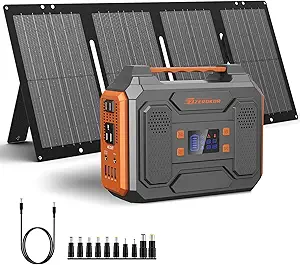 | Best Value Solar Starter Bundle | Maximum output: 300W | AC outlets: 2 × 300W maximum | Included solar panel: 60W monocrystalline (20.5% efficiency) | VIEW ON AMAZON | See Our Full Breakdown |
| ALLWEI Portable Power Station 300W, 256Wh LiFePO4 Solar Generator |  | Best Longevity on a Budget | Capacity: 256Wh | Continuous Output: 300W (600W surge) | Battery Type: LiFePO4 (LFP), 3,000 cycles | VIEW ON AMAZON | See Our Full Breakdown |
| Anker SOLIX C300 Portable Power Station, 288Wh |  | Best Fast-Charging Compact | Capacity: 288Wh | Output: 300W (600W surge) | Ports: 8 total: 3 AC, 1 car socket, 3 USB-C, 1 USB-A | VIEW ON AMAZON | See Our Full Breakdown |
| EnginStar Portable Power Station, 300W, 296Wh |  | Best First Backup for Beginners | Capacity: 296Wh | Output: 300W | AC Outlets: 2 x 110V pure sine wave | VIEW ON AMAZON | See Our Full Breakdown |
| Anker SOLIX C1000 Gen 2 Portable Power Station |  | Best Home Outage System | Capacity: 1,024Wh | Output: 2,000W continuous (3,000W peak) | Battery Type: LiFePO4, 4,000 cycles to 80% capacity | VIEW ON AMAZON | See Our Full Breakdown |
| backup battery generator | Capacity | Weight |
|---|---|---|
| Jackery HomePower 3600 Plus Po | 3584Wh (expandable to 21kWh per unit, 43kWh with multiple units) | — |
| BLUETTI AC180 Portable Power S | 1152Wh | — |
| Anker SOLIX S2000 Portable Pow | 2,010Wh | 35.7 lbs |
| Jackery Explorer 300 Portable | 292Wh | ~7.1 pounds |
| Jackery Solar Generator 1000 v | — | 23.8 lbs |
| 1000W Portable Power Station | — | 27.73 lbs |
| MARBERO Portable Power Station | 88Wh (24,000mAh) | 3.2 lbs |
| Jackery Explorer 1000 v2 Porta | 1070Wh | 23.8 lbs |
| Jackery HomePower 3600 Plus Po | 3,584Wh (expandable to 43kWh) | — |
| ZeroKor 300W Portable Power St | — | — |
| ALLWEI Portable Power Station | 256Wh | 6.4 lbs |
| Anker SOLIX C300 Portable Powe | 288Wh | — |
| EnginStar Portable Power Stati | 296Wh | 6.5 lbs |
| Anker SOLIX C1000 Gen 2 Portab | 1,024Wh | 11.3 kg (24.9 lbs) |
More Details on Our Top Picks
Jackery HomePower 3600 Plus Power Station, 3584Wh, 3600W AC Output
When the goal is a genuine power outage system rather than a camping toy, this option stands out for scale. At 3584Wh expandable to 43kWh, it can run pumps, heaters, and dryers — appliances that completely overwhelm the BLUETTI AC180 or Anker SOLIX S2000. The 3600W output covers most household circuits on its own, though the 240V capability that well pumps and some HVAC systems need requires a second unit in parallel, which is a real budget consideration. Compared with the Jackery Solar Generator 1000 v2, the gap is night and day: the 1000 v2 keeps a fridge and some lights running, while this one sustains a household. The 2-hour hybrid recharge means it is ready before the next outage, and the wheeled luggage design offsets the weight you would expect at this capacity.
Pros:- Expandable from 3584Wh up to 43kWh for multi-day whole-home backup
- 3600W output handles heavy appliances like pumps, heaters, and dryers
- Fast 2-hour full recharge via hybrid AC+DC charging
- LFP cells rated for 6,000 cycles and a 10-year lifespan
Cons:- 240V output requires buying a second unit for parallel connection
- Solar-only recharge is slower at 4 hours
Best for: Homeowners who want to keep major appliances — well pumps, heaters, refrigerators — running through multi-day outages without a gas generator
Not ideal for: Apartment dwellers or occasional campers — the capacity and price are wasted if you only need to charge devices or run a mini fridge
- Capacity:3584Wh (expandable to 21kWh per unit, 43kWh with multiple units)
- AC Output:3600W (7200W in parallel)
- Voltage:120V & 240V (240V in parallel)
- Battery Cell Type:High-temp resistant ceramic membrane LFP
- Lifespan:6,000 cycles, 10-year lifespan
- Full Recharge Time:2 hours (hybrid AC+DC)
- Design:Luggage-style with wheels and telescopic handle
Our verdict“This is the pick for households serious about riding out extended outages with appliances running, provided they accept the cost of a second unit for 240V needs.”
BLUETTI AC180 Portable Power Station, 1152Wh LiFePO4 Battery with 1800W Output
What separates the AC180 from similarly sized rivals is speed: a full charge in about an hour, with 80% recovered in 45 minutes. During a rolling outage where grid power flickers back on, that matters more than raw capacity. Compared with the Anker SOLIX S2000, you give up roughly half the runtime but gain a higher 1800W output — enough to actually run a microwave or hair dryer, boosted to 2700W via the app. The 20ms UPS switchover makes it a legitimate drop-in backup for a home office or fish tank. The tradeoff is honest: 1152Wh drains quickly under high-draw appliances, and solar panels cost extra, so off-grid replenishment takes planning. As a mid-budget power outage system for essentials, this model makes the most sense for buyers who prioritize turnaround time over endurance.
Pros:- Full AC recharge in about 1 hour, 80% in 45 minutes
- 1800W output boostable to 2700W handles most kitchen appliances
- 20ms UPS switchover for seamless home backup
- LiFePO4 chemistry backed by a 5-year warranty
Cons:- Solar panels sold separately, adding to total cost
- 1152Wh capacity limits runtime with high-draw appliances
Best for: Buyers who want fast recharge cycles and true UPS protection for a fridge, home office, or medical device on a moderate budget
Not ideal for: Anyone expecting multi-day runtime from a single charge — high-draw appliances will exhaust 1152Wh within hours
- Capacity:1152Wh
- Battery Type:LiFePO4
- AC Output:1800W (2700W peak)
- Outlets:8
- Full AC Charge Time:1 hour (0-80% in 45 minutes)
- Solar Input / Charge Time:500W / 2.8-3.3 hours
- UPS Switchover:20 ms
- Warranty:5 years
Our verdict“The best mid-range choice if your priority is getting back to full quickly between outages rather than maximum stored energy.”
Anker SOLIX S2000 Portable Power Station (2,010Wh, 1,500W)
The S2000’s headline is its 10,000-cycle, ~15-year battery rating — roughly double the cycle life of the Jackery Solar Generator 1000 v2 and the Jackery Explorer 300. For a power outage system you buy once and forget about, that longevity changes the value math. At 2010Wh, it nearly doubles the BLUETTI AC180’s capacity while staying compact at 35.7 pounds, and the sub-10ms UPS switchover is fast enough that computers and routers never notice an outage. The 1,500W continuous output covers essentials comfortably but rules out heavy hitters like space heaters on high. Six recharge methods, including alternator charging, give flexibility the smaller Jackery units can’t match. One omission stands out: there is no 12V DC port, which will frustrate anyone running car-style accessories or certain CPAP setups.
Pros:- 10,000-cycle LFP battery rated for roughly 15 years of use
- Compact and light for a 2kWh class station
- Sub-10ms UPS switchover protects computers and networking gear
- Six recharge methods including 400W solar and alternator charging
Cons:- No 12V DC port limits accessory compatibility
- Fridge runtime claims vary in real-world conditions
Best for: Home-office workers and small households who want set-and-forget backup that outlasts the hardware around it
Not ideal for: Users who need 12V DC output for car accessories or CPAP rigs — the port simply isn’t there
- Capacity:2,010Wh
- Continuous Output:1,500W (3,000W peak)
- Battery Chemistry:314Ah LFP cells
- Battery Lifespan:10,000 cycles / ~15 years
- Weight:35.7 lbs
- Solar Input:Up to 400W
- Outlets:8 (front and rear)
- UPS Switchover:<10 ms
- Recharge Methods:6 (AC, solar, generator, alternator charger, car outlet)
Our verdict“The strongest choice if you plan to keep this unit for a decade and want clean UPS-grade backup for electronics rather than heavy appliances.”
Jackery Explorer 300 Portable Power Station, 292Wh
Not every backup need involves a fridge. At 7 pounds with an integrated handle, the Explorer 300 is the unit you grab for a blackout kit — phones, headlamps, a router, a CPAP for a night. Compared with the BLUETTI AC180, it is a fraction of the size and cost, but the 300W rating means no microwaves, no kettles, no heaters; even a 600W surge only covers brief motor starts. The LiFePO4 chemistry with 4,000+ cycles is genuinely impressive at this size, where many competitors still ship shorter-lived cells. Six ports let you keep a household’s phones alive simultaneously. Its role in a power outage system is the affordable first layer, not the whole solution — pair it with a bigger station if outages in your area stretch past a day. Just remember the solar panel is sold separately.
Pros:- Genuinely portable at roughly 7 pounds with integrated handle
- Charges or powers up to six devices at once
- LiFePO4 battery rated for over 4,000 cycles
- 80% solar recharge in about 2.8 hours with a 100W panel
Cons:- Solar panel sold separately
- 300W output rules out most kitchen appliances and heaters
Best for: Apartment dwellers and car-campers building an affordable emergency kit for phones, lights, and small devices
Not ideal for: Anyone who needs to run a refrigerator or medical equipment for more than a few hours — 292Wh cannot sustain it
- Capacity:292Wh
- Weight:~7.1 pounds
- Ports:2 AC, 1 USB-C PD (100W), 2 USB-A, 1 car port (120W)
- Battery Chemistry:LiFePO4
- Charge Cycles:4,000+ cycles to 70% capacity
- AC Charge Time:4 hours
Our verdict“A smart, low-cost first step into outage preparedness for small devices — as long as you understand it is not an appliance backup.”
Jackery Solar Generator 1000 v2 with 200W Solar Panel
This bundle earns its spot by solving the problem every other pick here leaves you with: the solar panel is included. The BLUETTI AC180, Anker S2000, and Explorer 300 all require a separate panel purchase, which quietly adds cost and compatibility guesswork. With 1070Wh of LFP storage and a 1500W output — notably higher than the Anker S2000’s continuous rating — the 1000 v2 can run a fridge, a microwave, or a coffee maker during an outage, then replenish from the 200W panel during the day. That loop is what makes it a genuine entry-level power outage system rather than just a battery. Tradeoffs exist: the 4000-cycle rating trails Anker’s 10,000-cycle cells, and the advertised one-hour charge requires enabling emergency mode in the app, which is not obvious out of the box. Note the panel and station ship separately.
Pros:- 200W solar panel included, no separate compatibility research needed
- 1500W output runs fridges and small kitchen appliances
- App-controlled charging with quiet and emergency modes
- 5-year warranty and 4,000-cycle LFP battery
Cons:- One-hour charging only works after enabling emergency mode in the app
- Station and solar panel arrive in separate shipments
Best for: First-time buyers who want a working solar backup loop in one purchase without researching compatible panels
Not ideal for: Households needing multi-day heavy-appliance runtime — 1070Wh covers essentials, not whole-home loads
- Battery Capacity:1,070Wh LFP
- AC Output:1,500W (3,000W surge)
- Solar Panel:200W (included)
- Ports:3 AC, 2 USB-C (100W PD), 1 USB-A, 1 DC car port
- Weight:23.8 lbs
- Charge Cycles:4,000 cycles retaining 70%+ capacity
- Warranty:5 years
Our verdict“The easiest one-box entry into solar outage backup, ideal if you want everything working together the day it arrives.”
1000W Portable Power Station, 1024Wh LiFePO4 Battery
For buyers who want genuine outage-ready capacity without paying premium-brand prices, this 1024Wh unit hits a sensible middle ground. Its 1000W continuous output comfortably runs a fridge, router, and lights during a power cut — the core of a basic power outage system — and the LiFePO4 chemistry with 3,000+ cycles means it will still be dependable years from now. Compared with the JBL-free generic field, it matches the Jackery Explorer 1000 v2 on capacity at 1024Wh vs 1070Wh, though it gives up 500W of headroom and the Jackery’s one-hour fast charging. Against the MARBERO M82, it’s a different class entirely: five times the capacity for whole-outage coverage rather than phone top-ups. The tradeoff is weight — at 27.73 lbs it’s noticeably heavier than the Jackery despite the smaller output rating, and the solar panel costs extra.
Pros:- 1024Wh capacity covers multi-hour fridge, router, and lighting loads during outages
- LiFePO4 chemistry rated for 3,000+ cycles for long-term reliability
- Charges up to five devices simultaneously across AC, USB-C, and USB-A
- 300W solar input supports genuine off-grid recharging
Cons:- At 27.73 lbs, it is heavier than competing 1kWh stations like the Jackery Explorer 1000 v2
- Solar panel is optional and sold separately
Best for: Households building a first power outage system who need fridge-and-router runtime on a budget
Not ideal for: Anyone prioritizing portability — it’s one of the heavier 1kWh-class units and has no wheels or telescopic handle
- Continuous output:1000W
- Battery capacity:1024Wh
- Battery chemistry:LiFePO4
- AC outlets:2 × 110V
- Maximum solar input:300W
- Charge cycles:3000+ cycles, retaining 80% capacity
- Weight:27.73 lbs
- Safety features:Six-layer smart BMS protection
Our verdict“This pick makes the most sense for buyers who want Jackery-class capacity for outage coverage at a lower price and can accept a heavier, slower-charging unit.”
MARBERO Portable Power Station M82, 88Wh Solar Generator with 120W Surge
The MARBERO M82 is the grab-and-go option in this lineup — at 3.2 lbs and roughly the size of a paperback stack, it’s the station you actually take somewhere. Its role is narrow but real: keeping phones, a tablet, a headlamp, and a CPAP-adjacent small device alive during a short outage or a night of camping. Eight simultaneous ports is unusually generous at this size, and the built-in LED flashlight with SOS mode and 37–68 hours of light runtime make it a legitimate emergency kit component rather than a gadget. Compared with the ZeroKor 300W, it’s far more portable but offers a fraction of the runtime; compared with the Jackery Explorer 1000 v2, it can’t run a fridge at all. The 2-hour 0–80% recharge is a genuine strength for its class.
Pros:- Featherweight 3.2 lb design that genuinely fits in a backpack
- Eight output ports charge a full kit of small devices at once
- Fast 0–80% recharge in about 2 hours
- LED flashlight with SOS mode and up to 68 hours of runtime
Cons:- 88Wh capacity cannot sustain anything beyond phones, tablets, and small lights
- Solar recharging requires separately purchased MARBERO-branded panels
Best for: Campers, road-trippers, and apartment dwellers who want a pocketable backup for phones and small devices
Not ideal for: Anyone expecting refrigerator or medical-device runtime — 88Wh is roughly one laptop charge plus a few phone charges
- Capacity:88Wh (24,000mAh)
- Output wattage:80W (120W surge)
- Total output ports:8
- Input options:AC adapter, car DC charger, MARBERO 30W/60W solar panels
- Weight:3.2 lbs
- LED light runtime:37–68 hours (3 brightness levels)
- Safety features:BMS with short circuit, overload, overcharge, over-voltage protection
Our verdict“This model is better suited to personal-device emergencies and camping than any real home backup role — buy it as a kit supplement, not a primary outage system.”
Jackery Explorer 1000 v2 Portable Power Station, 1070Wh, 1500W
This option stands out for doing the everyday-outage job better than anything else in the 1kWh class. The combination of 1500W output (3000W surge) and 1070Wh capacity means it runs a fridge, a microwave pull, or even a small AC unit — appliances the 1000W generic unit simply can’t start. Its LFP battery is rated for 4,000+ cycles, beating both the generic 1024Wh unit (3,000) and most budget rivals, and the 1-hour emergency-mode recharge means you can refill it between outage windows in a way most competitors can’t match. The 23.8 lb weight with a foldable handle makes it genuinely movable during a storm. The real tradeoff is ecosystem lock-in: solar works only with Jackery panels, sold separately, whereas the ZeroKor bundle includes a panel outright.
Pros:- 1500W output with 3000W surge starts appliances other 1kWh units can’t
- 1-hour full recharge in emergency mode (1.7 hours default)
- LFP battery rated 4,000+ cycles for 10+ years of service
- Lightest-in-class 23.8 lbs with foldable handle
Cons:- Only compatible with Jackery-branded solar panels, which are not included
- 1-hour emergency charging must be manually re-enabled in the app before each use
Best for: Homeowners who want a single, fast-recharging station that bridges overnight outages running a fridge and essentials
Not ideal for: Off-grid solar users who already own third-party panels — Jackery compatibility is closed
- Capacity:1070Wh
- AC output:1500W (3000W surge peak)
- Battery type:LFP (LiFePO4), 4000+ cycles
- Full charge time:1 hour (emergency mode) / 1.7 hours (default)
- Ports:3× pure sine wave AC, 2× USB-C (100W PD), 1× USB-A, 1× DC car port
- Weight:23.8 lbs
- Extra features:Smart app control, ChargeShield 2.0, 30 dB quiet charging mode
Our verdict“This is the pick for buyers who want one dependable, fast-cycling station for outage nights and accept paying into a closed solar ecosystem for it.”
Jackery HomePower 3600 Plus Portable Power Station with Two 200W Solar Panels
When the goal shifts from bridging an outage to outlasting one, this is the only answer in this batch. With 3,584Wh of capacity and 3,600W of output (7,200W in parallel), it runs well pumps, furnaces, full kitchens, and multiple rooms at once — coverage no 1kWh unit like the Jackery Explorer 1000 v2 can approach. As a power outage system, its flexibility is the headline: it recharges from AC, solar (400W of included panel), a gas generator, or a hybrid mode that fills it in 2 hours, and it expands to 43kWh with additional units for multi-day blackouts. The 6,000-cycle battery rating also dwarfs the smaller picks’ longevity. The drawbacks are logistical: it’s a big, expensive commitment, and the panels and station ship separately, so arrival timing may not line up.
Pros:- 3,584Wh capacity with 3,600W output runs major household appliances simultaneously
- Four recharge methods including a 2-hour hybrid AC+DC mode
- Expandable up to 43kWh with multiple units for extended blackouts
- Wheels and telescopic handle make a heavy unit movable
Cons:- Power station and solar panels ship separately, which complicates delivery and setup
- Far more capacity and cost than most users actually need for short outages
Best for: Homeowners in outage-prone regions who need days of whole-house runtime, not hours of essential-device coverage
Not ideal for: Apartment dwellers or casual campers — the size, cost, and 400W panel setup are wasted on small loads
- Capacity:3,584Wh (expandable to 43kWh)
- AC output:3,600W (7,200W parallel)
- Battery cycle life:6,000 cycles
- Charging time (hybrid AC+DC):2 hours
- Charging time (solar, 400W):4 hours
- Solar panels:Two 200W panels included
- Transport:Wheels and telescopic handle
Our verdict“This pick makes the most sense for buyers building a true whole-home outage system where the smaller stations in this list are stopgaps rather than solutions.”
ZeroKor 300W Portable Power Station with 60W Solar Panel
This option stands out as the only entry here that puts a solar panel in the box, which changes the value math entirely for newcomers. The 60W monocrystalline panel gives you a genuinely functional off-grid recharging loop from day one — something the JBL-free Jackery Explorer 1000 v2 and the generic 1024Wh unit both charge extra for. As a starter power outage system, it will keep phones, lights, a router, and a fan running through a short interruption, and the multiple recharge methods (AC, car, solar) add real redundancy. The honest tradeoff: 300W of output means no fridge, no microwave, no hairdryer — overloading can actually disable the unit — and the unstated battery capacity makes runtime planning guesswork. Compared with the MARBERO M82, you trade pocketability for included solar; compared with the big Jackery, you trade appliance capability for price.
Pros:- 60W monocrystalline solar panel included in the box
- Multiple recharge methods (AC, car port, solar) provide redundancy
- Flashlight with reading and SOS modes for emergencies
- Built-in protections plus a temperature-controlled cooling fan
Cons:- Hard 300W output limit — overload can damage or shut down the unit
- Solar panel junction box is not waterproof, limiting weatherproof outdoor use
- Battery capacity is not specified, making runtime estimates difficult
Best for: First-time buyers who want a complete station-plus-panel solar kit for small-device outage coverage at low cost
Not ideal for: Anyone needing to run a refrigerator or power tools — the 300W ceiling is hard and unforgiving
- Maximum output:300W
- AC outlets:2 × 300W maximum
- Included solar panel:60W monocrystalline (20.5% efficiency)
- USB ports:3 × 5V/3A plus quick-charge port
- Recharge methods:AC outlet, compatible solar panel, 12V car port
- Protection features:Short circuit, over-current, over-voltage, overload, overheating protection
- Included accessories:AC adapter, car charging cable, 60W solar panel kit, manuals
Our verdict“This model is better suited to budget-conscious beginners who want solar included and only need small devices covered, not whole-appliance backup.”
ALLWEI Portable Power Station 300W, 256Wh LiFePO4 Solar Generator
Most sub-$300-class power stations cut corners on battery chemistry, but ALLWEI sticks with LiFePO4 cells rated for 3,000 cycles — roughly a decade of regular use before capacity fades meaningfully. That matters for a backup battery generator you’ll store for years between outages, since cheaper lithium-ion packs degrade even sitting idle. The pure sine wave inverter is another differentiator at this size, making it safe for a CPAP machine or laptop during an overnight outage. Compared with the similarly sized EnginStar 296Wh, this model trades slightly lower capacity for far better battery longevity and dual AC-plus-solar charging that cuts recharge time to around 2 hours. The tradeoff is real, though: 300W won’t run a fridge, microwave, or any heating device, so think phones, lights, routers, and medical gear — not appliances.
Pros:- LiFePO4 battery rated for 3,000 cycles, roughly 10 years of service
- Pure sine wave output safe for CPAP machines and sensitive electronics
- Dual AC + solar charging cuts recharge time to 2-2.5 hours
- 5-year warranty, unusually long for this price class
Cons:- Solar panel sold separately
- 300W continuous output excludes most kitchen appliances
Best for: Budget-conscious buyers and CPAP users who want a small, long-lived emergency unit for essentials during short outages
Not ideal for: Households wanting to run refrigerators or other appliances during extended outages — 300W output can’t handle them
- Capacity:256Wh
- Continuous Output:300W (600W surge)
- Battery Type:LiFePO4 (LFP), 3,000 cycles
- Waveform:Pure sine wave
- Ports:1x AC, 2x DC5521, 1x car socket, 1x USB-A 18W, 1x USB-C PD 60W
- Charge Time:3.5-4 hrs AC; 2-2.5 hrs dual charging
- Weight:6.4 lbs
- Warranty:5 years
Our verdict“A smart pick for anyone who wants a decade-lasting emergency power source for essentials without spending big.”
Anker SOLIX C300 Portable Power Station, 288Wh
The C300’s standout trait is recharge speed: it hits 80% in 50 minutes from a wall outlet, which means it’s ready again almost immediately when grid power returns mid-outage. No other 300W-class unit here recharges that fast — the ALLWEI 300W needs 3.5-4 hours on AC alone. Port selection is generous too, with eight outputs including two 140W USB-C ports, so a desk full of laptops, cameras, and phones can ride out an outage simultaneously. The LiFePO4 cells rated for 3,000 cycles and near-silent 25dB operation make it comfortable for indoor, overnight use as a bedside or home-office backup. Two frustrations hold it back: the shoulder strap costs extra, and Anker restricts solar compatibility to its own 60W/100W panels — several Anker panel models simply won’t work with it.
Pros:- 80% recharge in 50 minutes via wall outlet
- Eight ports, including two-way USB-C at up to 140W per port
- LiFePO4 battery rated for 3,000 cycles
- Whisper-quiet 25dB operation suits indoor overnight use
Cons:- Shoulder strap sold separately
- Not compatible with several Anker solar panel models (PS30, PS200, PS400)
Best for: Remote workers and tech-heavy households who need laptops and devices kept alive through short outages with minimal downtime
Not ideal for: Buyers planning to build a solar charging setup with third-party or older Anker panels — compatibility is limited
- Capacity:288Wh
- Output:300W (600W surge)
- Ports:8 total: 3 AC, 1 car socket, 3 USB-C, 1 USB-A
- USB-C:Two-way, up to 140W per port
- Recharge Time:80% in 50 minutes via AC
- Battery Type:LiFePO4, 3,000 cycles
- Noise Level:25dB at 3.3 ft
- Warranty:5 years
Our verdict“The fastest-refilling small backup in this lineup, ideal for keeping a work-from-home setup alive during brief power cuts.”
EnginStar Portable Power Station, 300W, 296Wh
This EnginStar is the simplest entry point into backup power in the batch — plug it in, top it off, and stash it in a closet until the lights go out. With 296Wh of capacity and two pure sine wave AC outlets, it edges out the Anker SOLIX C300 in both capacity and AC outlet count, which is handy when you want a lamp and a router running at once. It’s also the lightest full-size option here at 6.5 lbs, and the onboard battery management system covers overload and short-circuit protection without any settings to fiddle with. The compromises are the battery chemistry and support: a standard lithium-ion pack rated for just over 1,000 cycles and a 12-month warranty, versus 3,000 cycles and 5-year coverage on the ALLWEI. It’s also the slowest charger of the group at 65W maximum input.
Pros:- Two pure sine wave AC outlets, more than most 300W rivals
- Lightest full-size option at 6.5 lbs with a grab-and-go footprint
- Wall, car, and solar recharging options for flexibility
- Built-in overload and short-circuit protection
Cons:- Lithium-ion battery rated for only 1,000+ cycles, far less than LiFePO4 alternatives
- 65W maximum charging speed means slow recharges
- Only 12 months of warranty coverage
Best for: First-time buyers who want a no-frills, affordable emergency unit for lights, phones, and a router during brief outages
Not ideal for: Anyone planning to cycle the battery frequently for camping or van life — the 1,000-cycle lithium-ion pack will age much faster than LFP rivals
- Capacity:296Wh
- Output:300W
- AC Outlets:2 x 110V pure sine wave
- Ports:2 AC, 2 regulated DC (12V/24V), USB 5V/3.1A, USB-C 18W
- Battery Type:Lithium-ion, 1,000+ cycles
- Charging:Wall, 12V car socket, or 12-25V solar (panel not included)
- Weight:6.5 lbs
- Warranty:12 months
Our verdict“A low-commitment starter backup for occasional outages, as long as you accept a shorter battery lifespan than its LFP competitors.”
Anker SOLIX C1000 Gen 2 Portable Power Station
When the goal is a genuine power outage system rather than a gadget charger, this is the pick of this batch. With 1,024Wh of capacity and 2,000W of continuous output, it runs refrigerators, microwaves, and medical equipment — things every 300W unit here simply can’t touch. The sub-10ms UPS switchover is the real differentiator: plug a computer or fish tank heater into it, and when the grid fails, the transfer happens faster than most devices notice, preventing shutdowns and data loss. It also recharges from empty to full in 49 minutes, so a brief grid restoration tops you right back up before the next interruption. Against the BLUETTI AC180, it offers similar capacity in a smaller, lighter body, though the BLUETTI edges it on raw wattage. The annoyances: fast charging must be enabled through the Anker app, and solar panels cost extra.
Pros:- 1,024Wh capacity with 2,000W continuous (3,000W peak) output runs household appliances
- Sub-10ms UPS switchover protects computers and sensitive gear during grid failure
- Full recharge in 49 minutes via HyperFlash technology
- LiFePO4 cells retain 80% capacity after 4,000 cycles
Cons:- HyperFast recharging must be manually enabled in the Anker app
- Solar panels sold separately
- At 24.9 lbs, it’s far less portable than the smaller units in this roundup
Best for: Homeowners who want a whole-essentials outage solution with true UPS protection for computers and critical devices
Not ideal for: Campers and travelers who count ounces — at nearly 25 lbs, it’s a stationary backup, not a trail companion
- Capacity:1,024Wh
- Output:2,000W continuous (3,000W peak)
- Battery Type:LiFePO4, 4,000 cycles to 80% capacity
- Total Ports:10
- AC Recharge Time:49 minutes at 1,600W
- Solar Recharge Time:1.8 hours at 600W input
- UPS Switchover:Under 10 ms
- Weight:11.3 kg (24.9 lbs)
Our verdict“The closest thing to a true home outage system in this batch — buy it if keeping appliances and computers alive matters more than portability.”

How We Picked
I ranked these backup battery generators by how well their stated capacity, AC output, battery type, portability, and included charging options match real backup jobs. For a power outage system, stored energy matters because it affects how long a station can supply power, while output matters because it sets the load it can handle at one time. I gave the strongest positions to products with a clearer path to running multiple or higher-demand devices, then weighed size and setup against that capability.
Smaller stations remain useful, but their place in the ranking reflects narrower use: keeping phones, lights, and small electronics running rather than replacing household power. I also distinguished a station sold with a solar panel from one that requires a separate panel, since that changes the buyer’s setup. The product details provided do not state every runtime, recharge time, outlet configuration, or transfer-switch capability, so I do not treat these models as automatic whole-home or medical-device backup; buyers should verify those requirements against the manufacturer’s specifications.
Factors to Consider When Choosing Backup Battery Generators
Choosing a backup battery generator starts with the devices you need to keep running and for how long. I’d plan around actual loads and outage length before comparing names or bundled accessories. These factors help prevent the common mismatch between a station that has enough capacity on paper and one that cannot start or support the device you depend on.
Separate watt-hours from watts
Watt-hours (Wh) describe stored energy, while watts (W) describe the power a station can deliver at a given moment. A large capacity does not guarantee that a station can start a device with a high initial draw. List each device’s running wattage and, for equipment with a motor or compressor, check its startup requirement too. Add the running loads you expect to use together and compare that total with the station’s output rating. Then estimate runtime from energy use rather than assuming the advertised capacity transfers fully to your appliances. This two-part check helps avoid choosing a long-lasting battery that cannot run the intended load.
Plan for the outage you actually need to cover
A station for overnight phone charging has a different job from one meant to keep a refrigerator or several household devices going through a long outage. Write down which items are essential, how many hours each will run, and whether they will operate at the same time. A rough energy estimate can reveal whether you need a compact backup or a much larger reserve. Include a margin for conversion losses and changing conditions rather than treating the listed Wh figure as guaranteed usable energy. If outages commonly last several days, work out how the battery will be recharged between uses. This plan is more useful than choosing a capacity based on one device alone.
Check charging options as part of the system
Solar recharging can help when an outage lasts beyond the energy stored in the battery, but a panel is only useful if it is compatible with the station. Check the supported solar input, connector requirements, and whether the product includes a panel or sells the station by itself. A bundled panel simplifies initial setup, but its size and expected production still affect how quickly the station can recover energy. Cloud cover, shade, season, and panel placement all change real-world solar output. Grid charging before severe weather remains a sensible part of preparation. Buyers who expect to rely on solar should compare the complete charging setup, not just the battery capacity.
Match portability to where the station will live
Capacity usually brings more size and weight, which can matter if you need to carry a unit upstairs, move it between rooms, or take it camping. A large station may suit a home outage plan but be awkward to store or reposition. Smaller models are easier to grab and pack, yet their limited energy makes them a poor substitute for a larger home reserve. Decide where the unit will sit during an outage and whether one person can move it safely. Also consider cable reach and access to the devices it will power. The right size is the one that fits both your energy plan and your physical setup.
Look beyond the headline output for sensitive or essential equipment
Some devices need a particular type of power, a stable supply, or uninterrupted handoff when the grid fails. A station’s headline AC wattage alone does not confirm that it can meet those needs. Check the manufacturer’s guidance for medical equipment, network hardware, refrigerators, and any device with a motor. If you want a station connected to household circuits, verify whether the model supports that arrangement and what installation hardware or electrician work is required. Do not assume a portable power station acts as a home transfer system simply because it has AC outlets. For life-support equipment, consult the equipment provider and make a backup plan that does not rely on an unverified runtime estimate.
Frequently Asked Questions
Which of these backup battery generators is the strongest fit for a home power outage system?
The Jackery HomePower 3600 Plus is the strongest fit by the stated capacity and AC output: 3,584Wh and 3,600W. That combination gives it more stored energy and higher output than the other listed models, which can support a broader outage plan. It still does not confirm whole-home wiring or automatic transfer capability, so check those details before planning to power circuits. Buyers who need a smaller portable setup may prefer the Anker SOLIX C1000 Gen 2 or BLUETTI AC180, with the tradeoff of less stored energy.
Can a 300Wh-class station keep a refrigerator running during an outage?
A 300Wh-class station may run a compatible refrigerator briefly, but the listed capacity alone cannot confirm useful runtime. Refrigerators cycle on and off, draw different amounts of power, and can require a surge when the compressor starts. Compare the appliance’s running and startup needs with the station’s output, then estimate runtime using the fridge’s actual energy use and a margin for conversion losses. For a longer outage plan, a 1,000Wh-class or larger station is a more plausible starting point, though the specific refrigerator still determines fit.
Should I buy a solar bundle or choose a station without a panel?
A solar bundle makes sense if you want a ready-made charging path and have a place to set up the panel. In this lineup, the Jackery Solar Generator 1000 v2 and ZeroKor 300W include panels, while several other options are listed as power stations alone. A bundle does not guarantee fast recovery: panel wattage, sunlight, shade, and the station’s solar input limit all affect charging. If you already own compatible panels or want to choose a larger array, a station-only package may suit your setup better. Check connector and input specifications before buying accessories.
Is a 1,000Wh station enough for a full day without grid power?
It can be enough for a carefully limited set of low-power devices, but a 1,000Wh rating does not mean every household load will run for a full day. Add the energy use of the devices you intend to power, including their operating time and any startup surges. Phones, lights, and a router have a different energy budget from a refrigerator, heater, or cooking appliance. If your plan includes high-draw devices or repeated use, a larger station or a way to recharge it may be necessary. Build the estimate around your actual outage routine rather than the capacity label alone.
What should I verify before relying on a power station for medical equipment?
Check the medical device manufacturer’s requirements for wattage, surge draw, power quality, and approved backup options, then compare those requirements with the station’s specifications. Ask the care provider or equipment supplier for an expected runtime calculation using the device’s settings. Confirm whether the station can supply power continuously and whether any interruptions during switching would be acceptable. Keep the device’s prescribed backup plan available, since battery runtime can vary with use and condition. A product’s capacity and outlet rating by themselves do not establish medical suitability.
Conclusion
For a broader home power outage system, I’d choose the Jackery HomePower 3600 Plus for its leading stated capacity and output. The best value by capability is the BLUETTI AC180 for buyers who want LiFePO4 chemistry and 1,800W output in a more portable station, while the best premium pick is the larger HomePower 3600 Plus with its two included 200W panels for a solar-ready package. Beginners who want a clear mid-size starting point can look at the Jackery Explorer 1000 v2 or its solar bundle, depending on whether they need a panel included. For compact needs, the Anker SOLIX C300 offers a more capable small-station option than the 88Wh MARBERO M82; choose the MARBERO only when minimal size and light electronic loads matter most. Match the final pick to your device loads, expected outage length, and charging plan.
NFL season / tailgating Picks
team gear
As an affiliate, we earn on qualifying purchases.