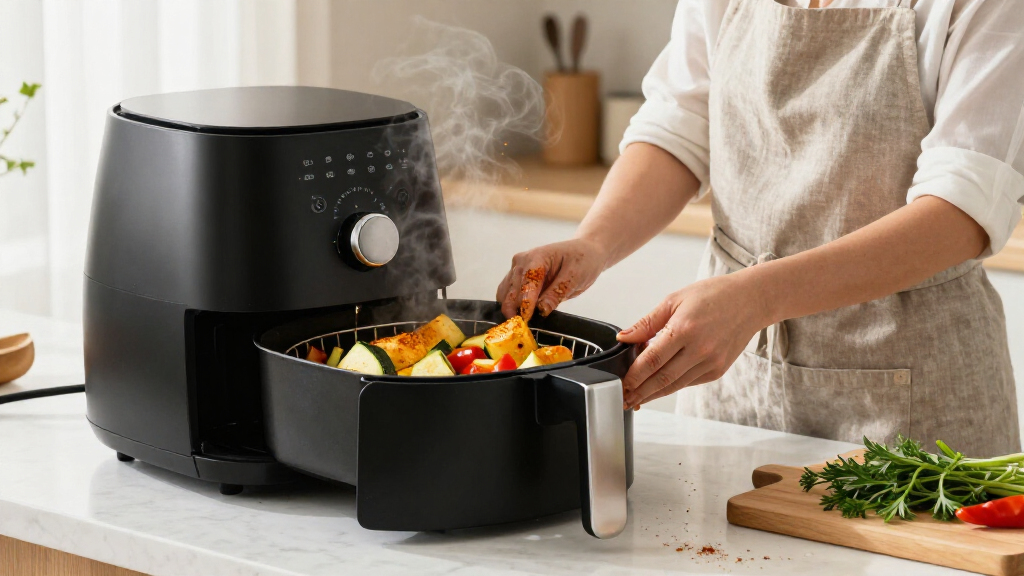

Use an air fryer to cook a balanced meal with crisp surfaces and little added oil. This guide is for beginners who want to prepare vegetables and a protein safely, control portions, and avoid common texture problems. Plan about 30-45 minutes for one meal, depending on the food and your air fryer.

Get kitchen staples and gadgets delivered free with Prime
- Fast, free delivery on millions of items
- Prime Video, Amazon Music and more included
- Member-only deals all year

Cosori TurboBlaze Air Fryer, 9-in-1, 6 Qt, PFAS-Free Ceramic Coating
- ✔ Capacity: 6 qt / 5.7 L
- ✔ Coating: PFAS-free ceramic nonstick
- ✔ Temperature range: 90°F–450°F

bella Fits-anywhere™ Slim 4qt Air Fryer, Non-Toxic Ceramic Coating, Oatmilk
- ✔ Capacity: 4 qt / 4 L; 3.3 lb
- ✔ Coating: EverGood ceramic
- ✔ Temperature range: 90°F–400°F

NutriChef 5.8 Quart Air Fryer – 8 Preset Cook Modes, Transparent Bowl, Precise Temp & Time Control, Grey
- ✔ Capacity: 5.8 L
- ✔ Coating: Nonstick; composition not specified in supplied details
- ✔ Temperature range: 100°F–390°F
Difficulty: Beginner | Time: 30-45 minutes for a meal
What You’ll Need
Tools & Materials:
- Air fryer and its cooking basket or rack
- Food thermometer
- Knife and cutting board
- Mixing bowl
- Tongs or a heat-safe spatula
Knowledge:
- Basic kitchen knife handling
- How to use the air fryer controls
- How to read a food thermometer
Check your appliance manual for basket capacity, preheating guidance, and care instructions. Choose fresh or frozen ingredients without relying on a specific cooking time alone; air fryer models and food sizes vary. Keep raw meat and poultry separate from ready-to-eat foods.
Cosori TurboBlaze Air Fryer, 9-in-1, 6 Qt, PFAS-Free Ceramic Coating
The Cosori TurboBlaze is our strongest all-around pick because it combines a PFAS-free ceramic cooking surface with a 6-quart square basket and a stated 90°F–450°F range. That low starting temperature gives it more flexibility than the bella, which reaches 400°F, while the higher ceiling may suit cooks who want more browning range. Its five-fan speed system and preheat function are designed to help prepare food efficiently, though the supplied details do not establish how results compare in independent testing.Capacity is the practical differentiator. Compared with the narrower 4-quart bella, the Cosori is better suited to larger portions or cooking for several people at once; unlike the NutriChef, it uses a conventional basket rather than a transparent bowl. The ceramic coating and quiet-operation claim may appeal to buyers prioritizing a specific surface and a less intrusive appliance. The compromise is its 13.2-pound weight and sizable footprint, so it is less convenient to tuck away after each use. For small kitchens, the bella is easier to place; for checking food visually, NutriChef has the edge.
Pros:
- PFAS-free ceramic coating is specifically identified in the product description.
- 6-quart basket offers the largest stated quart capacity in this lineup.
- 90°F–450°F range is broader than the ranges listed for the bella and NutriChef.
- Preheat function and five fan speeds provide additional cooking controls.
Cons:
- At 13.2 pounds, it is the heaviest option by the listed weights.
- Its footprint needs counter space and clearance behind and above the unit.
- A larger basket may be unnecessary for single portions or very small kitchens.
Best for: Households that want a roomy basket, a specifically identified PFAS-free ceramic coating, and broad temperature settings.
Not ideal for: People with limited counter depth or anyone who needs a lightweight appliance to move and store frequently.
Bottom line: We’d choose the Cosori when basket capacity and a clearly specified PFAS-free ceramic surface matter more than compact storage.
“We’d choose the Cosori when basket capacity and a clearly specified PFAS-free ceramic surface matter more than compact storage.”
bella Fits-anywhere™ Slim 4qt Air Fryer, Non-Toxic Ceramic Coating, Oatmilk
When counter width is the deciding factor, the bella Fits-anywhere Slim makes a more convincing case than the larger Cosori or NutriChef. Its listed width is just 8.22 inches, and the 7.3-pound body is lighter than the Cosori. The tall, slim shape is designed to save counter space while still offering a 4-quart basket, so it keeps a useful cooking capacity without spreading as widely across the worktop.For buyers focused on cooking-surface details, bella names its EverGood ceramic coating and says it excludes PFAS, PFOA, PTFE, lead, and cadmium. That is more specific than the NutriChef’s general nonstick description. Six presets and touch controls lower the learning curve, although preset counts alone do not tell us how well a recipe will turn out. Compared with the Cosori, the bella gives up 2 quarts and tops out at 400°F; against the NutriChef, it trades the see-through bowl for a narrower profile and a stated ceramic coating. Its Oatmilk finish may also be limiting if color coordination matters.
Pros:
- Slim 8.22-inch width suits counters where side-to-side space is limited.
- EverGood ceramic coating is described as free of PFAS, PFOA, PTFE, lead, and cadmium.
- Six presets and touch controls make the basic functions accessible.
- At 7.3 pounds, it is lighter than the listed Cosori and NutriChef weights.
Cons:
- 4-quart capacity is smaller than the Cosori’s 6-quart basket.
- Maximum temperature is 400°F, below the Cosori’s stated 450°F maximum.
- Only the Oatmilk color is listed for this version.
Best for: Apartment cooks and anyone who wants a ceramic-coated air fryer with a narrower counter footprint and straightforward presets.
Not ideal for: People regularly cooking large batches, seeking a maximum temperature above 400°F, or wanting a transparent cooking chamber.
Bottom line: We’d pick the bella when compact placement and a clearly described ceramic coating outweigh maximum capacity and temperature.
“We’d pick the bella when compact placement and a clearly described ceramic coating outweigh maximum capacity and temperature.”
NutriChef 5.8 Quart Air Fryer – 8 Preset Cook Modes, Transparent Bowl, Precise Temp & Time Control, Grey
The NutriChef stands apart with a transparent cooking bowl, which lets us check progress without opening the appliance. That can be handy when we want to judge browning as food cooks. It also offers eight preset modes, touch controls, and a dishwasher-safe nonstick basket, giving it a straightforward routine for common meals. At 5.8 liters, its stated capacity is close to the Cosori’s 5.7 liters, although the supplied information describes the NutriChef in liters and the Cosori in both liters and quarts.The tradeoff is less clarity about the cooking surface. The NutriChef is described as nonstick, but the supplied specs do not identify that coating as ceramic or PFAS-free; buyers who prioritize a named coating should look first at the Cosori or bella. Its 100°F–390°F range is also narrower than either competitor, and its timer stops at 60 minutes, unlike the Cosori’s longer timer setting. Although the product is described as compact, the listed 7.14 kg weight makes it a less natural choice for frequent cupboard storage. We’d choose it for visual monitoring and convenient cleanup rather than for the strongest coating documentation or broadest temperature range.
Pros:
- Transparent bowl makes it possible to monitor food without opening the unit.
- Eight preset modes offer several guided cooking options.
- Nonstick basket is described as dishwasher-safe for cleanup.
- 5.8-liter capacity is comparable to the Cosori’s stated 5.7-liter capacity.
Cons:
- Supplied information does not identify the nonstick basket coating as PFAS-free or ceramic.
- 100°F–390°F range is narrower than both competing models’ stated ranges.
- At 7.14 kg, it is heavy to move despite the compact-design description.
Best for: Cooks who value seeing food through the bowl and want a dishwasher-safe basket for easier cleanup.
Not ideal for: Buyers who require a specifically documented PFAS-free coating, need a temperature above 390°F, or want a light appliance.
Bottom line: We’d choose the NutriChef for its see-through bowl and cleanup convenience, provided its less-specified coating meets your needs.
“We’d choose the NutriChef for its see-through bowl and cleanup convenience, provided its less-specified coating meets your needs.”
As an Amazon Associate we earn from qualifying purchases.
Before You Start
Choose a meal with vegetables, a protein, and an optional whole grain or other filling side. Air frying can reduce the amount of oil needed compared with deep frying, but it does not automatically make every food nutritious: breaded, salty, or highly processed foods still have those qualities. Use a small measured amount of oil when helpful, and avoid filling the basket so tightly that hot air cannot circulate.
For poultry, cook to an internal temperature of 165°F (74°C); for ground meats, follow a reliable food safety temperature chart for the specific meat. Check fish and other proteins against current food safety guidance. Put the thermometer into the thickest part, away from bone. Wash hands and utensils after handling raw animal products.
Step-by-Step Instructions
Step 1: Choose a balanced meal
Select a protein such as chicken breast, salmon, tofu, or beans, then add at least one vegetable. For a more filling meal, plan a side such as brown rice, whole-grain bread, or potatoes. Check package labels on prepared foods for sodium and added ingredients, and use whole or minimally processed ingredients when convenient.
Tip: Foods with different cooking times may need separate batches. Plan to cook the item that takes longest first.
Check: Your meal plan includes a protein and vegetables, with a suitable filling side if desired.
Step 2: Prepare the ingredients evenly
Wash produce under running water and dry it. Cut vegetables into similar-sized pieces so they cook at a similar rate. Trim excess fat from meat, and cut protein into portions that fit with space around each piece. Pat wet ingredients dry with clean paper towels; surface moisture can slow browning.
Tip: Keep raw meat on a separate board from vegetables that will be served uncooked.
Check: Pieces are reasonably uniform, dry on the surface, and sized to fit without crowding.
Step 3: Season with a measured amount of oil
Toss vegetables or protein with herbs, spices, pepper, citrus, or a modest amount of salt. Add a teaspoon or two of oil for a batch if the food benefits from it, then toss to coat lightly. Use an oil suitable for the cooking temperature. Avoid pouring oil directly into the appliance or using aerosol sprays if the manual warns against them.
Tip: A small amount of oil can help seasoning adhere and support browning; more oil does not guarantee a better result.
Check: Ingredients have a light, even coating rather than pools of oil or clumps of seasoning.
Step 4: Preheat if the manual recommends it
Check the appliance manual and recipe guidance. If preheating is recommended, run the empty air fryer at the stated temperature for the stated time. Set a timer and keep the appliance on a stable, heat-safe surface with room for its vents.
Tip: Some models do not require preheating. Follow the instructions for your specific unit.
Check: The air fryer is ready at the planned setting, and its vents remain unobstructed.
Step 5: Load the basket without crowding
Arrange food in a single layer when possible, leaving gaps around pieces for airflow. Cook in batches if necessary. Put ingredients with similar cooking times together; if cooking vegetables and protein separately, keep raw-food utensils and plates away from cooked food.
Tip: Do not line or cover the basket in a way that blocks airflow or conflicts with the appliance manual.
Check: Hot air can move around the food, and the basket is below its recommended capacity.
Step 6: Cook and turn as needed
Set the temperature and starting time using the appliance manual or a trusted recipe for the ingredient and size. Check food before the timer ends, since air fryers vary. Shake the basket or turn pieces partway through when the recipe or food shape calls for it. Return the basket promptly and continue cooking in short intervals if needed.
Tip: Treat recipe times as estimates. A thick piece takes longer than a thin one, even at the same temperature.
Check: Food is browning as expected and cooking evenly, with no pieces scorched on one side.
Step 7: Verify doneness with a thermometer
Remove the basket carefully and check the thickest part of each large protein portion with a food thermometer. Cook poultry to 165°F (74°C), and use current food safety guidance for other proteins. If the reading is below the safe temperature, return the food to the fryer and recheck after a few minutes. Do not rely on color or crispness alone to judge safety.
Tip: Avoid touching bone or the basket with the thermometer probe, which can give a misleading reading.
Check: The protein reaches the safe internal temperature for that food, and vegetables are tender to your preference.
Step 8: Serve safely and clean the appliance
Transfer cooked food to a clean plate with clean utensils. Let hot food rest if the recipe calls for it, then serve with the planned side. Once the appliance has cooled, clean the basket and tray according to the manual; remove stuck-on residue before the next use.
Tip: Do not put cooked food on a plate or board that held raw meat unless it has been washed with hot, soapy water.
Check: The meal is served hot on clean dishes, and the cooled appliance is free of food residue.
Common Mistakes to Avoid
- Overfilling the basket — Cook smaller batches with space between pieces so hot air reaches the food.
- Adding too much oil — Measure a small amount and toss ingredients until they have a thin coating.
- Using the timer as the only doneness check — Check early and use a food thermometer for meat, poultry, and fish as appropriate.
- Cooking ingredients with very different sizes together — Cut pieces evenly or remove smaller pieces as they finish.
Troubleshooting
Problem: Food is soft instead of crisp
Solution: Pat ingredients dry, reduce the batch size, and leave space between pieces. Cook briefly longer while checking often to prevent burning.
Problem: Food browns outside but is undercooked inside
Solution: Lower the temperature slightly and cook longer in short intervals. Check the thickest piece with a thermometer; cut oversized portions smaller next time.
Problem: Some pieces cook faster than others
Solution: Use more uniform cuts, arrange similar sizes together, and shake or turn food partway through when suitable.
Problem: The appliance smokes during cooking
Solution: Stop the appliance if smoke is heavy, then follow the manual before handling it. Remove excess grease or residue after cooling, avoid excess oil, and check that food is not touching the heating element.
What Success Looks Like
The meal includes vegetables and a protein, uses only as much added oil as needed, and has no overcrowded or visibly burnt portions. The protein reaches the appropriate safe internal temperature, the vegetables are cooked to your preferred texture, and the food is served with clean utensils and dishes.
Next Steps
Write down the ingredient sizes, settings, and cooking times that worked with your model, then use them as a starting point for the next batch. Adjust one variable at a time, such as cut size or batch size. Wash the basket after it cools, and check the manual for routine cleaning and care.
Frequently Asked Questions
Does air frying make food healthy?
Air frying can help you cook with less added oil than deep frying. The overall meal still depends on ingredients, portion sizes, salt, and preparation, so pair vegetables with a suitable protein and limit heavily processed foods when that fits your needs.
Do I need to add oil?
No. Many foods cook without added oil, though a small amount can help dry vegetables brown and seasonings stick. Use only what the food needs and follow your appliance manual.
Can I cook fresh and frozen vegetables?
Yes. Fresh vegetables should be dry before cooking. Frozen vegetables can often go into the fryer directly, but ice and surface moisture may affect browning; follow package or recipe directions and check texture as they cook.
How do I know when chicken is safe to eat?
Insert a food thermometer into the thickest part of the chicken, avoiding bone. Poultry should reach 165°F (74°C). If it has not, continue cooking and check again.